Category: Uncategorized

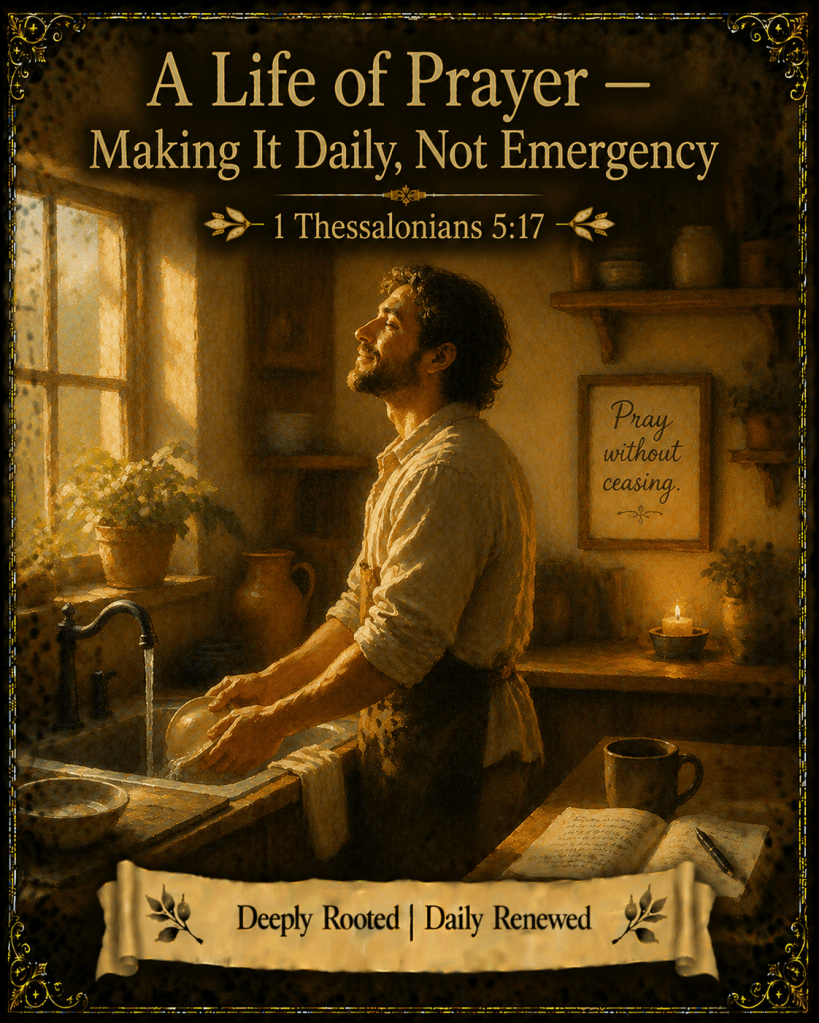
  • Saturday, August 15, 2026–Talking with God — The Practice of Prayer: A Life Of Prayer: Making It Daily, Not Emergency

    KEY VERSE

    “Pray continually.”

    — 1 Thessalonians 5:17


    ROOTED TRUTH

    Pray continually is not an impossible command designed to make you feel guilty. It is an invitation into a way of living in which the awareness of God is the constant atmosphere of your day.


    FAITH STORY

    Two words. Pray continually.

    Of all the commands in the New Testament, this may be the most brief and the most baffling. Continually? Without ceasing? Is Paul describing a person who does nothing but pray — who cannot hold a conversation, do their work, or live any ordinary human life because they are in perpetual, unbroken prayer?

    That is not what he means. The Greek word translated continually is adialeiptos — without omission, without missing the regular occasions. It carries the idea of a steady, habitual, regular practice rather than a single unbroken act. The same word was used of a recurring cough — not a cough that never stopped for a single second, but one that kept coming back.

    Pray continually means: let prayer be the regular rhythm of your life, not the emergency measure of your crises. Let it be the first instinct rather than the last resort. Let the awareness of God’s presence be so woven into the fabric of your day that conversation with Him is as natural as breathing.

    Brother Lawrence, a seventeenth-century monk who worked in a monastery kitchen, described this practice as the practice of the presence of God — the cultivation of an ongoing awareness of God in every moment, conversation, and task. Washing dishes became prayer. Cooking became prayer. Every ordinary moment became a place of communion with the God who was already there.

    This is the goal toward which everything this week has been pointing. Not a scheduled prayer time, though that matters. Not a crisis call, though God is there for those too. But a life so saturated with the awareness of God that prayer becomes the texture of the whole day.

    The good news is that this is not achieved by effort alone — it is cultivated through practice. Start with the scheduled time. Build the daily habit. Pray the Scripture. Listen as well as speak. Persist in the long prayers. Stand in the gap for others. And over time, the scheduled becomes the spontaneous, and the practice becomes the posture, and the posture becomes a life.

    That is what it looks like to pray continually. And it is available to you — right now, in this ordinary week, starting today.


    SCRIPTURE FOR DEEPER ROOTS

    1 Thessalonians 5:16–18 — Rejoice always, pray continually, give thanks in all circumstances.

    Luke 18:1 — Jesus told them they should always pray and not give up.

    Colossians 4:2 — “Devote yourselves to prayer, being watchful and thankful.”


    DAILY PRACTICE

    As you close this week, design a simple, sustainable daily prayer framework for your life — not an impressive or elaborate one, but a realistic one you will actually keep. Include: a set time each day, a starting practice (honest prayer, Scripture prayer, or listening), at least one person to intercede for regularly, and one way to carry the awareness of God through the rest of your day. Write it down. Commit to it for the next thirty days. This week was the teaching — now comes the living.


    DAILY PRAYER

    Father, I want prayer to be the atmosphere of my life, not the emergency kit I reach for when everything else has failed. I want to walk through ordinary days in ordinary places with an extraordinary awareness that You are present and I am talking to You. Teach me to pray without ceasing — not as an impossible standard but as a beautiful way of living. I commit to the practice. Meet me in it. Amen.


    DEEP REFLECTION

    1.  Pray continually does not mean pray every second — it means pray habitually and regularly, without omission. What does a realistic version of that look like in the specific rhythms of your daily life?

    2.  Brother Lawrence practiced the presence of God in a monastery kitchen. What would it look like to practice God’s presence in your kitchen, your commute, your workplace, your ordinary Tuesday? What would change about those moments?

    3.  Looking back over this entire week on prayer — honest prayer, listening prayer, persistent prayer, intercessory prayer, praying Scripture, and a life of prayer — which practice has most challenged or inspired you? What is the one thing you will actually do differently in your prayer life starting this week?


    #DeeplyRooted#DailyRenewed Devotions for a Grounded and Growing Faith

  • Friday, August 14, 2026–Talking with God — The Practice of Prayer: Praying Scripture — Using God’s Words To Talk To God

    KEY VERSE

    “I rise before dawn and cry for help; I have put my hope in your word.”

    — Psalm 119:147


    ROOTED TRUTH

    When you run out of words to pray, God has provided His own. Praying Scripture is one of the most powerful practices available to the believer — because you are returning to God exactly what He has already said.


    FAITH STORY

    There are seasons when words for prayer simply will not come.

    The grief is too thick. The confusion is too deep. The weariness has gone on too long. The soul sits before God and finds itself empty of language — wanting to pray, needing to pray, but unable to manufacture the words.

    And in those moments — and in every other moment — the entire Bible is available as a prayer book.

    Praying Scripture is exactly what it sounds like: taking the words of Scripture and returning them to God as prayer. The Psalms are the most obvious starting point — they are already prayers, already the language of human beings talking to God through every conceivable emotion and circumstance. But the practice extends throughout the entire Bible.

    Paul’s prayers in his letters — Ephesians 1:17–19, Ephesians 3:16–19, Philippians 1:9–11 — are extraordinary models. They are theologically rich, deeply personal, and when prayed for others or for yourself, they carry a weight that our own improvised language rarely matches.

    The promises of Scripture become prayers when you hold them before God: You said You would never leave me or forsake me — I am claiming that now. You said Your compassions are new every morning — I need them this morning. You said You work all things for the good of those who love You — I am trusting You with this.

    And when you are too empty to pray anything of your own, you can simply open the Psalms and read them aloud as your prayer. Psalm 23 for a season of uncertainty. Psalm 34 for a season of fear. Psalm 139 for a season of feeling unknown. Psalm 51 for a season of failure. Psalm 46 for a season of chaos.

    The words are already there. God inspired them. He will receive them back.

    You never have to be at a loss for how to pray. He has already given you the language.


    SCRIPTURE FOR DEEPER ROOTS

    Psalm 119:147–148 — Rising before dawn to pray the Word.

    Ephesians 3:16–19 — Paul’s prayer for the Ephesians — a model to pray for others.

    Hebrews 4:12 — “The word of God is alive and active…it judges the thoughts and attitudes of the heart.”


    DAILY PRACTICE

    Choose one of the following Psalms based on your current season: Psalm 23 (uncertainty), Psalm 34 (fear), Psalm 51 (failure or shame), Psalm 46 (chaos or crisis), Psalm 139 (feeling unknown or unseen). Read it slowly, out loud, as your prayer today — substituting I and me naturally where appropriate. Let God’s own words become your words back to Him. Notice what happens when the language of prayer comes from Scripture rather than improvisation.


    DAILY PRAYER

    Father, I return to You today the words You have already given me. Your Word is alive and active — and when I pray it back to You, something happens that my own improvised language cannot always produce. Teach me to saturate my prayer life with Scripture. Let Your words shape my prayers, correct my asking, deepen my faith, and give me language for the seasons when my own words fail. Amen.


    DEEP REFLECTION

    1.  Have you ever prayed a Psalm or another passage of Scripture as your own prayer? What was different about that experience compared to improvised prayer?

    2.  Praying Scripture means praying in alignment with what God has already revealed about Himself and His will. How does that alignment change the nature and confidence of prayer?

    3.  Paul’s prayers in Ephesians and Philippians are strikingly different from most prayer requests we hear in church — they focus on spiritual depth rather than circumstantial change. How does regularly praying those kinds of prayers for others reshape what you believe matters most?


    #DeeplyRooted#DailyRenewed Devotions for a Grounded and Growing Faith
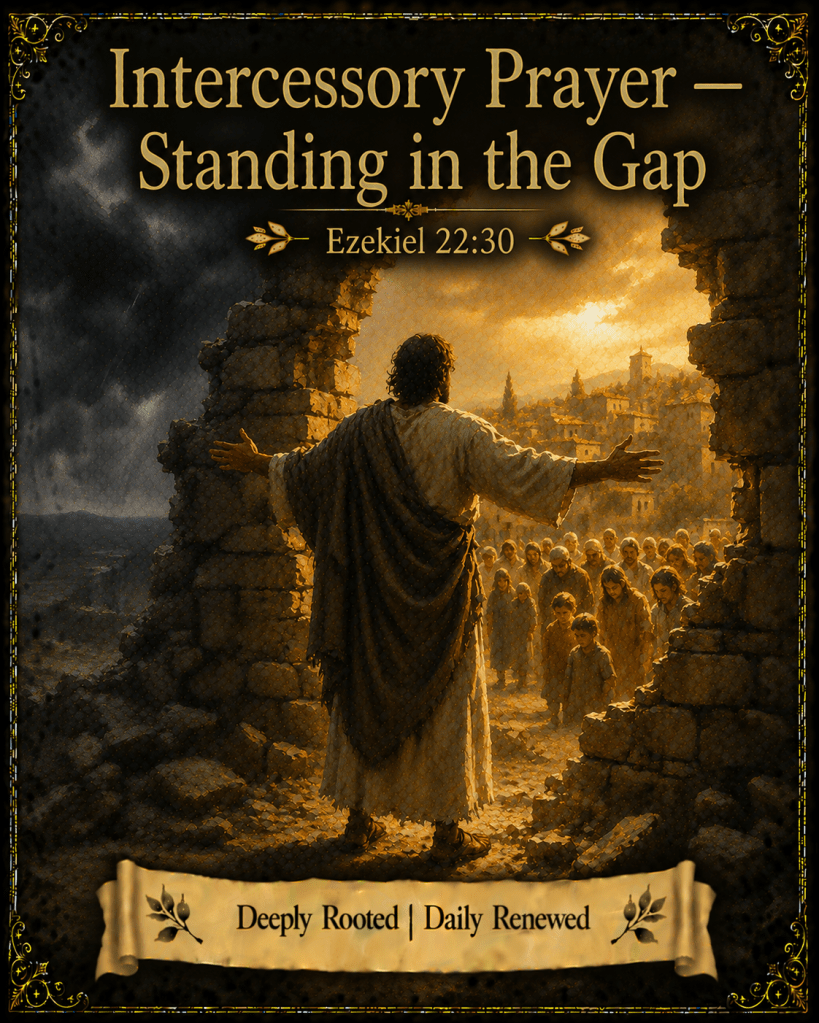
  • Thursday, August 13, 2026–Talking with God — The Practice of Prayer: Intercessory Prayer—Standing In The Gap

    KEY VERSE

    “I looked for someone among them who would build up the wall and stand before me in the gap on behalf of the land so I would not have to destroy it, but I found no one.”

    — Ezekiel 22:30


    ROOTED TRUTH

    Intercessory prayer is one of the most significant things one human being can do for another — and one of the most underestimated. When you pray for someone, you are doing something no other person in their life may be doing.


    FAITH STORY

    Ezekiel 22:30 contains one of the most haunting statements in all of the prophets.

    God looked for someone — anyone — who would stand in the gap on behalf of the land. Someone who would position themselves between the people and the judgment that was coming, and pray. Someone who would take on the burden of intercession for others.

    And He found no one.

    The image of standing in the gap comes from ancient warfare — when a wall was breached, a soldier would stand in the opening to stop the advance of the enemy until the wall could be repaired. Intercessory prayer is that — positioning yourself in the space between another person’s need and God’s provision, and refusing to move until something changes.

    Moses did this. When God’s anger burned against Israel after the golden calf, Moses stood in the gap: Lord, why should your anger burn against your people? Turn from your fierce anger; relent. And the text says God relented from the disaster He had said He would bring upon His people.

    Paul did this. His letters are saturated with the evidence of his intercessory prayer life. I have not stopped giving thanks for you, remembering you in my prayers. Night and day I pray most earnestly. I always pray with joy for all of you.

    Jesus does this — He always lives to intercede for us (Hebrews 7:25). Right now, at the right hand of the Father, the risen Christ is praying for you by name.

    And you are invited into that same ministry. The people in your life — your family, your friends, your city, the ones who do not yet know God — need someone to stand in the gap for them. To take on their burden in prayer. To refuse to stop until something changes.

    Who needs you to stand in the gap for them today?


    SCRIPTURE FOR DEEPER ROOTS

    Exodus 32:11–14 — Moses intercedes for Israel.

    Hebrews 7:25 — “He always lives to intercede for them.”

    1 Timothy 2:1 — “I urge, then, first of all, that petitions, prayers, intercession and thanksgiving be made for all people.”


    DAILY PRACTICE

    Create a simple intercessory prayer list today. Write down five people you will commit to praying for by name this week — at least one who does not yet know God, at least one who is going through a significant difficulty, and at least one you find difficult to love. Spend at least five minutes today praying specifically and earnestly for each one. Not a quick mention — genuinely standing in the gap for them before God.


    DAILY PRAYER

    Father, I want to be someone who stands in the gap. I bring before You today the people I love and the people I struggle to love, the ones who know You and the ones who do not, the ones whose needs I know and the ones I can only bring with an open hand. I stand in the gap for them today. Work in their lives what I cannot produce — what only You can do. Amen.


    DEEP REFLECTION

    1.  God looked for an intercessor and found no one. What does that absence tell you about both the importance and the rarity of genuine intercessory prayer? What might be preventing more believers from taking it seriously?

    2.  Moses’s intercession for Israel changed what God said He would do. How do you understand the relationship between intercessory prayer and God’s sovereignty — does prayer actually change things, and if so, how?

    3.  Jesus always lives to intercede for us — right now, He is praying for you. How does that truth change the way you think about your own struggles and needs, knowing that the Son of God is presenting them before the Father?


    #DeeplyRooted#DailyRenewed Devotions for a Grounded and Growing Faith
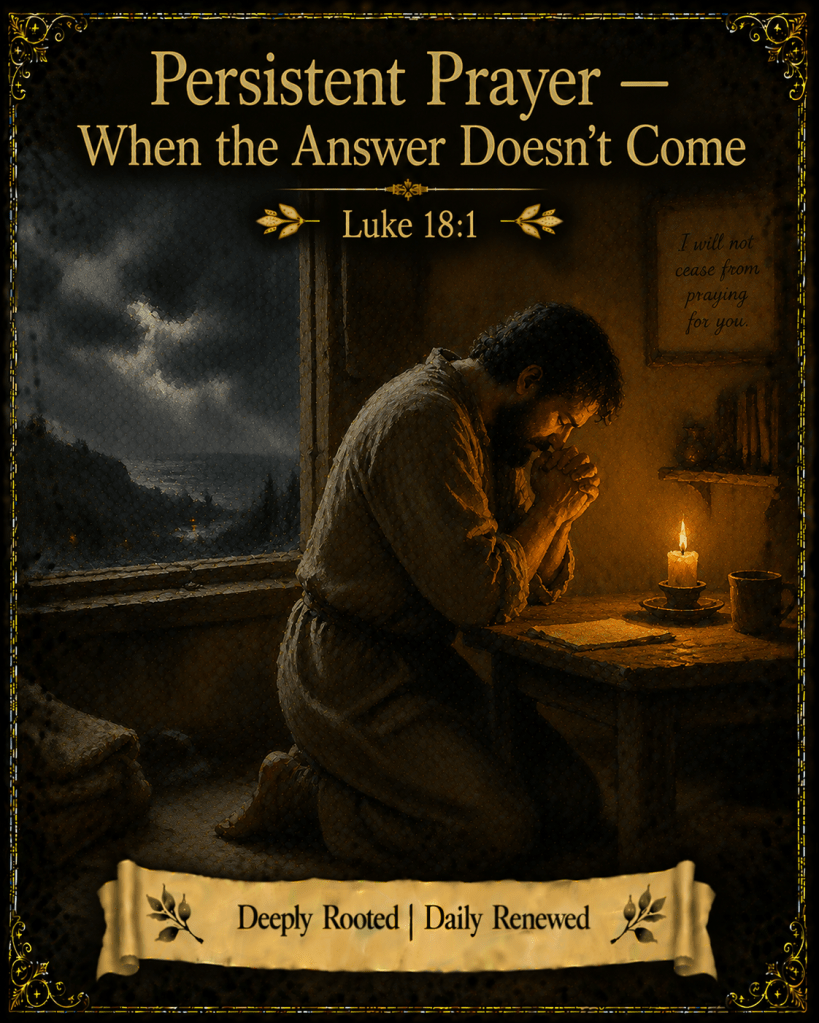
  • Wednesday, August 12, 2026–Talking with God — The Practice of Prayer: Persistent Prayer—When The Answer Doesn’t Come

    KEY VERSE

    “Then Jesus told his disciples a parable to show them that they should always pray and not give up.”

    — Luke 18:1


    ROOTED TRUTH

    The invitation to persistent prayer is not about changing God’s mind. It is about keeping our hearts oriented toward the One who holds the answer — and remaining in the posture of trust while we wait.


    FAITH STORY

    Jesus told the parable of the persistent widow with a stated purpose — Luke records it explicitly: He told this parable to show them that they should always pray and not give up.

    A widow kept coming before an unjust judge who neither feared God nor cared about people. He ignored her. She kept coming. He ignored her again. She kept coming. Finally, he granted her request — not out of justice or compassion, but simply because she kept showing up.

    The argument Jesus draws is from the lesser to the greater. If even an unjust judge eventually responds to persistence, how much more will a just and loving Father respond to the persistent prayers of His children? Will not God bring about justice for his chosen ones, who cry out to him day and night? I tell you, he will see that they get justice, and quickly.

    Persistent prayer is one of the most misunderstood practices in the Christian life. It is not nagging God until He changes His mind. It is not a formula that unlocks divine reluctance. God is not a vending machine that requires enough prayer-coins before dispensing what we need.

    Persistence in prayer is an act of faith. Every time you return to God with the same request, you are declaring: I still believe You are there. I still believe You hear. I still believe You are working even when I cannot see it. The persistence itself is the posture of trust — the refusal to conclude that the silence means absence.

    Some prayers take years. Some take decades. Some the answer arrives in forms we didn’t expect. And some — in this life — are not resolved in the way we hoped. But the practice of returning, day after day, to bring the same need before the same God, shapes us in ways that the quick answer never could.

    Keep praying. Don’t give up. The fact that you are still praying means you still believe — and that faith is never wasted.


    SCRIPTURE FOR DEEPER ROOTS

    Luke 18:1–8 — The parable of the persistent widow.

    Matthew 7:7–8 — “Ask and it will be given to you; seek and you will find; knock and the door will be opened.”

    Romans 12:12 — “Be joyful in hope, patient in affliction, faithful in prayer.”


    DAILY PRACTICE

    Write down the prayer you have been praying the longest — the request you have brought to God more times than you can count without a clear answer yet. Write it out fully. Then write the date beside it today as an act of recommitment: I am still praying. I have not given up. I still believe. Bring that prayer to God today with the same persistence the widow brought to the judge — and carry with you the assurance that the God you are bringing it to is nothing like that judge.


    DAILY PRAYER

    Father, I bring You again the prayer I have prayed so many times. I confess that I have been tempted to stop — to conclude that the silence means no or that the wait means You have forgotten. I choose today to keep praying. Not because I am wearing You down but because I still believe You hear, You care, and You are working. I will not give up. Amen.


    DEEP REFLECTION

    1.  Jesus said the purpose of the parable was to show that we should always pray and not give up. What makes giving up on a long-unanswered prayer feel spiritually reasonable — and what does persistent prayer declare about what you believe in spite of that feeling?

    2.  The persistent widow’s persistence was not about changing the judge’s character — it was about her own need and her refusal to be silenced. How does that reframe the purpose of persistent prayer — is it more about the one praying or the one being prayed to?

    3.  Is there a prayer you have given up on that God may be asking you to pick back up? What would it take to return to it with renewed persistence and trust?


    #DeeplyRooted#DailyRenewed Devotions for a Grounded and Growing Faith
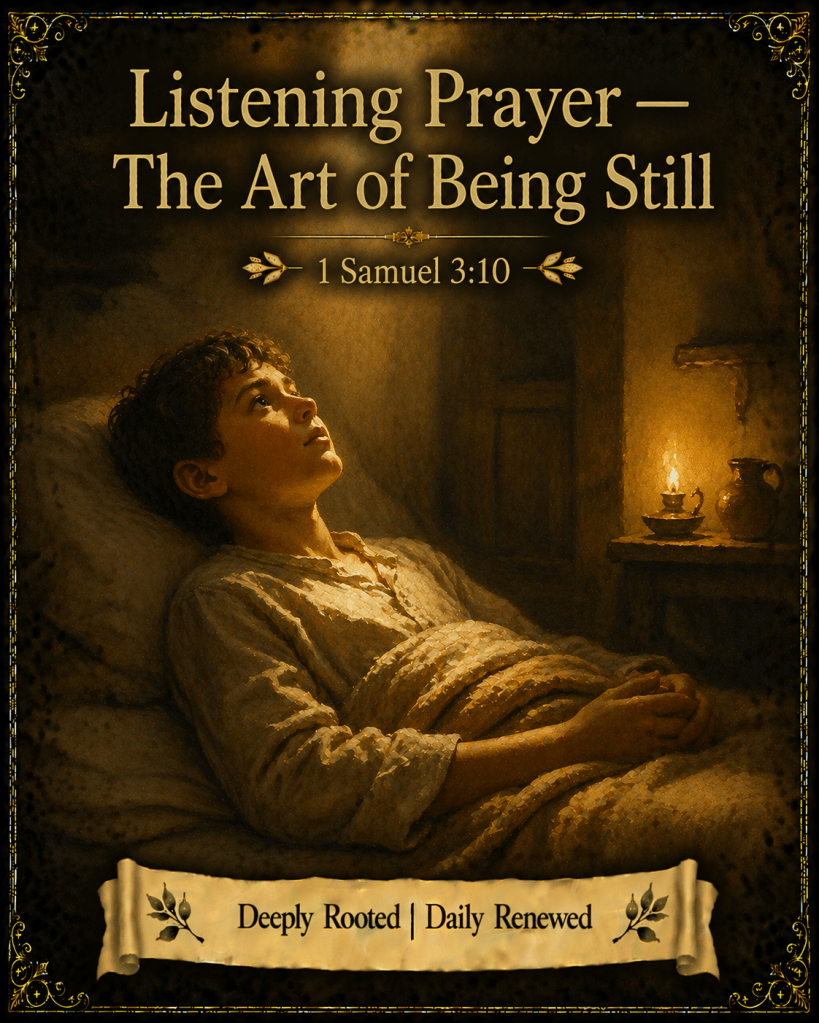
  • Tuesday, August 11, 2026–Talking with God — The Practice of Prayer: Listening Prayer—The Art Of Being Still

    KEY VERSE

    “Speak, LORD, for your servant is listening.”

    — 1 Samuel 3:10


    ROOTED TRUTH

    Most of us treat prayer as a monologue we deliver to God. But prayer was always designed to be a conversation — which means the listening half is just as essential as the speaking half.


    FAITH STORY

    Samuel was a boy sleeping in the temple when God called his name in the night.

    He heard a voice and assumed it was Eli, the priest. He ran to Eli — who had not called him. It happened a second time. A third time. And Eli, who recognized what was happening, gave Samuel the instruction that changed everything: go and lie down, and if he calls you, say, speak, LORD, for your servant is listening.

    The instruction was not go and speak. It was not go and present your requests. It was go and be still — and if He speaks, listen.

    The fourth time God called, Samuel responded with those six words: speak, LORD, for your servant is listening. And what followed was a significant prophetic word that shaped the rest of Samuel’s life and the future of Israel.

    Prayer in most Western Christian practice is overwhelmingly one-directional. We talk. We list. We petition. We confess. We praise. All of those things are good and right. But somewhere in the conversation we are having with the living God, we need to stop talking and listen.

    Listening prayer is not passive. It requires active stillness — the deliberate quieting of the internal noise, the to-do lists, the anxious thoughts, the wandering attention — in order to create space for what God might say. It requires a posture of expectation: the belief that God actually speaks and that His voice is worth waiting for.

    He speaks through Scripture — the primary and most reliable channel. He speaks through the quiet conviction of the Holy Spirit. Through the counsel of wise people. Through circumstances that open and close doors. Through the impressions that arrive in stillness that cannot be manufactured in noise.

    But none of it can be received by someone who is too busy talking to listen.

    Speak, LORD. Your servant is listening. That is a prayer worth praying — and then actually doing.


    SCRIPTURE FOR DEEPER ROOTS

    1 Samuel 3:1–10 — The call of Samuel.

    Psalm 46:10 — “Be still, and know that I am God.”

    John 10:27 — “My sheep listen to my voice; I know them, and they follow me.”


    DAILY PRACTICE

    After your regular prayer time today, add ten minutes of intentional silence. Set a timer. Begin by praying Samuel’s words: speak, LORD, for your servant is listening. Then be still — not sleeping, not scrolling, not planning, but genuinely waiting and attending. Write down anything that surfaces during that time — an impression, a Scripture that comes to mind, a sense of conviction or peace or direction. Practice listening as half of the conversation.


    DAILY PRAYER

    Speak, LORD, for Your servant is listening. I confess that I do most of the talking in my prayer life and very little of the listening. Quiet the noise in me today — the anxiety, the planning, the wandering thoughts — and create space for Your voice. I believe You speak. I believe Your voice is worth waiting for. I am still. I am listening. Speak to me. Amen.


    DEEP REFLECTION

    1.  Samuel needed to be taught how to listen — he didn’t recognize God’s voice at first. What does that tell you about the practice of hearing from God? Is it something that develops over time with practice?

    2.  Most prayer is speaking-heavy and listening-light. What is the practical and spiritual cost of a prayer life where you rarely stop to listen? What might you be missing?

    3.  John 10:27 says Jesus’s sheep know His voice. How confident are you in your ability to recognize God’s voice — to distinguish it from your own thoughts, others’ opinions, and cultural noise? What has helped you develop that discernment?


    #DeeplyRooted#DailyRenewed Devotions for a Grounded and Growing Faith

  • Monday, August 10, 2026–Talking with God — The Practice of Prayer: Coming Honestly—Prayer That Doesn’t Perform

    KEY VERSE

    “Trust in him at all times, you people; pour out your hearts to him, for God is our refuge.”

    — Psalm 62:8


    ROOTED TRUTH

    God is not impressed by polished prayers. He is moved by honest ones. The prayer that pours out the actual contents of your heart is always more powerful than the one that presents a curated version of it.


    FAITH STORY

    The Psalms are the prayer book of the Bible — and they are startlingly honest.

    They do not read like carefully edited spiritual journals prepared for public consumption. They read like the raw, unfiltered interior of human beings bringing everything they actually feel into the presence of God. My God, my God, why have you forsaken me? How long, LORD? Will you forget me forever? I am worn out from my groaning. I am poured out like water.

    The psalmists did not polish their prayers before bringing them to God. They poured them out — Psalm 62:8 uses exactly that word. Pour out your hearts to Him. Not present your hearts. Not arrange your hearts into acceptable order before approaching. Pour them out. Everything. The grief, the anger, the doubt, the fear, the confusion, the complaint.

    And God received all of it. He did not rebuke the Psalmist for the rawness. He did not withdraw when the words were too honest. The entire canon of these wildly honest prayers is preserved in Scripture as God’s own Word — which suggests that this kind of prayer is not a spiritual failure. It is a spiritual practice.

    The alternative — the polished, performance-driven prayer that presents only the acceptable emotions — is less prayer than it is religious theater. And God is not interested in theater. He already knows what is in your heart. The prayer that pours it out is not informing Him. It is choosing to engage honestly with what He already sees.

    There is a profound freedom in this. You do not have to feel spiritual to pray. You do not have to have it together. You do not have to edit your grief or suppress your doubt or manufacture gratitude you don’t feel. You can come exactly as you are, with exactly what is there, and pour it all out.

    He is your refuge. Refuges are for when you are not at your best.

    Come honestly. That is the prayer He is waiting for.


    SCRIPTURE FOR DEEPER ROOTS

    Psalm 22:1–2 — My God, my God, why have you forsaken me?

    Psalm 13:1–6 — How long, LORD? Will you forget me forever?

    Hebrews 4:15–16 — “We do not have a high priest who is unable to empathize with our weaknesses…Let us approach God’s throne of grace with confidence.”


    DAILY PRACTICE

    Write a completely unedited prayer today. Before you write, set a timer for ten minutes. During those ten minutes, write everything that is actually in your heart — including the things you would normally edit out. The frustration. The doubt. The fear. The things that feel too small or too dark or too confused to bring to God. Write them all. Then read what you have written back to God as your prayer. Do not edit it before you do.


    DAILY PRAYER

    Father, I come to You today not with my best version of myself but with my actual self. Here is what is really in my heart right now — the gratitude and the grief, the trust and the doubt, the praise and the complaint. I pour it all out before You because You already know it, and because You are big enough to hold it, and because You told me to trust You with all of it. Receive this honest prayer. Amen.


    DEEP REFLECTION

    1.  The Psalms include prayers of anger, doubt, complaint, and despair — and they are preserved as Scripture. What does that tell you about how God responds to raw, honest prayer versus polished, performance-driven prayer?

    2.  Is there something you have been editing out of your prayers — an emotion, a doubt, a grievance — because it felt too dark or too honest to bring to God? What would it take to pour that out today?

    3.  Hebrews 4:16 says to approach the throne of grace with confidence. How does the honesty God invites — receiving our unpolished prayers — increase your confidence to come to Him rather than decrease it?


    #DeeplyRooted#DailyRenewed Devotions for a Grounded and Growing Faith

  • Sunday, August 9, 2026–Talking with God — The Practice of Prayer: Why Prayer Changes Everything

    KEY VERSE

    “But when you pray, go into your room, close the door and pray to your Father, who is unseen. Then your Father, who sees what is done in secret, will reward you.”

    — Matthew 6:6


    ROOTED TRUTH

    Prayer is not a religious duty to perform. It is the primary means by which we stay connected to the source of everything we need — and everything we are called to become.


    FAITH STORY

    Most believers have a complicated relationship with prayer.

    They know it matters. They have seen it work. They have experienced seasons when their prayer life was rich and alive and seasons when it felt hollow and obligatory. They have prayed prayers that seemed to move mountains and prayers that seemed to bounce off the ceiling. And somewhere in all of that complicated history, many have settled into a prayer life that is less than what they know it could be.

    Jesus assumed His followers would pray. In the Sermon on the Mount He did not say if you pray — He said when you pray. Prayer was not optional equipment for the follower of Jesus. It was the engine.

    And yet what He described in Matthew 6:6 is strikingly simple and private. Go into your room. Close the door. Pray to your Father who is unseen. No audience. No performance. No impressive vocabulary or elaborate structure required. Just a person and their Father, behind a closed door, in secret.

    The word Jesus uses for Father — Abba — is the intimate address of a child to a parent. Not a formal title. Not a distant honorific. The word a child uses when they run in from outside and need something immediately. Abba. Dad.

    That is the relationship prayer is designed to sustain and deepen. Not a transaction where we submit requests and await divine responses. A conversation with a Father who sees what is done in secret, who is already present in the room before we close the door, and whose greatest gift is not the answers He gives but the access He grants.

    This week we are going to look honestly at the practice of prayer — how to come honestly, how to listen, how to persist, how to pray for others, how to use Scripture in prayer, and how to make prayer not an event but a way of life.

    The disciples asked the right question: Lord, teach us to pray. Come to this week with the same posture. You are about to be taught.


    SCRIPTURE FOR DEEPER ROOTS

    Matthew 6:5–13 — Jesus on prayer in the Sermon on the Mount.

    Romans 8:26 — “The Spirit himself intercedes for us through wordless groans.”

    Philippians 4:6 — “In every situation, by prayer and petition, with thanksgiving, present your requests to God.”


    DAILY PRACTICE

    Today, before anything else, go somewhere private — your car, a closet, a quiet room — close the door, and spend ten minutes simply talking to God as you would talk to a trusted Father. No formal structure, no impressive language. Just honest conversation. Tell Him what is on your mind. What you are worried about. What you are grateful for. What you need. Start where you are, not where you think you should be.


    DAILY PRAYER

    Father, I come to You this week as a student of prayer, not an expert. Teach me. Show me what I have been missing, correct what I have been doing out of habit rather than relationship, and deepen what is already alive. I don’t want a prayer life that is impressive to others. I want one that is real to You. Abba — teach me to pray. Amen.


    DEEP REFLECTION

    1.  Jesus said when you pray, not if — prayer was assumed as a regular practice. How regularly do you actually pray — and is it driven more by relationship or by obligation?

    2.  The closed-door, private prayer Jesus describes stands in contrast to performance-driven prayer. Where in your prayer life might performance have crept in — praying for an audience rather than for connection with God?

    3.  What would you most like to be different about your prayer life by the end of this week? Name it specifically — that named desire is already a prayer.


    #DeeplyRooted#DailyRenewed Devotions for a Grounded and Growing Faith

  • Saturday, August 8, 2026–Who God Is — The Character of God: God Is Near

    KEY VERSE

    “The LORD is near to all who call on him, to all who call on him in truth.”

    — Psalm 145:18


    ROOTED TRUTH

    Of all the things that could be said about an infinite, eternal, all-powerful God, perhaps the most staggering is this: He is near. Not distant. Not remote. Near.


    FAITH STORY

    The God of Scripture is unlike every other conception of deity in the ancient world.

    The gods of the surrounding nations were distant, capricious, and demanding — powerful beings who needed to be appeased, who operated from a position of remote authority and required elaborate rituals to approach. The idea that a god might choose to draw near to ordinary people, to listen to them, to be genuinely present with them in their daily lives — that was not the religious default of the ancient world.

    And yet it is the testimony of Scripture from beginning to end. God walked in the garden with Adam and Eve in the cool of the day. He spoke to Abraham as a friend. He met Moses face to face. He was present in the pillar of cloud and fire. He dwelt in the tabernacle in the middle of the camp — not at the edge, in the center. He came in the flesh in Jesus of Nazareth. He sent His Spirit to dwell not merely among His people but within them.

    Psalm 145:18 captures it with stunning simplicity: the LORD is near to all who call on Him. Not the theologically sophisticated. Not the spiritually advanced. All who call — in truth, with honest hearts — find Him near.

    Near means accessible. Near means responsive. Near means that the distance between your need and His presence is not the vast gulf it might feel like in the hardest moments. Near means He is not watching from a remote throne, unmoved by what moves you.

    This is why prayer is not a long-distance call. It is not a message sent into the void, hoping someone is listening. It is a conversation with Someone who is already present — closer than your next breath, more attentive than your most devoted friend.

    As we close this week of walking through the character of God — His holiness, His love, His faithfulness, His justice, His goodness, and now His nearness — let this be the attribute that brings all the others home.

    The holy God is near. The loving God is near. The faithful, just, and good God is near.

    He is near to you. Right now. Call to Him.


    SCRIPTURE FOR DEEPER ROOTS

    Psalm 145:14–19 — God is near to all who call.

    Acts 17:27–28 — “He is not far from any one of us. For in him we live and move and have our being.”

    James 4:8 — “Come near to God and he will come near to you.”


    DAILY PRACTICE

    As you close this week, practice the nearness of God in a tangible way today. Set a reminder on your phone every two hours. When it goes off, stop for sixty seconds — wherever you are, whatever you are doing — and simply acknowledge: God is here. Not a long prayer. Not a theological exercise. Just a moment of awareness: the God we have been studying this week is present in this moment, in this place, with me. Practice His nearness throughout the day.


    DAILY PRAYER

    Father, You are near — and that changes everything. Not remote, not indifferent, not requiring elaborate ritual to approach. Near. To all who call on You in truth. I call on You now — not from a distance, not through intermediaries, but directly, because You have made Yourself near. Be near to me today in the ordinary moments, the difficult ones, and the quiet ones. And let my awareness of Your nearness change the texture of everything I do. Amen.


    DEEP REFLECTION

    1.  The God of Scripture is uniquely near — dwelling among and within His people rather than at a distant remove. How does the nearness of God change the way you pray, the way you make decisions, and the way you face hard moments?

    2.  Acts 17:28 says in Him we live and move and have our being — we are already surrounded by His presence. Why, if God is that near, does He often feel distant — and what closes the gap between the truth of His nearness and the feeling of His distance?

    3.  Looking back over this entire week — God’s holiness, love, faithfulness, justice, goodness, and nearness — which attribute has most deeply touched something in you, and how will you carry it forward into the coming week?


    #DeeplyRooted#DailyRenewed Devotions for a Grounded and Growing Faith

  • Friday, August 7, 2026–Who God Is — The Character of God: God Is Good

    KEY VERSE

    “Taste and see that the LORD is good; blessed is the one who takes refuge in him.”

    — Psalm 34:8


    ROOTED TRUTH

    The goodness of God is not a theological proposition to accept. It is a reality to taste — discovered through experience, not just declared through doctrine.


    FAITH STORY

    Psalm 34 was written by David when he feigned madness to escape from a Philistine king.

    It was not written from a comfortable palace or a season of obvious blessing. It was written from a desperate, undignified moment — a man so afraid for his life that he pretended to be insane to survive. And from that place, David declared: taste and see that the LORD is good.

    This is the pattern of biblical faith regarding God’s goodness. It is almost never declared from positions of obvious comfort and ease. It is declared from caves and prisons, from exile and grief, from the rubble of destroyed cities and the depths of desperate fear. People who have nothing left to rely on but God are often the ones most equipped to testify to His goodness.

    The word taste is deliberate. Taste is experiential. You cannot taste by reading a recipe or studying a menu. You have to actually eat. David is not inviting his readers to accept a theological proposition about God’s goodness — he is inviting them to discover it through personal encounter.

    And the discovery is not always what we expect. God’s goodness does not mean the absence of hard things. David’s life was full of hard things. It means that in, through, and sometimes because of the hard things, something good is being worked — something worth tasting, worth naming, worth testifying about.

    God is good — not because everything feels good, not because life is comfortable, not because prayers are answered on our timeline. God is good because His character is good, His purposes are good, His love is good, and the end toward which He is working all things is good beyond what we can currently see.

    Have you tasted it? Have you named it? The invitation of Psalm 34 is not just to believe God is good. It is to taste the evidence — to look back over your own story and find the goodness woven through it.

    It is there. Look more carefully.


    SCRIPTURE FOR DEEPER ROOTS

    Psalm 34:1–10 — Taste and see.

    Romans 8:28 — “In all things God works for the good of those who love him.”

    Psalm 107:1 — “Give thanks to the LORD, for he is good; his love endures forever.”


    DAILY PRACTICE

    Today, do a goodness audit of your own life. Look back over the last year — or the last decade — and identify five specific moments where you can say, looking back: that was good. God was good to me there. It may not have felt good at the time. The goodness may have been hidden inside something hard. But name five specific evidences of God’s goodness in your story. Write them down. Taste them again. And thank Him for each one specifically.


    DAILY PRAYER

    Father, You are good — not because everything in my life feels good, but because Your character is good and Your purposes are good and the end toward which You are working is good beyond what I can see. I look back at my own story and I can taste Your goodness in it — even in the hard chapters, especially in the hard chapters. Thank You. I trust Your goodness with everything I am still waiting on. Amen.


    DEEP REFLECTION

    1.  David wrote taste and see from a desperate, undignified situation. What does the context of this declaration tell you about the relationship between hardship and the discovery of God’s goodness?

    2.  The invitation to taste implies active, personal engagement — not passive acceptance of a doctrine. When did you last actively taste the goodness of God — encounter it personally rather than just believe it theologically?

    3.  Romans 8:28 says God works all things for good for those who love Him. This is one of the most tested promises in Scripture. Has there been a hard chapter of your life that, looking back, you can now see God’s goodness working through? What did that reveal about His character?


    #DeeplyRooted#DailyRenewed Devotions for a Grounded and Growing Faith

  • Thursday, August 6, 2026–Who God Is — The Character of God: God Is Just

    KEY VERSE

    “He is the Rock, his works are perfect, and all his ways are just. A faithful God who does no wrong, upright and just is he.”

    — Deuteronomy 32:4


    ROOTED TRUTH

    The justice of God is not a threat to those who trust Him — it is one of the most stabilizing truths in the universe. A just God means nothing that has ever been done in darkness will escape the light.


    FAITH STORY

    Justice is perhaps the attribute of God most frequently misunderstood by those inside the church and most desperately longed for by those outside it.

    Inside the church, God’s justice can feel like a threat — the attribute that makes grace necessary, the standard that reveals our falling short. It can feel like the cold, demanding side of a God whose love is warm and whose justice is harsh.

    But that is not the picture Scripture gives. Deuteronomy 32:4 pairs justice directly with faithfulness and with being upright. God’s justice is not the opposite of His love — it is an expression of it. Because God is just, He takes seriously what has been done to the vulnerable. Because He is just, the powerful cannot ultimately exploit the powerless and escape accountability. Because He is just, the suffering of the innocent is not meaningless — it will be reckoned.

    Outside the church, justice is often the thing people most hunger for. The survivors of abuse who never saw their abuser face consequences. The families of victims whose cases were never resolved. The marginalized communities that have experienced generation after generation of injustice with no human court stepping in. To them, the justice of God is not a threat — it is hope. The assurance that someone with perfect knowledge and absolute authority is keeping a record that no human court can expunge.

    And for those who have done wrong — there is mercy available, extended through the cross of Jesus Christ, who absorbed the just penalty so that justice could be satisfied and mercy could be extended together. The cross is not God setting aside His justice for love. It is the place where justice and love meet.

    God is just. Nothing done in darkness will remain in darkness forever. And for everyone who has suffered unjustly, that is not a threat. It is the most important promise in the universe.


    SCRIPTURE FOR DEEPER ROOTS

    Psalm 89:14 — “Righteousness and justice are the foundation of your throne.”

    Romans 3:25–26 — God presented Christ as a sacrifice — to demonstrate his justice.

    Micah 6:8 — “Act justly and to love mercy and to walk humbly with your God.”


    DAILY PRACTICE

    The justice of God calls His people to reflect that justice in the world. Identify one situation — in your community, your workplace, your relationships — where injustice is present and where you have the capacity to act. It doesn’t have to be grand or public. It may be speaking up when something unfair is happening, advocating for someone who has no voice, or simply treating someone with the dignity they are being denied. Take one specific step today toward reflecting the justice of God.


    DAILY PRAYER

    Father, You are just — perfectly, completely, unfailingly just. Nothing escapes Your sight. No injustice is beyond Your reckoning. I bring to You today the situations that feel most unjust — in my own life and in the world around me — and I trust them to Your justice, which is perfect where mine is limited. Make me an instrument of Your justice in the places where I have influence. Amen.


    DEEP REFLECTION

    1.  How does your understanding of God’s justice change when you consider it not primarily as a threat to yourself but as hope for those who have suffered unjustly? Does that shift change how you feel about this attribute?

    2.  The cross is the place where God’s justice and love meet — not where justice is set aside for love. How does that understanding of the cross deepen your appreciation of what Christ accomplished?

    3.  Micah 6:8 calls God’s people to act justly. Where in your sphere of influence is God’s justice calling you to action — not just belief?


    #DeeplyRooted#DailyRenewed Devotions for a Grounded and Growing Faith