
Category: Uncategorized

  • Tuesday, July 21, 2026–Unshakeable — The Life of Daniel: God Of The Impossible

    KEY VERSE

    “Daniel replied, ‘No wise man, enchanter, magician or diviner can explain to the king the mystery he has asked about, but there is a God in heaven who reveals mysteries.’”

    — Daniel 2:27–28


    ROOTED TRUTH

    When every human resource has been exhausted and every expert has admitted defeat, the God who reveals mysteries is just getting started.


    FAITH STORY

    King Nebuchadnezzar had a dream that disturbed him deeply — and then forgot what it was.

    He summoned every wise man, magician, enchanter, and astrologer in Babylon and gave them an impossible demand: tell me what I dreamed, and then tell me what it means. If you can’t tell me the dream itself, I will know your interpretations are worthless. And if you fail, you will all be cut to pieces.

    The wise men were stunned. No human being could do what the king was asking. No one can reveal it to the king except the gods, they said, and they do not live among humans.

    The death warrant went out for all the wise men of Babylon — which included Daniel and his friends.

    Daniel’s response is instructive. He did not panic. He asked for time. He went home and asked his friends to pray — to seek mercy from the God of heaven concerning this mystery. And that night, God revealed the mystery to Daniel in a vision.

    Before he went to the king, Daniel stopped to praise God. Not to rehearse his strategy. Not to prepare his presentation. He praised the God who gives wisdom to the wise and reveals deep and hidden things, who knows what lies in darkness, and with whom light dwells.

    Then he went to Nebuchadnezzar with the dream, the interpretation, and a very clear word: there is a God in heaven who reveals mysteries. Not I have solved your problem. Not my skill has delivered you. There is a God.

    Daniel used his moment of extraordinary access and influence to point to something beyond himself.

    When God gives you the answer everyone else has been unable to find, the temptation is to take the credit. Daniel shows us the better way: give it back to the One who gave it.


    SCRIPTURE FOR DEEPER ROOTS

    Daniel 2:1–49 — Nebuchadnezzar’s dream and Daniel’s interpretation.

    James 1:5 — “If any of you lacks wisdom, you should ask God, who gives generously to all.”

    Proverbs 3:5–6 — “Trust in the LORD with all your heart and lean not on your own understanding.”


    DAILY PRACTICE

    Is there a situation in your life right now where every human resource has been tried and every expert has admitted defeat — where you are facing something that genuinely feels impossible? Follow Daniel’s pattern today: gather people to pray with you specifically, seek God for the mystery you cannot solve on your own, and commit to giving Him the credit when the answer comes. Name the impossible situation and bring it to God by name in prayer.


    DAILY PRAYER

    Father, there is a God in heaven who reveals mysteries — and that God is You. I bring You the situations in my life that are beyond my wisdom, my resources, and my ability to solve. I am not asking You to make me smarter. I am asking You to reveal what only You can reveal. And when You do, let me be like Daniel — pointing everyone back to You rather than taking the credit for myself. Amen.


    DEEP REFLECTION

    1.  Daniel’s first response to an impossible deadline was to go home and pray with friends. What does that instinct reveal about where he believed the real resource was — and how does that compare to your own first instinct when facing an impossible situation?

    2.  Before Daniel went to the king with the answer, he spent time praising God. Why is that order — praise before presentation — spiritually significant, and what does skipping it cost us?

    3.  Daniel’s explanation to the king began with there is a God in heaven, not I have the answer. When God gives you wisdom, insight, or ability that others notice, how do you handle the credit — and what would Daniel’s example look like in your context?


    #DeeplyRooted#DailyRenewed Devotions for a Grounded and Growing Faith

  • Monday, July 20, 2026–Unshakeable — The Life of Daniel: Faithful In A Foreign Land

    KEY VERSE

    “To these four young men God gave knowledge and understanding of all kinds of literature and learning. And Daniel could understand visions and dreams of all kinds.”

    — Daniel 1:17


    ROOTED TRUTH

    Faithfulness to God in a culture that does not share your values does not require withdrawal from that culture. It requires rootedness deep enough that the culture cannot reshape what matters most.


    FAITH STORY

    Daniel did not retreat from Babylon. He excelled in it.

    After his quiet resolution about the food, Daniel and his three friends — Shadrach, Meshach, and Abednego — were found to be ten times better than all the magicians and enchanters in the kingdom at the end of their training. They did not boycott the king’s educational system. They did not refuse to learn. They engaged fully — and God gave them wisdom and understanding that surpassed everyone around them.

    This is one of the most important and often overlooked aspects of Daniel’s story. His faithfulness was not expressed through disengagement from the culture he was placed in. It was expressed through excellence within it, rooted in an integrity that the culture could not touch.

    Daniel served four different kings across decades — Nebuchadnezzar, Belshazzar, Darius the Mede, and Cyrus the Persian. He was a statesman, an advisor, an interpreter of dreams, a bureaucrat at the highest levels of two successive empires. He was, in the fullest sense, engaged with the world around him.

    And through all of it, he remained distinctly himself. Not because he isolated himself from the surrounding culture, but because his roots went deeper than the culture’s reach.

    This is the model for every believer navigating a world that does not share their values. Not withdrawal. Not compromise. Engagement with deep roots. Excellence in the work, integrity in the character, distinctiveness in the convictions.

    You were not placed in your workplace, your neighborhood, your school, or your cultural moment by accident. Like Daniel in Babylon, you are exactly where God has positioned you.

    Be excellent. Stay rooted. Let the two work together.


    SCRIPTURE FOR DEEPER ROOTS

    Daniel 1:17–20 — God blesses Daniel and his friends with wisdom.

    Matthew 5:13–14 — “You are the salt of the earth…the light of the world.”

    Colossians 3:23 — “Whatever you do, work at it with all your heart, as working for the Lord.”


    DAILY PRACTICE

    Daniel excelled in the culture he was placed in while maintaining his integrity within it. Reflect on your own workplace, neighborhood, or sphere of influence. Are you engaging excellently — bringing your full effort and ability? And are you maintaining what makes you distinctively yourself? Identify one area where you could pursue greater excellence, and one area where your distinctiveness as a follower of Christ needs to be more visible.


    DAILY PRAYER

    Father, like Daniel, I am placed in a culture that does not always share my values. Help me to engage it fully rather than withdrawing from it, and to be excellent in my work rather than merely adequate. Let my faithfulness and my excellence work together — so that the people around me see both what I can do and who I belong to. Amen.


    DEEP REFLECTION

    1.  Daniel was ten times better than his peers in wisdom and understanding — and this was the result of God’s blessing on his faithfulness. How does the connection between integrity and excellence show up in your own experience?

    2.  Daniel served pagan kings faithfully for decades without compromising his faith. What is the difference between serving a system faithfully and being co-opted by it?

    3.  You are placed where you are for a reason. What does Daniel’s example of engaged, excellent, rooted faithfulness look like specifically in the environments where God has placed you right now?


    #DeeplyRooted#DailyRenewed Devotions for a Grounded and Growing Faith
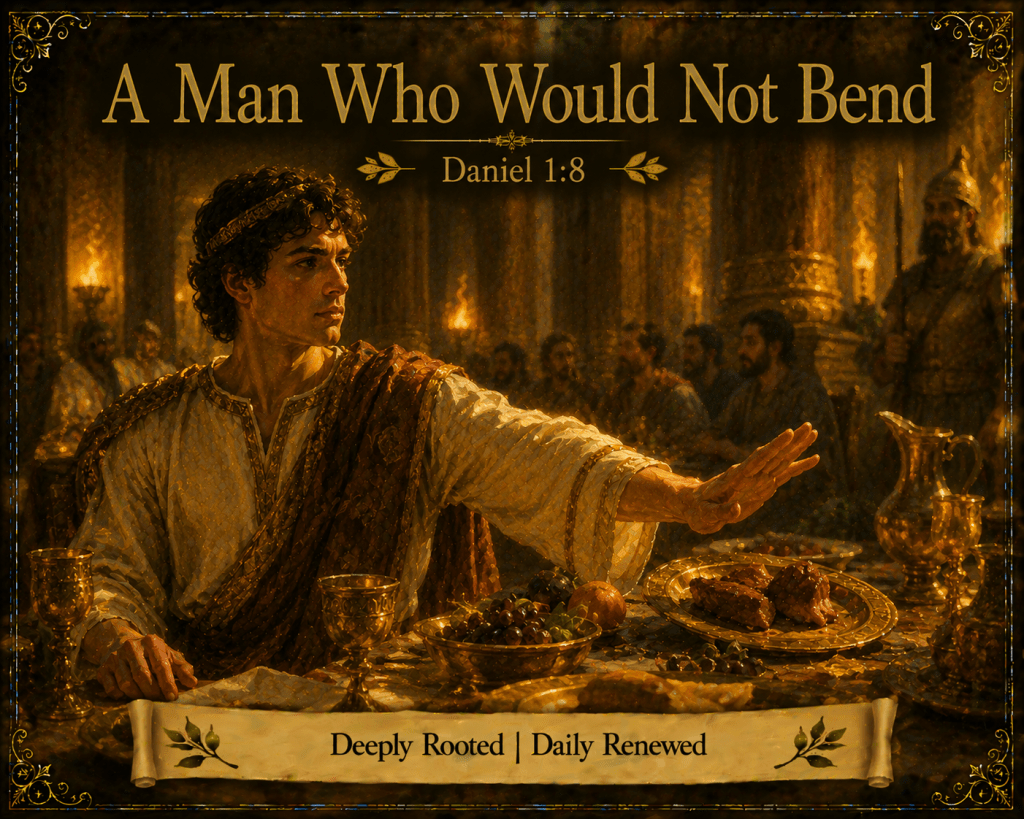
  • Sunday, July 19, 2026–Unshakeable — The Life of Daniel: A Man Who Would Not Bend

    KEY VERSE

    “But Daniel resolved not to defile himself with the royal food and wine, and he asked the chief official for permission not to defile himself this way.”

    — Daniel 1:8


    ROOTED TRUTH

    Daniel’s unshakeable life was not built in the lion’s den or the fiery furnace. It was built in the small, daily decision to resolve — before the crisis — who he was and whose he was.


    FAITH STORY

    Daniel arrived in Babylon as a captive.

    He was young — a teenager by most estimates — stripped from his home, his family, his culture, and his land by the most powerful empire on earth. The Babylonians had a strategy for the best and brightest of the nations they conquered: take them, rename them, educate them, feed them from the royal table, and absorb them into the empire. Assimilation through privilege.

    Daniel was given a new name — Belteshazzar, a name honoring a Babylonian god. He was enrolled in the king’s educational program. He was offered the king’s food and wine. Everything about his environment was designed to gradually reshape who he was.

    And in the middle of all of that, in what might seem like a small moment, Daniel resolved. The Hebrew word is a strong one — he set it upon his heart. Before anyone was watching. Before the stakes were obvious. Before the crisis arrived. He decided.

    He would not defile himself with the royal food.

    This first decision — quiet, private, seemingly small — is the foundation of everything that follows in Daniel’s life. The man who would later walk calmly into a den of lions was the same man who, years earlier, had quietly resolved over a dinner table. The unshakeable faith of the crisis moments was built in the ordinary moments of private conviction.

    Daniel’s story this week will take us from Babylon’s court to a furnace, from a king’s dream to a wall covered in writing, from a den of lions to visions of eternity. In every scene the same man appears — not because he was superhuman, but because he had resolved before each test who he was.

    That is the invitation this week. Not to wait for the lion’s den to decide what you believe — but to resolve now, in the quiet, before the pressure comes.

    Who are you when no one is watching? That is who you will be when everyone is.


    SCRIPTURE FOR DEEPER ROOTS

    Daniel 1:1–21 — Daniel and his friends in Babylon.

    Joshua 24:15 — “But as for me and my household, we will serve the LORD.”

    Romans 12:2 — “Do not conform to the pattern of this world, but be transformed by the renewing of your mind.”


    DAILY PRACTICE

    Identify one area of your life where cultural pressure is gradually shaping you in a direction away from God — a slow drift rather than a dramatic fall. It may be in what you consume, what you say, how you spend your time, or what you are slowly beginning to accept as normal. Like Daniel, resolve now — before the pressure intensifies. Write down your resolution and share it with one trusted person this week.


    DAILY PRAYER

    Father, I want to be a person who has resolved before the crisis comes. So much of my spiritual stability depends on decisions I make in ordinary, unobserved moments. Give me Daniel’s quiet courage — not the dramatic kind that shows up for the lion’s den, but the daily kind that holds the line over a dinner table. Let me be the same person in private that I want to be in public. Amen.


    DEEP REFLECTION

    1.  Daniel’s most important decision in the book was not the lion’s den — it was a quiet resolution over food in chapter 1. What does that tell you about where character is actually formed?

    2.  The Babylonians used privilege and comfort — the king’s food, the king’s education, even a new name — as tools of cultural assimilation. What are the equivalents in your own cultural moment that most subtly reshape identity?

    3.  Daniel resolved who he was before the pressure arrived. Is there an area of your life where you need to make that resolution now — before the test comes — rather than trying to decide in the middle of it?


    #DeeplyRooted#DailyRenewed Devotions for a Grounded and Growing Faith

  • Saturday, July 18, 2026–The Most Excellent Way — 1 Corinthians 13: The Greatest Of These

    KEY VERSE

    “And now these three remain: faith, hope and love. But the greatest of these is love.”

    — 1 Corinthians 13:13


    ROOTED TRUTH

    Faith will one day become sight. Hope will one day become possession. Only love will remain exactly what it always was — because love is the nature of the God in whose presence we will live forever.


    FAITH STORY

    Paul closes the chapter with one of the most quietly stunning sentences in all of Scripture.

    And now these three remain: faith, hope and love. But the greatest of these is love.

    Faith, hope, and love — the triad that has come to define the essential shape of the Christian life. Faith that trusts what cannot yet be seen. Hope that reaches toward what has not yet arrived. Love that gives itself for the sake of another.

    All three endure through this age. All three are essential. The Christian life is not livable without any one of them. But when Paul says love is the greatest, he is not grading them on usefulness. He is pointing to what they become when this age is over.

    Faith will one day become sight. When we stand in the full presence of God, trust in what we cannot see will be replaced by vision — we will see Him as He is. Faith will have served its magnificent purpose and will be fulfilled in the thing it was always pointing toward.

    Hope will one day become arrival. The things we have longed for, the restoration we have waited for, the reunion we have ached toward — all of it will have come. Hope will be swallowed up in the having.

    But love — the self-giving, other-oriented, delight-in-the-flourishing-of-another love that we have been studying all week — love will not be transformed into something else when eternity arrives. It will simply continue. Because love is not a provisional grace for an age of partial knowledge. It is the permanent nature of the God who is love, and of the community that lives in Him forever.

    We began this week with Paul’s corrective to a church that had gifts without love. We close with his conclusion: in the end, after the gifts have served their purpose and the partial has given way to the complete — love is what remains.

    Make it what you are known for. Make it what you live for. Make it the thing you pour your best energy into.

    It is the most excellent way. It is the greatest thing. And it will never, ever fail.


    SCRIPTURE FOR DEEPER ROOTS

    1 John 3:14 — “We know that we have passed from death to life, because we love each other.”

    John 15:12 — “My command is this: Love each other as I have loved you.”

    Romans 13:10 — “Love is the fulfillment of the law.”


    DAILY PRACTICE

    As you close this week in 1 Corinthians 13, go back to the practice from Sunday: read the chapter again and substitute your name for love. This time, notice what has shifted — in your understanding, in your conviction, in your desire. Then write a one-paragraph response to God — not a prayer request, but a declaration of what you want love to look like in your life in the week ahead. Be specific. Name the relationships. Name the choices. Commit to the most excellent way.


    DAILY PRAYER

    Father, I have spent a week in the most important chapter in Scripture about what You are — because You are love. I want to be known by it. Not by my gifts, not by my knowledge, not by my achievements — by love. Patient, kind, not envious, not boastful, keeping no record, always protecting, always trusting, always hoping, always persevering, never failing. That is what I want. That is only possible in You. Make it true of me. Amen.


    DEEP REFLECTION

    1.  Faith becomes sight and hope becomes arrival in eternity — but love simply continues. What does the permanent nature of love tell you about why it is the greatest of the three?

    2.  Looking back over the whole week in 1 Corinthians 13 — which quality of love has most convicted you, and which one has most encouraged you about what God is growing in you?

    3.  Paul wrote this chapter to correct a gifted but loveless church. If he were writing to you specifically, which verse do you think he would most want you to sit with — and what would he tell you to do differently as a result?


    #DeeplyRooted#DailyRenewed Devotions for a Grounded and Growing Faith

  • Friday, July 17, 2026–The Most Excellent Way — 1 Corinthians 13: Love Never Fails

    KEY VERSE

    “Love never fails. But where there are prophecies, they will cease; where there are tongues, they will be stilled; where there is knowledge, it will pass away.”

    — 1 Corinthians 13:8


    ROOTED TRUTH

    Every gift is temporary. Every achievement fades. Every human capacity has an expiration date. Love alone will survive into eternity — because love is the nature of the God who is eternal.


    FAITH STORY

    Paul makes a breathtaking claim: love never fails.

    The word fails is the Greek pipto — to fall, to collapse, to come to an end. Love does not fall. It does not collapse. It does not come to an end. It is the one thing in the universe that is not subject to obsolescence.

    Everything else Paul lists will pass away. Prophecies will cease — when the full revelation of God is complete, the partial word will be swallowed up by the whole. Tongues will be stilled. Knowledge — even the deepest and most treasured knowledge — will be surpassed by knowing face to face rather than through a glass darkly.

    Paul is not minimizing gifts. He spent the previous two chapters affirming them. He is simply pointing out that they are tools, designed for this age — and tools have a use-by date. When the building is complete, the scaffolding comes down.

    But love is not scaffolding. Love is the structure itself. Love is the nature of God — and since God is eternal, love is eternal. When we arrive in the fullness of what God is preparing, the gifts will have served their purpose. But love will still be there, because love will always have been the point.

    This is what makes love the highest and most enduring pursuit of the Christian life. Not because it produces the most impressive results in the short term — often the most loving choice produces no visible result at all. But because it is the only thing we practice here that we will also practice there.

    Heaven will not require faith — we will see. It will not require hope — what we hoped for will have arrived. But love — the giving of yourself for another, the delight in the flourishing of the beloved — that will continue forever.

    What you invest in love is the only investment that never depreciates.

    Love never fails. Build your life on it.


    SCRIPTURE FOR DEEPER ROOTS

    1 Corinthians 13:9–12 — We know in part, but then face to face.

    1 John 4:16 — “God is love. Whoever lives in love lives in God, and God in them.”

    Romans 8:38–39 — Nothing can separate us from God’s love.


    DAILY PRACTICE

    Consider what you are most investing your energy and attention in right now. Ask honestly: will this last? Then ask: where is love calling me to invest today — in a way that might produce no visible return but will outlast everything else? Make one investment in love today that no one else will see or measure — a sacrificial act of kindness, a word of encouragement, a prayer for someone who doesn’t know you are praying, a forgiveness extended in private.


    DAILY PRAYER

    Father, I confess that I invest most heavily in things that will not last — in accomplishments, in reputation, in productivity, in things that feel significant in the moment but will not survive into eternity. Reorder my priorities this week. Let love be the thing I spend most freely — because it is the only currency that never devalues. Your love never fails. Let mine reflect Yours. Amen.


    DEEP REFLECTION

    1.  Paul says prophecies, tongues, and knowledge will all pass away — but love never fails. How does the permanence of love reorder what you consider most important in your spiritual life and daily choices?

    2.  If love is the only thing we practice here that we will also practice in eternity, what does that say about how much time and energy we should invest in learning to love well — versus other spiritual pursuits?

    3.  Can you think of an act of love you have witnessed or received that felt as if it could not be diminished by time — something that still carries weight years later? What made it so enduring?


    #DeeplyRooted#DailyRenewed Devotions for a Grounded and Growing Faith

  • Thursday, July 16, 2026–The Most Excellent Way — 1 Corinthians 13: Love Always—Four Words That Cover Everything

    KEY VERSE

    “It always protects, always trusts, always hopes, always perseveres.”

    — 1 Corinthians 13:7


    ROOTED TRUTH

    The word always is love’s most demanding word. Not usually. Not when it’s easy. Not when it’s deserved. Always.


    FAITH STORY

    Four qualities. One word repeated four times. Always.

    Always protects. The word is stego in Greek — to cover, to roof over, to bear a burden so that another doesn’t have to. Love covers. Not in the sense of enabling harm or hiding what is wrong, but in the sense of choosing to shield rather than expose, to defend rather than criticize, to absorb rather than deflect. Love is not a gossip. It does not broadcast another person’s failures or weaknesses. It covers.

    Always trusts. This is not gullibility — love is not without wisdom or discernment. It is the posture of choosing to believe the best about a person rather than the worst. Of extending the benefit of the doubt rather than rushing to the most unflattering interpretation. Of refusing to assume the worst motive when a better one is possible.

    Always hopes. Even when trust has been broken. Even when the pattern is discouraging. Even when every human indicator suggests nothing will change. Love maintains a posture of hope — not a denial of reality, but a refusal to write anyone off entirely. Because the God who transforms people is still at work, and love believes that.

    Always perseveres. The word is hupomeno — to remain under, to bear up beneath a weight without being crushed by it. Love stays. It does not quit when staying is costly. It does not walk away when walking away would be easier. It endures.

    Four always statements. Together they describe a love that is not passive or sentimental but actively engaged — covering, extending trust, maintaining hope, and staying put — even when none of those choices feel natural.

    This is the love that most closely resembles God’s love for us. He covered us. He trusts the work He is doing in us. He hopes for our completion. He perseveres — He never gives up on a single soul He has begun to work in.

    That love is the standard. And it is only possible because the source of it is not us — it is Him, living and loving through us.


    SCRIPTURE FOR DEEPER ROOTS

    Romans 8:38–39 — Nothing can separate us from the love of God.

    Lamentations 3:22–23 — “Great is his faithfulness” — God’s love that never ceases.

    1 Peter 4:8 — “Above all, love each other deeply, because love covers over a multitude of sins.”


    DAILY PRACTICE

    Take each of the four always qualities and apply it to one specific relationship today. Protects — is there something about this person you have been sharing that you should cover instead? Trusts — are you assuming the worst motive when a better one is possible? Hopes — have you written off the possibility of change in this person or relationship? Perseveres — are you tempted to quit? Address one of these specifically in prayer and in action today.


    DAILY PRAYER

    Father, the word always is the hardest word in this chapter. I don’t always protect — sometimes I expose. I don’t always trust — sometimes I assume the worst. I don’t always hope — sometimes I have given up. I don’t always persevere — sometimes I want to walk away. Grow in me the always of love. Not from my own reserves, which run dry — but from Yours, which never do. Amen.


    DEEP REFLECTION

    1.  Which of the four always qualities — protects, trusts, hopes, perseveres — is hardest for you to maintain consistently in your closest relationships? What makes it difficult?

    2.  Always hopes does not mean denying reality — it means refusing to write anyone off. Is there a person or situation you have given up on that love is asking you to bring back into hope?

    3.  Always perseveres describes a love that stays under weight without being crushed. What weight is love asking you to stay under right now rather than put down — and what sustains you in that staying?


    #DeeplyRooted#DailyRenewed Devotions for a Grounded and Growing Faith

  • Wednesday, July 15, 2026—The Most Excellent Way — 1 Corinthians 13: Love Keeps No Records Of Wrongs

    KEY VERSE

    “It does not delight in evil but rejoices with the truth. It keeps no record of wrongs.”

    — 1 Corinthians 13:5b–6


    ROOTED TRUTH

    Keeping a record of wrongs is the quiet practice that slowly turns a relationship into a courtroom. Love tears up the record — not because the wrongs weren’t real, but because grace is greater.


    FAITH STORY

    The phrase keeps no record of wrongs is one of the most striking in the entire chapter.

    The Greek word for record is a bookkeeping term — it refers to the practice of logging entries in an account. Paul is describing a very human tendency: the mental ledger we maintain of every offense, slight, failure, and disappointment we have experienced from another person. The running total that we consult when deciding how much trust to extend, how much grace to offer, how much warmth to show.

    We are remarkably accurate record-keepers of what others have done to us. We remember the exact words. We remember the context. We remember how many times. And we pull the record out, consciously or not, in moments of conflict — as evidence, as leverage, as self-protection.

    Love, Paul says, does not do this. Not because love is naive or has no memory. But because love has chosen to release the debt rather than maintain the account.

    This is one of the most counter-intuitive and difficult aspects of love, because keeping the record feels wise. It feels like prudence, like appropriate self-protection, like reasonable caution in a world where people repeat their patterns.

    But the record always costs more than it protects. It keeps the wound alive. It prevents genuine reconciliation. It makes every present interaction carry the weight of every past failure. And it is the opposite of how God has treated us — who removed our transgressions as far as the east is from the west, who remembers our sins no more.

    Forgiveness does not mean pretending the wrong didn’t happen or removing all consequences. It means closing the account. Tearing up the ledger. Choosing not to reach for it the next time conflict arises.

    Is there a record you have been keeping? Love is asking you to put down the pen.


    SCRIPTURE FOR DEEPER ROOTS

    Psalm 103:12 — “As far as the east is from the west, so far has he removed our transgressions from us.”

    Ephesians 4:32 — “Forgive each other, just as in Christ God forgave you.”

    Colossians 3:13 — “Bear with each other and forgive one another if any of you has a grievance against someone.”


    DAILY PRACTICE

    Is there a relationship in which you are actively keeping a record — mentally cataloguing offenses, returning to past failures in present conflicts, holding a ledger of wrongs? Name the relationship and name the record. Then pray a specific prayer of release: I choose to close this account. I am not holding this against them any longer. If necessary, make a practical decision — delete the mental note, stop bringing up the past issue — that puts action behind the prayer.


    DAILY PRAYER

    Father, I am an accurate record-keeper of what others have done to me. I hold onto offenses longer than I should and reach for the ledger in moments of conflict. You have removed my sins as far as the east is from the west — and I want to extend that same grace. Give me the courage to close the account. Help me forgive as I have been forgiven — completely, without taking it back. Amen.


    DEEP REFLECTION

    1.  Paul uses a bookkeeping term — love doesn’t log wrongs in an account. Do you have a mental ledger on someone in your life right now? What does keeping that record cost you — and cost the relationship?

    2.  Closing the account doesn’t mean pretending the wrong didn’t happen. What is the difference between genuine forgiveness and the kind of denial that pretends hurt away?

    3.  God’s forgiveness of us is described as remembering our sins no more. That is the standard love sets. How does the depth of your own experience of being forgiven affect your capacity to forgive others — and is there a connection between the two that you need to explore?


    #DeeplyRooted#DailyRenewed Devotions for a Grounded and Growing Faith
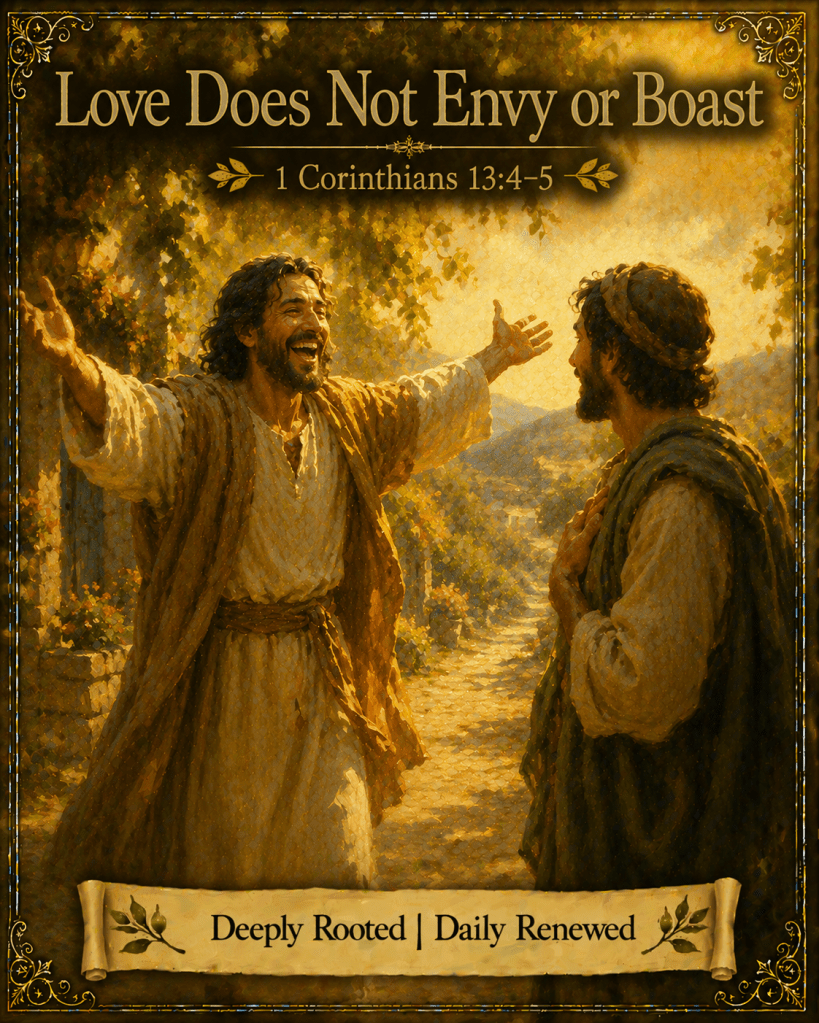
  • Tuesday, July 14, 2026–The Most Excellent Way — 1 Corinthians 13: Love Does Not Envy Or Boast

    KEY VERSE

    “It does not envy, it does not boast, it is not proud. It does not dishonor others, it is not self-seeking, it is not easily angered.”

    — 1 Corinthians 13:4b–5


    ROOTED TRUTH

    Envy wants what someone else has. Boasting wants someone else to want what you have. Love is freed from both — because it has found its sufficiency in something that cannot be compared.


    FAITH STORY

    Paul moves from what love does to what love doesn’t — and the list cuts close.

    Envy is the pain of someone else’s blessing. It is the hollow, corrosive feeling that rises when a friend gets the promotion, the relationship, the platform, or the recognition that part of you wanted. It is not neutral — it is actively destructive, eating away at the ability to genuinely celebrate another person’s good.

    Boasting is envy’s mirror image. Where envy resents another person’s status, boasting is the attempt to establish your own — to make sure people know your achievements, your insights, your spiritual experiences, your sacrifices. It is insecurity performing as confidence.

    Pride — the root that feeds both — is the posture of a person whose sense of worth is built on comparison. The proud person needs to be above. Which means every person who rises feels like a threat, and every personal achievement needs an audience.

    Love, Paul says, is free from all of this. Not because the person walking in love has no achievements or desires — but because their identity is not built on comparison. When your worth is rooted in being loved by God, you don’t need to outshine anyone, and you don’t need to diminish yourself by envying what they have.

    You can genuinely celebrate someone else’s success when you are not threatened by it. You can hold your own gifts and accomplishments quietly when you are not dependent on others’ admiration to feel valuable.

    The Corinthians were competitive and status-conscious — comparing spiritual gifts, claiming loyalty to different apostles, jockeying for position within the community. Paul’s corrective was not an organizational restructuring. It was love. Because love, properly rooted, dissolves the need that drives both envy and boasting.

    Whose success have you found it hardest to celebrate lately? That may be the most honest answer to where envy is still at work.


    SCRIPTURE FOR DEEPER ROOTS

    James 3:16 — “For where you have envy and selfish ambition, there you find disorder and every evil practice.”

    Philippians 2:3 — “Do nothing out of selfish ambition or vain conceit. Rather, in humility value others above yourselves.”

    Galatians 5:26 — “Let us not become conceited, provoking and envying each other.”


    DAILY PRACTICE

    Do an honest inventory of envy today. Is there someone whose success, recognition, relationship, or platform you find genuinely difficult to celebrate? Name them. Then do the hardest thing: pray a blessing over them specifically. Ask God to prosper them, to increase what they have, to bless what they are doing. Pray it until you mean it — and notice what happens in your own heart as you do.


    DAILY PRAYER

    Father, I confess that envy is more present in me than I admit. I have found it hard to celebrate certain people’s success because part of me wanted what they have. Forgive me. Root my identity so deeply in Your love that comparison loses its grip. Free me to celebrate others fully, hold my own gifts quietly, and find my sufficiency entirely in You. Amen.


    DEEP REFLECTION

    1.  Envy is described as the pain of someone else’s blessing. Have you experienced that — a moment when someone’s good news felt like bad news to you? What does that reveal about where your sense of worth is rooted?

    2.  Boasting is insecurity performing as confidence. Can you identify places in your own communication — conversations, social media, prayer requests — where boasting might be at work, even subtly?

    3.  Love is freed from envy and boasting because it finds its sufficiency in something that cannot be compared. What would it look like practically for your identity to be so rooted in God’s love that comparison simply lost its power over you?


    #DeeplyRooted#DailyRenewed Devotions for a Grounded and Growing Faith
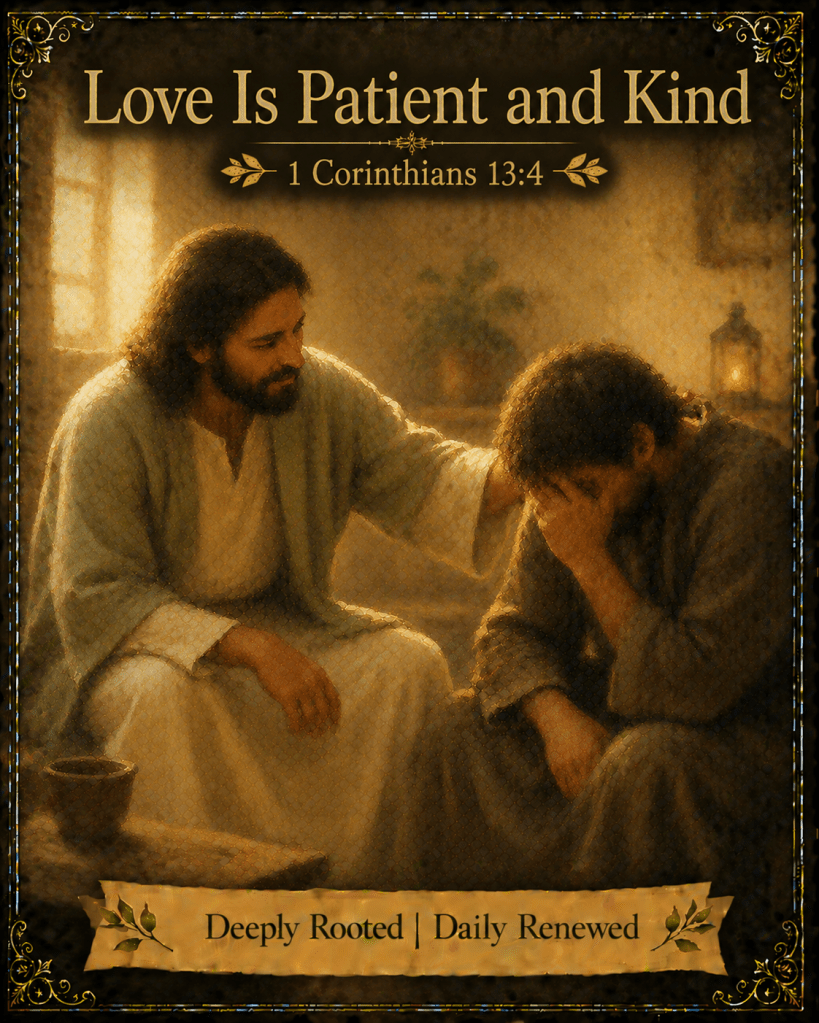
  • Monday, July 13, 2026–The Most Excellent Way — 1 Corinthians 13: Love Is Patient And Kind

    KEY VERSE

    “Love is patient, love is kind. It does not envy, it does not boast, it is not proud.”

    — 1 Corinthians 13:4


    ROOTED TRUTH

    Patience is love’s long fuse. Kindness is love’s warm face. Together they describe a love that neither snaps under pressure nor turns cold under strain.


    FAITH STORY

    Paul opens his description of love with two qualities that sound gentle and are anything but.

    Patience — the Greek word is makrothumia, literally long-tempered. The capacity to absorb provocation, disappointment, or slow progress without snapping. It is the opposite of the short fuse, the quick reaction, the sharp word that comes out before wisdom has had a chance to speak.

    Kindness — the Greek word is chrestotes, carrying the sense of usefulness and goodness in action. Not just the warm feeling of benevolence, but the actual doing of good toward another person. Kindness shows up. It acts. It finds a way to do something good even when the feeling isn’t there to motivate it.

    The order matters. Paul put patience first because kindness without patience is performance — it is the warm act toward someone we have not yet grown frustrated with. True kindness requires patience as its foundation, because the people who most need kindness are almost always the people who are most difficult to be patient with.

    Think about where you are least patient. Probably at home, with the people closest to you — because familiarity removes the social pressure to perform. You can be endlessly patient with strangers and completely short-tempered with the people you love most. That gap is not hypocrisy, exactly — it is the honest revelation of how much patience you actually have versus how much you perform.

    And think about kindness — not the grand gesture, but the small, unremarkable, repeated choice to do good toward someone even when they haven’t earned it, even when you are tired, even when they won’t notice.

    Jesus was both. Endlessly patient with the slow, the doubting, the repeated failure. And actively, practically kind — healing, feeding, touching, speaking, seeking. Not waiting to be asked. Going toward the need.

    That is the love this chapter is describing. Slow to anger, quick to do good. Long fuse, warm face.

    Who in your life needs both of those from you today?


    SCRIPTURE FOR DEEPER ROOTS

    Romans 2:4 — “God’s kindness is intended to lead you to repentance.”

    Ephesians 4:2 — “Be completely humble and gentle; be patient, bearing with one another in love.”

    Colossians 3:12 — “Clothe yourselves with compassion, kindness, humility, gentleness and patience.”


    DAILY PRACTICE

    Choose one relationship today where patience is most difficult for you. Before any interaction with that person, pause and pray specifically: give me a long fuse and a warm face. Then choose one act of intentional kindness toward them — not because they deserve it or will notice it, but because love acts. Do the act whether or not the feeling follows.


    DAILY PRAYER

    Father, I am more short-tempered and less kind than I want to be — especially with the people I love most. Grow patience in me that doesn’t snap under pressure and kindness that doesn’t wait for the right feeling. Let me treat the people closest to me with the same warmth I extend to those I am still trying to impress. Make me long-tempered and warm-faced. Amen.


    DEEP REFLECTION

    1.  Where are you least patient — and who is on the receiving end of your shortest fuse? What does that reveal about the condition of love in that relationship?

    2.  Kindness is described as love in action rather than just feeling. What is the difference between feeling kind toward someone and actually being kind to them — and which one does Paul’s description require?

    3.  God’s kindness leads to repentance (Romans 2:4) — it is powerful, not passive. Has someone’s patience or kindness toward you ever led you toward change or toward God? What made it so effective?


    #DeeplyRooted#DailyRenewed Devotions for a Grounded and Growing Faith

  • Sunday, July 12, 2026–The Most Excellent Way — 1 Corinthians 13: The Most Excellent Way

    KEY VERSE

    “And yet I will show you the most excellent way.”

    — 1 Corinthians 12:31b


    ROOTED TRUTH

    Without love, every gift becomes noise, every sacrifice becomes performance, and every achievement becomes hollow. Love is not one quality among many — it is the one that gives all the others meaning.


    FAITH STORY

    The church in Corinth had a gift problem.

    They were, by Paul’s own account, not lacking in any spiritual gift (1 Corinthians 1:7). They had tongues and prophecy and knowledge and healing and mighty works. They were spiritually gifted in abundance. And they were also deeply divided, competitive, proud, and confused about what mattered most.

    Into that context, Paul wrote what we now call 1 Corinthians 13 — not as a wedding reading, though it has become one of the most beloved at every wedding in the Western world. He wrote it as a corrective. A reorientation. A word to gifted, active, spiritually productive people who had somehow built an impressive religious operation while missing the thing that was supposed to be at the center of all of it.

    Love.

    The chapter begins with a series of if statements that are devastating in their logic. If I speak in the tongues of men and angels but have not love, I am a clanging cymbal. If I have prophetic powers and understand all mysteries and have all knowledge, and if I have faith to move mountains, but have not love, I am nothing. If I give away everything I have, even my body, but have not love, I gain nothing.

    Nothing. Noise. Zero.

    Not less effective. Not less impressive. Nothing. The gifts without love don’t just produce less — they produce nothing that lasts.

    This week we are going to walk slowly through Paul’s description of what love actually looks like — not the feeling, but the character. Not the sentiment, but the daily, costly, chosen practice of agape.

    It will be both convicting and freeing. Because love, properly understood, is not a standard we achieve. It is a Person we abide in — and the more fully we abide, the more naturally it flows.

    Come to this week not as a checklist to complete, but as a mirror to look into honestly and a well to draw from deeply.


    SCRIPTURE FOR DEEPER ROOTS

    1 Corinthians 12:31–13:3 — The introduction to the love chapter.

    1 John 4:8 — “Whoever does not love does not know God, because God is love.”

    John 13:35 — “By this everyone will know that you are my disciples, if you love one another.”


    DAILY PRACTICE

    Read 1 Corinthians 13 in full today — slowly, out loud if possible. As you read each quality of love, pause and substitute your own name: [Your name] is patient. [Your name] is kind. [Your name] does not envy. Let the exercise be honest, not condemning. Notice where love is growing in you and where it is still being formed. Bring both to God.


    DAILY PRAYER

    Father, I want to be known by my love — not my gifts, not my knowledge, not my spiritual productivity. This week, let 1 Corinthians 13 do its searching work in me. Show me where I have been making noise instead of making love. And draw me deeper into You — the source of every quality Paul describes — so that love becomes not something I perform but something I overflow. Amen.


    DEEP REFLECTION

    1.  Paul wrote this chapter to a church that had gifts in abundance but love in shortage. Is it possible to be spiritually active, even gifted, while missing love as the animating center? What does that look like in practice?

    2.  The if statements in verses 1–3 are radical — gifts without love amount to nothing. How does that reorder what you prioritize in your spiritual life and in the way you evaluate your own faithfulness?

    3.  Paul calls love the most excellent way — not just a good way, but the best one. What would it look like for love to be the primary lens through which you make decisions, relate to people, and evaluate your spiritual health this week?


    #DeeplyRooted#DailyRenewed Devotions for a Grounded and Growing Faith