
Category: Uncategorized

  • Tuesday, August 25, 2026–Amazing Grace — Understanding What God Has Done for Us: Grace That Forgives

    KEY VERSE

    “He forgave us all our sins, having canceled the charge of our legal indebtedness, which stood against us and condemned us; he has taken it away, nailing it to the cross.”

    — Colossians 2:13–14


    ROOTED TRUTH

    The debt was real. The cancellation was complete. And the nail that held the record of your sins to the cross is the same nail that held the hands of the One who paid it.


    FAITH STORY

    Paul uses the image of a legal document — a certificate of debt — to describe what stood between us and God.

    In the ancient world, when a person owed a debt they could not pay, a record was kept — a handwritten list of everything owed, everything outstanding, everything that would have to be settled before the debtor was free. It was a document of condemnation. It testified against you. And as long as it existed, you were not free.

    Paul says God took that document — the full record of everything we owe, everything we have done, every act of rebellion and indifference and failure — and nailed it to the cross.

    The image is stunning. The very instrument of our condemnation was attached to the instrument of our redemption. The record of our debt was cancelled not by being lost or ignored or minimized, but by being paid — absorbed by the One who hung beside it on the wood.

    This is why forgiveness through grace is not the same as God simply looking the other way. The debt was not overlooked. It was satisfied. Justice was not abandoned to make room for mercy. Justice and mercy met at the cross — the debt was paid in full by the only One with the resources to pay it, so that forgiveness could be offered freely to those who had no resources of their own.

    Canceled. The Greek word means wiped out — like ink wiped off a tablet, leaving nothing behind. Not reduced. Not deferred. Wiped out. Gone.

    This is what has been done with your record. Not partially cleared, not held in escrow pending future performance — canceled. Nailed to the cross. Done.

    If you are carrying guilt today for something already forgiven, you are carrying a document that no longer exists. The cross already dealt with it.

    Receive the cancellation. It is already accomplished.


    SCRIPTURE FOR DEEPER ROOTS

    Colossians 2:13–15 — The certificate of debt nailed to the cross.

    Psalm 103:12 — “As far as the east is from the west, so far has he removed our transgressions from us.”

    1 John 1:9 — “If we confess our sins, he is faithful and just and will forgive us our sins.”


    DAILY PRACTICE

    Write down on a piece of paper something you have been carrying guilt or shame about — something forgiven by God that you have not fully released. Be specific. Then read Colossians 2:14 over it: He has taken it away, nailing it to the cross. Tear up the paper. This is not a magical act — it is a physical representation of a spiritual reality that is already true. The debt has been canceled. Practice receiving what has already been accomplished.


    DAILY PRAYER

    Father, You nailed the record of my debt to the cross — and I still carry it sometimes as if it were still valid. Forgive me for the guilt I hold onto after You have already declared it gone. The debt is canceled. The record is wiped clean. Help me live today in the freedom of what has already been accomplished, rather than the bondage of a document that no longer exists. I receive the cancellation — all of it. Amen.


    DEEP REFLECTION

    1.  Paul says the certificate of debt was nailed to the cross — not hidden, not ignored, but paid in full and publicly canceled. How does understanding forgiveness as the satisfaction of a real debt rather than the overlooking of it change what you believe about grace?

    2.  Is there something you have confessed to God but not fully received His forgiveness for — something you keep carrying back to Him as if the first forgiveness didn’t take? What would it mean to actually receive the cancellation?

    3.  The same cross that carried the record of your sins carried the Son of God. How does holding both of those realities together — the weight of what was owed and the price that was paid — deepen your understanding of what grace cost?


    #DeeplyRooted#DailyRenewed Devotions for a Grounded and Growing Faith

  • Monday, August 24, 2026–Amazing Grace — Understanding What God Has Done for Us: Grace That Finds Us

    KEY VERSE

    “Suppose one of you has a hundred sheep and loses one of them. Doesn’t he leave the ninety-nine in the open country and go after the lost sheep until he finds it?”

    — Luke 15:4


    ROOTED TRUTH

    Grace is not waiting for us to find our way back. It is already on its way to find us — and it will not stop until it does.


    FAITH STORY

    The first thing grace does is move.

    Every parable in Luke 15 — the lost sheep, the lost coin, the lost son — tells the same story from a different angle: what was lost was not left alone to find its own way back. The shepherd left the ninety-nine and searched. The woman lit a candle and swept every corner. The father ran.

    The seeking is always God’s initiative. Grace does not sit at a distance and issue an invitation, then wait to see who is interested enough to respond. It goes. It leaves the safe place. It searches the rough terrain. It scans the horizon. It runs toward what is still far off.

    This is radical because it runs directly against the religious instinct, which says that the movement is ours — that we must seek God, find God, come to God, return to God. And there is truth in that — Scripture does call us to seek. But the deeper truth, the one that precedes and makes possible our seeking, is that God was already seeking us.

    Jesus said the Son of Man came to seek and to save the lost (Luke 19:10). Not to wait for the lost to seek Him. To seek them. The initiative is His. The movement is His. The going into the far country is His.

    This matters enormously for how we understand our own coming to faith. We did not find God. He found us. We may have had the experience of searching, of seeking, of making our way back — but beneath our movement was His prior movement, drawing us, seeking us, making it possible for our seeking to succeed.

    And it matters for how we think about people who are still lost — the ones we love who seem far from God, who show no sign of returning. They are not beyond the reach of the seeking God. He is already in motion toward them. He has not given up.

    Grace moves first. It always has. It always will.


    SCRIPTURE FOR DEEPER ROOTS

    Luke 15:1–7 — The parable of the lost sheep.

    Luke 19:10 — “The Son of Man came to seek and to save the lost.”

    Romans 5:8 — “While we were still sinners, Christ died for us.”


    DAILY PRACTICE

    Reflect today on your own story of being found. Not the story you tell publicly, but the honest version — where were you when grace came looking? How lost were you, really? Write a paragraph describing your own experience of being found by God. Then think of one person in your life who seems far from God right now, and spend time praying specifically for grace to go find them — because you know from experience that the seeking God does not give up.


    DAILY PRAYER

    Father, thank You for coming after me. I was not on my way to You when grace arrived — I was heading somewhere else entirely. You came to where I was. You searched until You found me. I am undone by that. And now I pray with the same confidence for the people I love who are still lost: go after them. Don’t stop. They are worth the searching, and You are the God who never gives up. Amen.


    DEEP REFLECTION

    1.  Every parable in Luke 15 emphasizes the seeking of what was lost — the shepherd, the woman, the father all go first. How does understanding grace as God’s prior initiative change the way you understand your own coming to faith?

    2.  The shepherd left the ninety-nine to go after the one. What does that priority — the one over the many — tell you about how God values individual people, including you specifically?

    3.  Is there someone in your life who seems lost and unreachable right now? How does the image of grace as relentlessly seeking give you hope for them — and does it call you to any specific action?


    #DeeplyRooted#DailyRenewed Devotions for a Grounded and Growing Faith

  • Sunday, August 23, 2026–Amazing Grace — Understanding What God Has Done for Us: What Grace Actually Is

    KEY VERSE

    “For it is by grace you have been saved, through faith — and this is not from yourselves, it is the gift of God — not by works, so that no one can boast.”

    — Ephesians 2:8–9


    ROOTED TRUTH

    Grace is not God lowering His standards. It is God meeting the standard Himself on our behalf — and offering what He has accomplished as a gift we could never earn.


    FAITH STORY

    Grace is the most important word in the Christian vocabulary — and one of the most misunderstood.

    Most people, if asked to define grace, would say something like: God being nice despite what we deserve. Or: getting something good we didn’t earn. Both of those are in the neighborhood, but they don’t capture the full weight of what the New Testament means by the word.

    The Greek word charis — grace — carries the idea of a gift that flows from the generous character of the giver, completely independent of the merit of the receiver. It is not a reward adjusted downward to meet a lower standard. It is a gift given where no gift was deserved at all. And in the context of salvation, what is being given is not a discount or a partial payment — it is the full righteousness of Jesus Christ, credited to the account of the person who has nothing but debt.

    Paul’s statement in Ephesians 2 is almost redundant in its insistence: by grace, through faith, not from yourselves, the gift of God, not by works. He says the same thing five different ways because the human heart is so deeply convinced that it must contribute something — that surely God’s gift comes with conditions, with a minimum qualifying performance, with some portion that we have to bring.

    It doesn’t. That is what makes grace grace.

    This week we are going to explore grace not as a doctrine to understand but as a reality to receive. Grace that finds us when we are lost. Grace that forgives the debt we could never repay. Grace that transforms us into people we could never become on our own. Grace that sustains us through the seasons we could not survive alone. Grace that sends us out for purposes we could not invent ourselves.

    Come to this week as someone who has not yet fully understood what has been given to you. Because most of us haven’t. The grace of God is deeper than any of us have yet plumbed.

    We are just beginning to grasp it. And we will spend eternity marveling at it.


    SCRIPTURE FOR DEEPER ROOTS

    Ephesians 2:1–10 — Dead in sin, alive in grace.

    Romans 6:23 — “The wages of sin is death, but the gift of God is eternal life in Christ Jesus our Lord.”

    Titus 3:4–7 — “He saved us, not because of righteous things we had done, but because of his mercy.”


    DAILY PRACTICE

    Spend time today sitting with this question: Do I actually believe that God’s grace toward me is completely unconditional — not based on my performance, my consistency, or my spiritual productivity? Write down honestly where you still feel the pull to earn, to qualify, or to maintain God’s favor through your own effort. Bring that to God today and receive, again, the truth of Ephesians 2:8 — it is a gift, not a wage.


    DAILY PRAYER

    Father, I confess that I understand grace intellectually but live as if it were conditional far more often than I admit. I perform, I strive, I try to earn what You have already freely given. Today I receive, again, the gift — not because I have qualified for it this week or this month, but because You gave it when I had nothing to offer. Grace is the word that changes everything. Let it change me this week. Amen.


    DEEP REFLECTION

    1.  Paul repeats the unconditional nature of grace five different ways in two verses. Why do you think the human heart is so resistant to receiving grace without contributing something — and where do you feel that resistance most in your own spiritual life?

    2.  What is the difference between grace and leniency — between God genuinely meeting His own standard on our behalf versus simply looking the other way? Why does the distinction matter?

    3.  If grace is truly a gift and not a wage, what does that do to the anxiety, striving, and performance-orientation that so many believers carry? What would it feel like to be completely free of the need to earn God’s favor?


    #DeeplyRooted#DailyRenewed Devotions for a Grounded and Growing Faith

  • Saturday, August 22, 2026–Wind and Fire — The Holy Spirit: Walking In Step With The Spirit

    KEY VERSE

    “Since we live by the Spirit, let us keep in step with the Spirit.”

    — Galatians 5:25


    ROOTED TRUTH

    Walking in step with the Spirit is not a dramatic second-blessing experience. It is the daily, moment-by-moment choice to stay close enough to the Spirit that His movements become your movements.


    FAITH STORY

    Galatians 5:25 contains a striking image: keeping in step with the Spirit.

    The Greek word for keep in step is stoicheo — it was used of soldiers marching in formation, of planets moving in their ordered paths, of staying in the line that has been set. It carries the idea of deliberate, attentive alignment — not drifting, not running ahead, not falling behind, but matching your pace and direction to the One you are following.

    Paul sets up the logic clearly: since we live by the Spirit — since the Spirit is the source of our spiritual life, the One in whom we move and breathe and have our being as new creatures — let us also keep in step with Him. The life and the walking should match.

    What does keeping in step with the Spirit actually look like in the texture of an ordinary day? It looks like pausing before a conversation to ask the Spirit to guard your words. It looks like checking an impulse — the angry response, the unkind thought — against His gentle conviction. It looks like noticing when you feel a nudge toward someone and following it rather than rationalizing it away. It looks like staying in Scripture and prayer so that the Spirit has the material He needs to speak.

    Keeping in step requires attention. A soldier who is not paying attention falls out of formation. A person who is consumed by noise, distraction, and the relentless pace of modern life will find themselves consistently out of step with a Spirit who moves at the pace of love — which is often slower, gentler, and more attentive than the pace we typically set for ourselves.

    This is how everything this week comes together. The Spirit who convicts, comforts, guides, empowers, and intercedes is the same Spirit we are invited to walk in step with — every hour, every decision, every conversation.

    He is already moving. The question is simply: are you keeping pace with Him?

    Slow down. Pay attention. Stay close.

    He is worth following.


    SCRIPTURE FOR DEEPER ROOTS

    Galatians 5:16–25 — Life by the Spirit.

    Ephesians 4:30 — “Do not grieve the Holy Spirit of God.”

    1 Thessalonians 5:19 — “Do not quench the Spirit.”


    DAILY PRACTICE

    As you close this week, design one practical change to your daily rhythm that will help you stay in step with the Spirit. It might be a two-minute pause before each significant conversation to ask the Spirit to guide your words. It might be a morning acknowledgment of His presence before you check your phone. It might be a regular practice of asking at the end of each day: where did I keep in step with the Spirit today, and where did I get out of step? Commit to that one practice for the coming week.


    DAILY PRAYER

    Holy Spirit, I want to walk in step with You — not ahead, not behind, not off in a direction of my own choosing. Teach me to be attentive to Your movements, responsive to Your nudges, and quick to realign when I drift. I do not want to grieve You or quench You. I want to be a person who keeps pace with You through every hour of every day. Lead on. I am following. Amen.


    DEEP REFLECTION

    1.  Keeping in step requires paying attention to the One you are following. What most consistently pulls your attention away from the Spirit — what causes you to drift out of step most often?

    2.  Paul warns against grieving the Spirit (Ephesians 4:30) and quenching the Spirit (1 Thessalonians 5:19). What is the difference between the two — and which are you more prone to?

    3.  Looking back over this entire week on the Holy Spirit — His person, His conviction, comfort, guidance, empowerment, intercession, and the call to walk in step — which aspect of the Spirit’s work has most deeply touched or challenged you? What will you carry forward?


    #DeeplyRooted#DailyRenewed Devotions for a Grounded and Growing Faith

  • Friday, August 21, 2026–Wind and Fire — The Holy Spirit: The Spirit Who Intercedes

    KEY VERSE

    “In the same way, the Spirit helps us in our weakness. We do not know what we ought to pray for, but the Spirit himself intercedes for us through wordless groans.”

    — Romans 8:26


    ROOTED TRUTH

    When you run out of words to pray, the Holy Spirit does not run out. He takes what you cannot articulate and carries it before the Father in language that goes beyond human speech.


    FAITH STORY

    Romans 8:26 contains one of the most tender and practically significant promises in the entire New Testament.

    We do not know what we ought to pray for. Paul acknowledges, without embarrassment or qualification, that prayer involves real limitation on our part. There are situations where we genuinely do not know what to ask. The grief is too complex to name. The confusion is too deep to articulate. The need is real but its shape is unclear. We kneel before God and find ourselves with nothing — or with the wrong things.

    And in those moments, the Spirit intercedes. The word is the same one used of Jesus’s ongoing intercession at the right hand of the Father — the Spirit takes on the same role within us. He reads what is in us, understands it more completely than we do ourselves, and carries it before the Father in a language that transcends human speech.

    The groans Paul describes are not human language — they are something the Spirit Himself produces, a communication between the Spirit and the Father that bypasses the limitations of our vocabulary and our understanding. And God, who searches hearts, understands perfectly what the Spirit is saying on our behalf.

    This means that your prayer life is never as inadequate as it feels. In the moments when you cannot pray, the Spirit is praying for you — from within you, before the same Father who is already inclined toward you in love. The limitation of your prayer is never the limitation of your access.

    It also means that the Spirit takes your situation more seriously than you do. What you can only groan about, He articulates fully. What you can only gesture at, He presents completely. What you would not know to ask for, He requests on your behalf.

    You are never without an intercessor. Even when you have no words — especially then.


    SCRIPTURE FOR DEEPER ROOTS

    Romans 8:26–27 — The Spirit intercedes for us.

    Hebrews 7:25 — Jesus always lives to intercede.

    Jude 20 — “Build yourselves up in your most holy faith and pray in the Holy Spirit.”


    DAILY PRACTICE

    Today, practice a form of prayer that acknowledges the Spirit’s intercession. Find a quiet place. Bring before God the situation that feels most impossible to articulate — the one that resists being put into words. Don’t try to force language. Simply hold it before God in silence, acknowledging that the Spirit knows what you cannot say and is saying it. Sit in that silence for five minutes. Then read Romans 8:26–27 aloud as a declaration that your wordless prayer has a Voice.


    DAILY PRAYER

    Holy Spirit, I am grateful that You intercede for me — that when I run out of words, You do not. Today I bring You what I cannot fully articulate — the ache I cannot name, the need I cannot shape into a request, the groan that is deeper than language. Take it. Present it before the Father in Your language. I trust that what I cannot say, You can. And I trust that He hears. Amen.


    DEEP REFLECTION

    1.  Paul acknowledges without shame that we do not know what we ought to pray for. How does that admission change the pressure you feel around prayer — the sense that you need to get it right or pray with sufficient faith or use the correct words?

    2.  The Spirit intercedes through wordless groans — a communication that bypasses human language. Have you experienced moments of prayer that felt more like groaning than speaking? How does this passage reframe what was happening in those moments?

    3.  Knowing that the Spirit intercedes for you from within — that you are never without an advocate even in your most wordless moments — how does that change the way you approach prayer in seasons of exhaustion, grief, or confusion?


    #DeeplyRooted#DailyRenewed Devotions for a Grounded and Growing Faith

  • Thursday, August 20, 2026–Wind and Fire — The Holy Spirit: The Spirit Who Empowers

    KEY VERSE

    “But you will receive power when the Holy Spirit comes on you; and you will be my witnesses in Jerusalem, and in all Judea and Samaria, and to the ends of the earth.”

    — Acts 1:8


    ROOTED TRUTH

    The power Jesus promised is not for personal benefit or spiritual achievement. It is for witness — for living and speaking in a way that points others toward the God who has transformed you.


    FAITH STORY

    The disciples had spent three years with Jesus.

    They had heard every sermon, witnessed every miracle, asked every question. By any measure, they were the most thoroughly trained group of followers in history. And yet, after the resurrection, Jesus told them to wait. Don’t go yet. Wait for what the Father has promised — the Holy Spirit. Because without that, all the training in the world would not be sufficient for the task ahead.

    The power Jesus promised was not the power of natural ability, impressive personality, or theological education. It was the specific, supernatural enablement that comes when the Spirit of God moves through a surrendered life. The power to speak when speech seems impossible. The power to love when love has run out. The power to persevere when quitting would be easier. The power to witness — to live and speak in ways that point people toward Jesus — in a world that is not always receptive.

    When the Spirit came at Pentecost, the evidence was immediate. Peter — who had denied Jesus three times six weeks earlier — stood before thousands and preached with such conviction and clarity that three thousand people were baptized in a single day. The same Peter. A completely different power.

    This is what the Spirit’s empowerment looks like. Not a feeling of confidence or a surge of human charisma. A capacity that exceeds what the person could produce on their own — and that points, by its very excess, to a source beyond the human.

    The power of the Holy Spirit is available to every believer. Not just to apostles, not just to preachers, not just in moments of dramatic public ministry. In the quiet witness of a faithful life. In the conversation at work. In the patience in the hard relationship. In the courage to say the true thing when the easy thing would go unnoticed.

    You have been given what you need. Not in your own reserves — in His.


    SCRIPTURE FOR DEEPER ROOTS

    Acts 1:4–8 — Wait for the gift my Father promised.

    Acts 2:1–4 — The coming of the Holy Spirit at Pentecost.

    Zechariah 4:6 — “Not by might nor by power, but by my Spirit, says the LORD Almighty.”


    DAILY PRACTICE

    Identify one area of your life or calling where you have been operating primarily in your own strength — trying to love, serve, witness, or persevere through willpower and personal capacity alone. Acknowledge honestly that you have reached the limit of what you can produce. Then specifically ask the Holy Spirit to empower you in that area today — not for your own glory or comfort, but for the witness that Jesus described. Watch what He does.


    DAILY PRAYER

    Holy Spirit, I need power that is not my own. I have reached the end of what I can produce through effort, discipline, and personal capacity. I ask for the empowerment You promised — not for impressive outcomes or personal achievement, but for the witness You have called me to. Work through me in ways that exceed what I could do on my own, so that what people see points not to me but to You. Amen.


    DEEP REFLECTION

    1.  Jesus told the disciples — thoroughly trained, personally mentored — to wait for the Spirit before they went. What does that tell you about the relationship between preparation and empowerment, and about the insufficiency of human capability alone?

    2.  The power of the Spirit is specifically for witness — for a life and words that point others to Jesus. How does that purpose-focus challenge any tendency to seek spiritual power for personal benefit or impressive religious experience?

    3.  Zechariah 4:6 says not by might nor by power, but by my Spirit. Where are you most tempted to rely on your own might and power rather than the Spirit’s — and what would surrendering that area to Him look like in practice?


    #DeeplyRooted#DailyRenewed Devotions for a Grounded and Growing Faith

  • Wednesday, August 19, 2026–Wind and Fire — The Holy Spirit: The Spirit Who Guides

    KEY VERSE

    “For those who are led by the Spirit of God are the children of God.”

    — Romans 8:14


    ROOTED TRUTH

    Being led by the Spirit is not a mystical experience reserved for the spiritually advanced. It is the normal, available, daily inheritance of every child of God — and it begins with learning to recognize His voice.


    FAITH STORY

    One of the most common questions in the Christian life is also one of the most anxious: how do I know what God wants me to do?

    It shows up around every significant decision — which job to take, who to marry, where to live, what to pursue, how to respond to a crisis. And for many believers, the process of discerning God’s will feels murky, uncertain, and anxiety-producing. They want clear direction and they often feel like they are not receiving it.

    Romans 8:14 offers both a promise and a reorientation. Those who are led by the Spirit of God are the children of God. The leading of the Spirit is not an exceptional experience that happens to especially spiritual people in particularly important moments. It is described as characteristic of the children of God — something that defines how they navigate life.

    The Spirit guides through multiple channels. Most fundamentally, He guides through Scripture — the Word He inspired, which provides the framework within which all other guidance is interpreted. He guides through the conviction and peace that accompany right decisions and the unrest that accompanies wrong ones. He guides through wise counsel from people who know God and know you. He guides through open and closed doors — the circumstances that make certain paths possible and others impossible.

    And He guides through what Paul elsewhere calls the renewing of the mind — the gradual transformation of our desires and instincts so that what we want increasingly aligns with what God wants. The more deeply we are formed by the Spirit, the more naturally our inclinations move in the direction He is already leading.

    Guidance is less about hearing a specific word for every decision and more about staying so close to the Guide that the direction becomes clearer as you walk.

    You don’t need a map for every turn if you know the One who knows every road.

    Stay close. He is leading.


    SCRIPTURE FOR DEEPER ROOTS

    Romans 8:12–17 — Led by the Spirit of God.

    Proverbs 3:5–6 — “Trust in the LORD with all your heart…and he will make your paths straight.”

    Isaiah 30:21 — “Whether you turn to the right or to the left, your ears will hear a voice behind you, saying, this is the way; walk in it.”


    DAILY PRACTICE

    Bring one specific decision or area of uncertainty to the Holy Spirit today. Instead of anxiously analyzing it, try a different approach: write it down, then spend time in Scripture and prayer, asking the Spirit to guide. Notice your level of peace or unrest as you consider different options. Ask a trusted, wise believer for their perspective. And hold the decision with open hands — trusting that the Spirit who promises to guide is actively doing so, even when the clarity isn’t immediate.


    DAILY PRAYER

    Holy Spirit, lead me. I confess that I often try to figure out the way forward on my own before I genuinely invite Your guidance. Today I bring You the decisions I am facing and the uncertainty I am carrying. You know what I do not know. You see what I cannot see. Guide me — through Your Word, through peace, through wise counsel, through the desires You are forming in me. I will follow where You lead. Amen.


    DEEP REFLECTION

    1.  Paul says those led by the Spirit are the children of God — implying that being led is normal, not exceptional. Does your experience of the Christian life feel like one of being regularly led by the Spirit? What contributes to or hinders that?

    2.  The Spirit guides through multiple channels — Scripture, peace, counsel, circumstances, and renewed desires. Which of these do you find most reliable and most accessible in your own experience of guidance?

    3.  Isaiah 30:21 promises a voice that says this is the way. Have you experienced that kind of specific inner direction? How did you recognize it as the Spirit’s guidance rather than your own preference?


    #DeeplyRooted#DailyRenewed Devotions for a Grounded and Growing Faith

  • Tuesday, August 18, 2026–Wind and Fire — The Holy Spirit: The Spirit Who Comforts

    KEY VERSE

    “But the Advocate, the Holy Spirit, whom the Father will send in my name, will teach you all things and will remind you of everything I have said to you.”

    — John 14:26


    ROOTED TRUTH

    The Holy Spirit does not comfort by removing difficulty. He comforts by being genuinely, powerfully present within it — and by reminding us of what is true when grief and fear make truth hard to hold.


    FAITH STORY

    The word Jesus uses for the Holy Spirit in John 14 is parakletos — and one of its richest translations is Comforter.

    Not comforter in the sense of something soft and warm that insulates you from the cold. Comforter in the old sense of the word — from the Latin com fortis, meaning with strength. The Comforter is the one who comes alongside and brings strength. Not a presence that makes the hard thing go away, but a presence that gives you what you need to go through it.

    When Jesus told the disciples He was leaving, they were devastated. Everything they had built their lives around for three years was about to be removed. And Jesus’s response to their grief was to promise them a Presence that would be more intimate, more constant, and more sustaining than His physical company had been.

    Do not let your hearts be troubled. He is coming. And when He comes, He will be with you — not occasionally, not in moments of special intensity, but always. Forever.

    John 14:26 adds something specific to the Spirit’s comfort: He will teach you and remind you of everything Jesus said. This is the particular comfort of the Holy Spirit — not a vague warm feeling that things will be okay, but the active, ongoing ministry of bringing truth to mind when circumstances are working overtime to crowd it out.

    In the middle of grief, the Spirit whispers: I will never leave you. In the middle of fear, He brings to mind: perfect love casts out fear. In the middle of confusion, He recalls: I know the plans I have for you. In the middle of failure, He reminds: there is no condemnation for those in Christ.

    He is the Comforter — the one who comes with strength and with truth, precisely in the moments when your own strength has run out and your grip on truth has loosened.

    He is present right now, in whatever you are walking through. He has not left you to navigate it alone.


    SCRIPTURE FOR DEEPER ROOTS

    John 14:15–27 — The promise of the Comforter.

    Romans 8:26 — “The Spirit helps us in our weakness.”

    Isaiah 51:12 — “I, even I, am he who comforts you.”


    DAILY PRACTICE

    Identify the area of your life right now where you most need comfort — the grief, the fear, the uncertainty, the weariness. Then open your Bible and find one specific promise of God that speaks directly to that need. Write it on a card or your phone. Throughout today, every time the need resurfaces, read the promise aloud and ask the Holy Spirit to make it real to you — not just as a text you know, but as a truth that holds you. Let Him do His reminding work.


    DAILY PRAYER

    Holy Spirit, Comforter — I need You today. Not a feeling, not a vague reassurance, but Your actual presence in the specific place where I am struggling. Bring to my mind what Jesus said. Remind me of what is true when my circumstances are working hard to convince me of something else. Come with strength — the strength I do not have on my own. Be near to me in the hard place. Amen.


    DEEP REFLECTION

    1.  The Comforter comes alongside with strength — not to remove difficulty but to sustain through it. How does that understanding of comfort differ from what the word usually means in our culture, and why does the distinction matter?

    2.  John 14:26 says the Spirit will remind you of everything Jesus said. When have you experienced the Holy Spirit bringing a specific truth or Scripture to mind at exactly the moment you needed it? What did that feel like?

    3.  Jesus told the disciples it was better that He go so the Spirit could come. In what ways have you found the indwelling comfort of the Spirit to be more sustaining than you might have expected from an external presence?


    #DeeplyRooted#DailyRenewed Devotions for a Grounded and Growing Faith
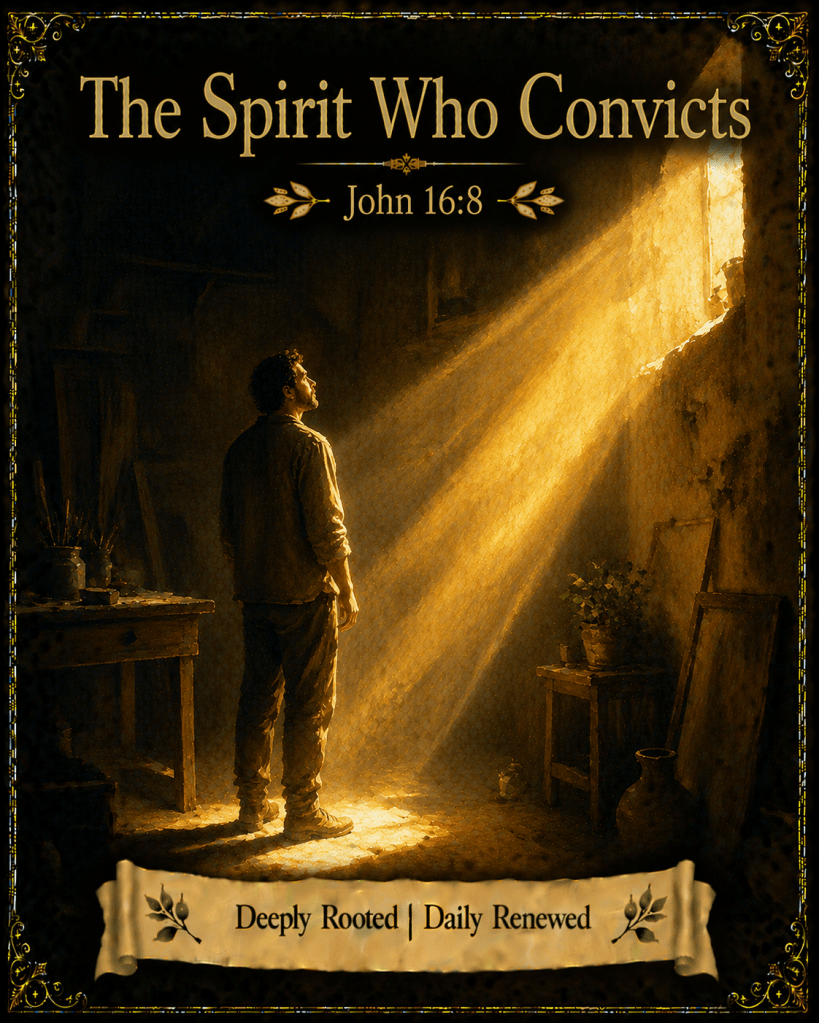
  • Monday, August 17, 2026–Wind and Fire — The Holy Spirit: The Spirit Who Convicts

    KEY VERSE

    “When he comes, he will prove the world to be in the wrong about sin and righteousness and judgment.”

    — John 16:8


    ROOTED TRUTH

    Conviction from the Holy Spirit is not condemnation. It is one of the most loving things God does — shining a light on what is wrong so that what is right can be restored.


    FAITH STORY

    The word convict sounds harsh to modern ears.

    We live in a culture that is deeply allergic to the idea that anything we do might be genuinely wrong — that someone or something outside ourselves has the right to name our behavior as sin and call us to change. The word convict sounds like accusation, like judgment, like the removal of autonomy.

    But the conviction of the Holy Spirit is nothing like that. Understanding what it actually is requires understanding who is doing it and why.

    The Spirit who convicts is the same Spirit Jesus described as the Comforter, the Advocate, the one who comes alongside to help. He is not a prosecuting attorney bent on condemning. He is a loving counselor who shines a light on what is wrong in order to make what is right possible.

    The Greek word for convict — elegcho — carries the idea of exposing something to the light so that its true nature becomes visible. Not to humiliate, but to heal. Not to condemn, but to open the door to repentance and restoration.

    Conviction and condemnation feel similar on the surface — both produce discomfort about sin. But they lead in entirely different directions. Condemnation says you are too far gone, there is no way back, you are defined by this. Conviction says this is not who you are meant to be, there is a way back, come.

    When you feel that uncomfortable inner knowing — the awareness that what you are doing or about to do is wrong, the restlessness that won’t let you settle when you have compromised — that is the Holy Spirit at work. Not punishing you. Inviting you.

    The right response to conviction is not self-flagellation or shame spiral. It is the same response David gave in Psalm 51: acknowledge what is true, receive what grace offers, and return to the path.

    The Spirit who convicts is the Spirit who restores. They are the same Person.


    SCRIPTURE FOR DEEPER ROOTS

    John 16:7–11 — The Spirit convicts the world.

    Psalm 51:10–12 — David’s response to conviction.

    2 Corinthians 7:10 — “Godly sorrow brings repentance that leads to salvation and leaves no regret.”


    DAILY PRACTICE

    Ask the Holy Spirit today to search your heart — specifically and honestly. Use David’s prayer from Psalm 139:23–24 as your starting point: search me, God, and know my heart; test me and know my anxious thoughts. See if there is any offensive way in me, and lead me in the way everlasting. Then sit quietly and receive whatever surfaces — not with shame, but with openness. Respond to conviction with repentance, not with self-condemnation.


    DAILY PRAYER

    Holy Spirit, search me. I invite Your light into the corners of my heart that I have kept in shadow. I know there are patterns, attitudes, and choices that You have been nudging me about that I have been ignoring or minimizing. I receive Your conviction today — not as condemnation, but as an invitation. Show me what needs to change. I will not run from the light. Amen.


    DEEP REFLECTION

    1.  What is the practical difference between conviction from the Holy Spirit and condemnation from the enemy? How do you tell them apart in your own experience?

    2.  Is there something the Spirit has been convicting you about that you have been resisting or postponing? What has kept you from responding?

    3.  2 Corinthians 7:10 says godly sorrow leads to repentance that leaves no regret — whereas worldly sorrow leads to death. What distinguishes godly sorrow from the shame spiral that condemnation produces?


    #DeeplyRooted#DailyRenewed Devotions for a Grounded and Growing Faith

  • Sunday, August 16, 2026–Wind and Fire — The Holy Spirit: Who The Holy Spirit Actually Is

    KEY VERSE

    “And I will ask the Father, and he will give you another advocate to help you and be with you forever — the Spirit of truth.”

    — John 14:16–17


    ROOTED TRUTH

    The Holy Spirit is not a force, a feeling, or an experience. He is a Person — the third Person of the Trinity — and He has come to make His home in every believer.


    FAITH STORY

    The Holy Spirit is the most misunderstood member of the Trinity.

    God the Father is easier to grasp — we understand fatherhood, authority, and the idea of a Creator above us. Jesus is tangible — He walked in history, spoke recorded words, lived a story we can read. But the Spirit is harder to picture. He is invisible, His movements are like the wind, and His work is often interior — happening in places that are difficult to see or describe.

    And so the Holy Spirit is often either over-emphasized in ways that become strange and unbiblical, or under-emphasized in ways that leave believers functionally operating without the very power Jesus said He was sending.

    Jesus called Him another advocate — the Greek word is parakletos, which means one called alongside to help. Comforter, counselor, helper, advocate — the translations vary because the word is rich enough to require all of them. The Spirit is not a vague spiritual energy. He is a Person who comes alongside, stays close, speaks, leads, convicts, comforts, and prays.

    Jesus told His disciples it was actually to their advantage that He was going away — because if He left, He would send the Spirit, and the Spirit would not simply be with them as Jesus had been, but in them. The presence of the Spirit in a believer is more intimate than the physical presence of Jesus walking beside them on the road.

    He is in you. Right now. In this moment, in this season, in this struggle — the Spirit of God has taken up residence in the person who has trusted Christ. Not visiting. Not occasionally available. Dwelling.

    This week we will explore what He does — how He convicts, comforts, guides, empowers, and prays. But it begins here: He is a Person, not a power. And He is present — closer than your next breath.

    Everything that follows this week flows from that.


    SCRIPTURE FOR DEEPER ROOTS

    John 14:15–26 — Jesus promises the Holy Spirit.

    1 Corinthians 6:19 — “Do you not know that your bodies are temples of the Holy Spirit, who is in you?”

    Romans 8:9 — “If anyone does not have the Spirit of Christ, they do not belong to Christ.”


    DAILY PRACTICE

    Spend time today simply acknowledging the presence of the Holy Spirit — not asking for anything yet, just recognizing that He is here. Pray something like: Holy Spirit, I acknowledge You. You are not a force or a feeling — You are a Person, and You are present with me right now. I want to be more aware of You this week. Teach me who You are. Then carry that awareness through your day, practicing the consciousness that you are never alone.


    DAILY PRAYER

    Holy Spirit, I confess that I have treated You more like an occasional experience than a constant presence. I have grieved You with inattention and sometimes with outright disobedience. Today I want to begin again — to recognize You as the Person You are, present within me, here to help me in every moment of this day. Make me more aware of You. I am listening. Amen.


    DEEP REFLECTION

    1.  Jesus said it was to the disciples’ advantage that He was leaving so the Spirit could come. In what way is the indwelling Spirit actually a greater gift than the physical presence of Jesus walking beside us — and do you actually experience it that way?

    2.  The Holy Spirit is described as another advocate — a Person called alongside to help. How does understanding the Spirit as a Person rather than a force change the way you relate to Him?

    3.  Paul says our bodies are temples of the Holy Spirit. How seriously do you take that reality — and what would change about your daily choices if you held it more consistently in view?


    #DeeplyRooted#DailyRenewed Devotions for a Grounded and Growing Faith