
KEY VERSE
“It does not delight in evil but rejoices with the truth. It keeps no record of wrongs.”
— 1 Corinthians 13:5b–6
ROOTED TRUTH
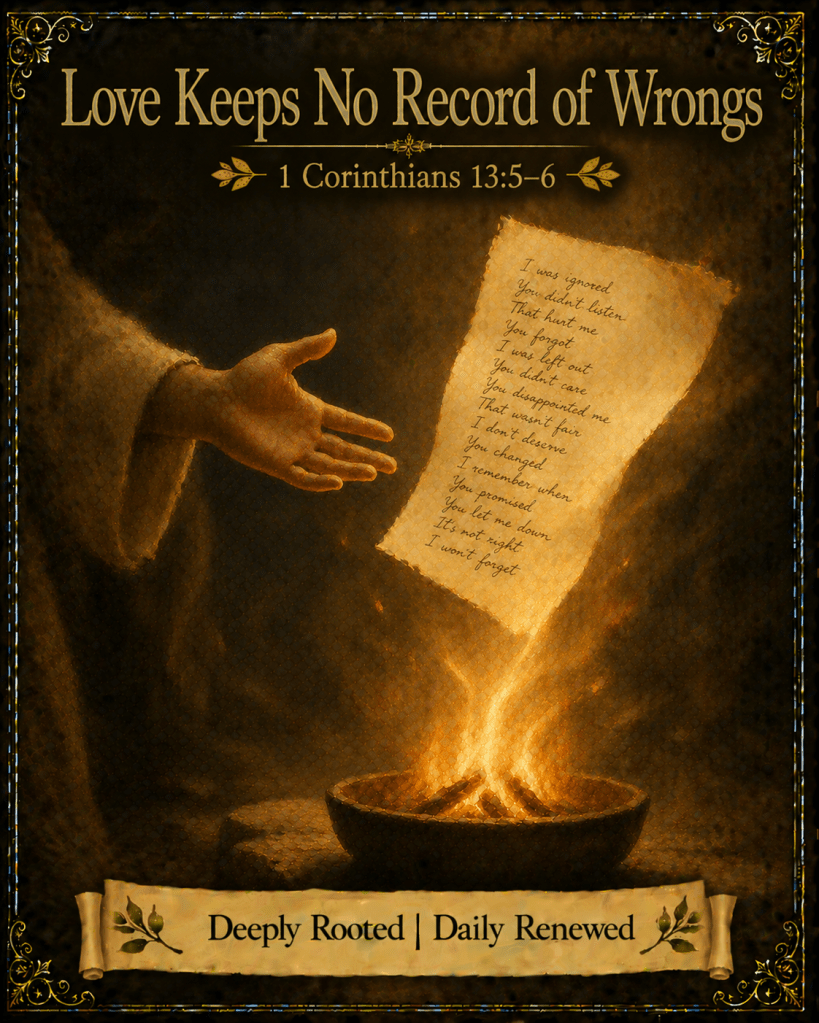
Keeping a record of wrongs is the quiet practice that slowly turns a relationship into a courtroom. Love tears up the record — not because the wrongs weren’t real, but because grace is greater.
FAITH STORY
The phrase keeps no record of wrongs is one of the most striking in the entire chapter.
The Greek word for record is a bookkeeping term — it refers to the practice of logging entries in an account. Paul is describing a very human tendency: the mental ledger we maintain of every offense, slight, failure, and disappointment we have experienced from another person. The running total that we consult when deciding how much trust to extend, how much grace to offer, how much warmth to show.
We are remarkably accurate record-keepers of what others have done to us. We remember the exact words. We remember the context. We remember how many times. And we pull the record out, consciously or not, in moments of conflict — as evidence, as leverage, as self-protection.
Love, Paul says, does not do this. Not because love is naive or has no memory. But because love has chosen to release the debt rather than maintain the account.
This is one of the most counter-intuitive and difficult aspects of love, because keeping the record feels wise. It feels like prudence, like appropriate self-protection, like reasonable caution in a world where people repeat their patterns.
But the record always costs more than it protects. It keeps the wound alive. It prevents genuine reconciliation. It makes every present interaction carry the weight of every past failure. And it is the opposite of how God has treated us — who removed our transgressions as far as the east is from the west, who remembers our sins no more.
Forgiveness does not mean pretending the wrong didn’t happen or removing all consequences. It means closing the account. Tearing up the ledger. Choosing not to reach for it the next time conflict arises.
Is there a record you have been keeping? Love is asking you to put down the pen.
SCRIPTURE FOR DEEPER ROOTS
Psalm 103:12 — “As far as the east is from the west, so far has he removed our transgressions from us.”
Ephesians 4:32 — “Forgive each other, just as in Christ God forgave you.”
Colossians 3:13 — “Bear with each other and forgive one another if any of you has a grievance against someone.”
DAILY PRACTICE
Is there a relationship in which you are actively keeping a record — mentally cataloguing offenses, returning to past failures in present conflicts, holding a ledger of wrongs? Name the relationship and name the record. Then pray a specific prayer of release: I choose to close this account. I am not holding this against them any longer. If necessary, make a practical decision — delete the mental note, stop bringing up the past issue — that puts action behind the prayer.
DAILY PRAYER
Father, I am an accurate record-keeper of what others have done to me. I hold onto offenses longer than I should and reach for the ledger in moments of conflict. You have removed my sins as far as the east is from the west — and I want to extend that same grace. Give me the courage to close the account. Help me forgive as I have been forgiven — completely, without taking it back. Amen.
DEEP REFLECTION
1. Paul uses a bookkeeping term — love doesn’t log wrongs in an account. Do you have a mental ledger on someone in your life right now? What does keeping that record cost you — and cost the relationship?
2. Closing the account doesn’t mean pretending the wrong didn’t happen. What is the difference between genuine forgiveness and the kind of denial that pretends hurt away?
3. God’s forgiveness of us is described as remembering our sins no more. That is the standard love sets. How does the depth of your own experience of being forgiven affect your capacity to forgive others — and is there a connection between the two that you need to explore?
#DeeplyRooted#DailyRenewed Devotions for a Grounded and Growing Faith


Leave a Reply