Category: Uncategorized

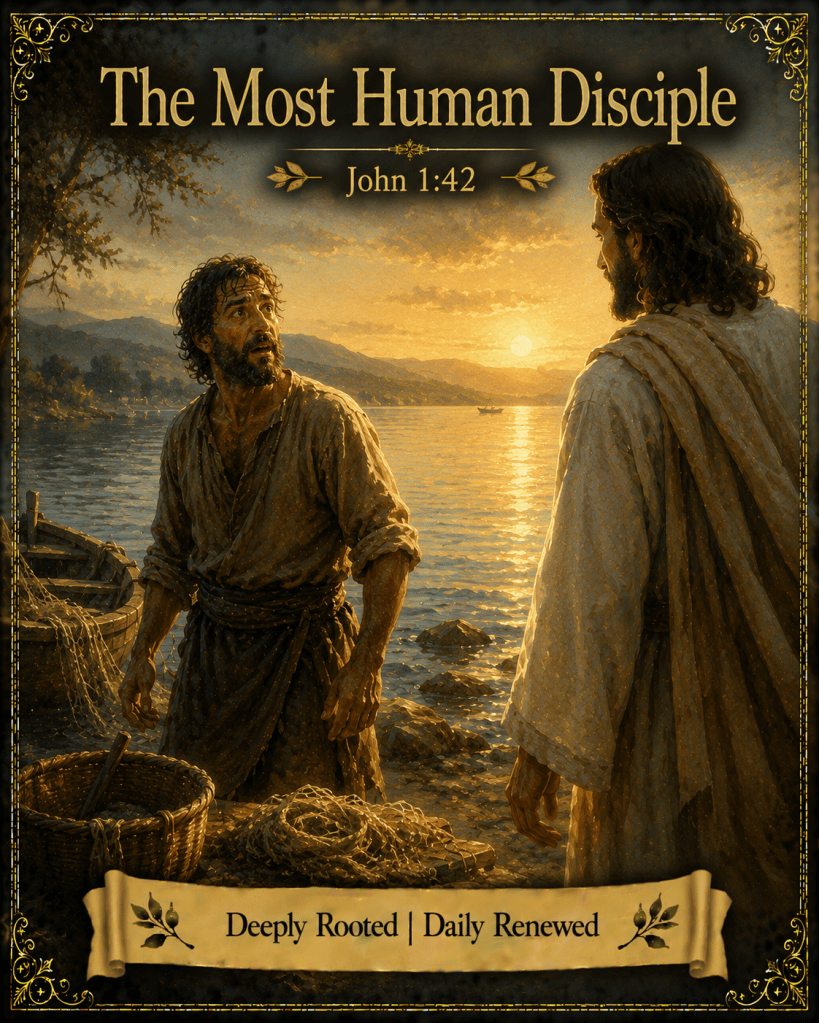
  • Sunday, July 26, 2026–From Fisherman to Rock — The Life of Peter: The Most Human Disciple

    KEY VERSE

    “And he brought him to Jesus. Jesus looked at him and said, ‘You are Simon son of John. You will be called Cephas’ (which, when translated, is Peter).”

    — John 1:42


    ROOTED TRUTH

    Jesus looked at Simon — impulsive, unpolished, unsteady — and saw Peter. He always sees not just who we are, but who we are becoming.


    FAITH STORY

    Simon Peter is the most fully drawn disciple in all four Gospels.

    He is also the most human. He speaks when he should be quiet and goes quiet when he should speak. He walks on water and sinks in it. He makes the greatest confession of faith in the Gospels and earns the sharpest rebuke Jesus ever gave a disciple — in the same conversation. He promises he will never deny Jesus and denies him three times before morning.

    He is, in short, recognizable. Which is exactly why his story has resonated with followers of Jesus for two thousand years.

    When Andrew brought his brother Simon to Jesus for the first time, Jesus looked at him and immediately gave him a new name. You are Simon. You will be called Cephas — Peter — the rock. It was a declaration about a future that had not yet arrived, spoken over a man whose present was anything but rock-like.

    Jesus named him for what he would become, not what he currently was. He saw through the impulsiveness, the instability, the spectacular failures that were still ahead — and He spoke the destination.

    That is how Jesus sees people. Not only as they are, but as they will be when His work in them is complete. Not only Simon, but Peter. Not only what the past has made you, but what grace is making you.

    This week we will walk through the defining moments of Peter’s life — from the fishing boat to the Pentecost sermon, from the confession on the road to the denial in the courtyard, from the beach at dawn to the early church in Jerusalem.

    In every scene, the same pattern emerges: a man who kept failing, kept returning, and kept being used — because Jesus never stopped seeing the rock in the fisherman.

    He sees the same in you.


    SCRIPTURE FOR DEEPER ROOTS

    John 1:40–42 — Andrew brings Simon to Jesus.

    Philippians 1:6 — “He who began a good work in you will carry it on to completion.”

    Isaiah 43:1 — “I have called you by name; you are mine.”


    DAILY PRACTICE

    Reflect on the name Jesus gave Simon before he had done anything to earn it — Peter, the rock — spoken over a man who was anything but steady. Ask God today: what name are You speaking over me? What are You seeing in me that I cannot yet see in myself? Spend time in prayer simply receiving how God sees you — not based on your track record, but based on His redemptive vision for who you are becoming.


    DAILY PRAYER

    Lord, You looked at Simon and saw Peter. You see past my failures, my inconsistencies, and my unfinished edges to the person You are making me. I want to see myself the way You see me — not through the lens of my worst moments, but through the lens of Your ongoing work. Speak Your name over me today. I am listening. Amen.


    DEEP REFLECTION

    1.  Jesus gave Simon a new name — Peter — before he had done anything to earn it. What does it tell you about how God works that He names us for our destination rather than our current condition?

    2.  Peter is the most human disciple — bold and broken, faithful and fearful, often in the same chapter. How does his very human story make Jesus’ investment in him more encouraging to you personally?

    3.  Which aspect of Peter’s story are you most curious or challenged by going into this week — the boldness, the failures, the restoration, or the fruitfulness that followed?


    #DeeplyRooted#DailyRenewed Devotions for a Grounded and Growing Faith

  • Saturday, July 25, 2026–Unshakeable — The Life of Daniel: Trusting God With The Future

    KEY VERSE

    “Those who are wise will shine like the brightness of the heavens, and those who lead many to righteousness, like the stars for ever and ever.”

    — Daniel 12:3


    ROOTED TRUTH

    Daniel’s visions were not given so he could map the future with certainty. They were given so he could trust the God who holds it.


    FAITH STORY

    The second half of Daniel is filled with visions — sweeping, symbolic, sometimes terrifying images of kingdoms rising and falling, of cosmic warfare, of the end of ages.

    Daniel was troubled by them. More than once the visions left him physically exhausted, pale, overwhelmed. He did not understand everything he was shown. He asked questions that were not fully answered. He was told to seal up the scroll — that the words were closed and sealed until the time of the end.

    And yet Daniel remained faithful. He served. He prayed. He continued in the calling God had given him, even while carrying visions of things he could not fully comprehend.

    This is a word for every believer who has prayed for clarity about the future and received silence, or partial answers, or images too complex to decode. We live, as Daniel did, between the revelation and the fulfillment. We have been shown enough to trust — but not everything. Enough to hope — but not the full picture.

    The closing promise of Daniel’s book is not a detailed timeline. It is a word about character and consequence: those who are wise will shine like the brightness of the heavens. Those who lead many to righteousness, like the stars for ever and ever.

    Daniel had no certainty about when the things he saw would occur. He had complete certainty about this: faithfulness matters forever. The wise — those who walk in the fear of God — will shine. Those who turn others toward righteousness will shine like stars.

    That is the conclusion of Daniel’s life and the conclusion of this week. Not a map of the future, but a call to faithfulness in the present. Not a guarantee of comfort or clarity, but a promise that what is done in faithfulness to God outlasts everything else.

    Be unshakeable. Shine. Lead others toward righteousness.

    The stars are waiting for your name.


    SCRIPTURE FOR DEEPER ROOTS

    Daniel 12:1–4 — The end times and the promise to the wise.

    Matthew 13:43 — “The righteous will shine like the sun in the kingdom of their Father.”

    Proverbs 4:18 — “The path of the righteous is like the morning sun, shining ever brighter till the full light of day.”


    DAILY PRACTICE

    As you close this week with Daniel, reflect on the arc of his entire life — from a teenage captive who resolved not to defile himself to an old man whose faithfulness had outlasted four empires. Ask God: what is the one thing from Daniel’s life this week that He most wants to embed in yours? Write it down. Then write Daniel 12:3 beside it as a promise — the faithfulness you invest now is building something that will shine forever.


    DAILY PRAYER

    Father, I don’t need to understand everything about the future to be faithful in the present. Daniel didn’t either. Give me his long view — the vision that sees beyond the current empire, the current pressure, the current confusion — to the eternal reality that faithfulness shines like stars forever. Let me be unshakeable not because I have all the answers, but because I know the One who does. Amen.


    DEEP REFLECTION

    1.  Daniel received visions he didn’t fully understand and was told some things were sealed until later. How do you hold the tension between wanting clarity about the future and trusting a God who gives you enough — but not everything?

    2.  The closing promise is about wisdom and leading others to righteousness — not about power, comfort, or success. How does that redefine what a successful life looks like in God’s economy?

    3.  Looking back over the entire week with Daniel — the quiet resolution, excellence in Babylon, the impossible dream, the fiery furnace, the writing on the wall, the lions’ den, and trusting God with the future — which moment of Daniel’s story has most spoken to where you are right now, and what will you carry forward?


    #DeeplyRooted#DailyRenewed Devotions for a Grounded and Growing Faith
  • Friday, July 24, 2026–Unshakeable — The Life of Daniel: Threatened But Unshakeable

    KEY VERSE

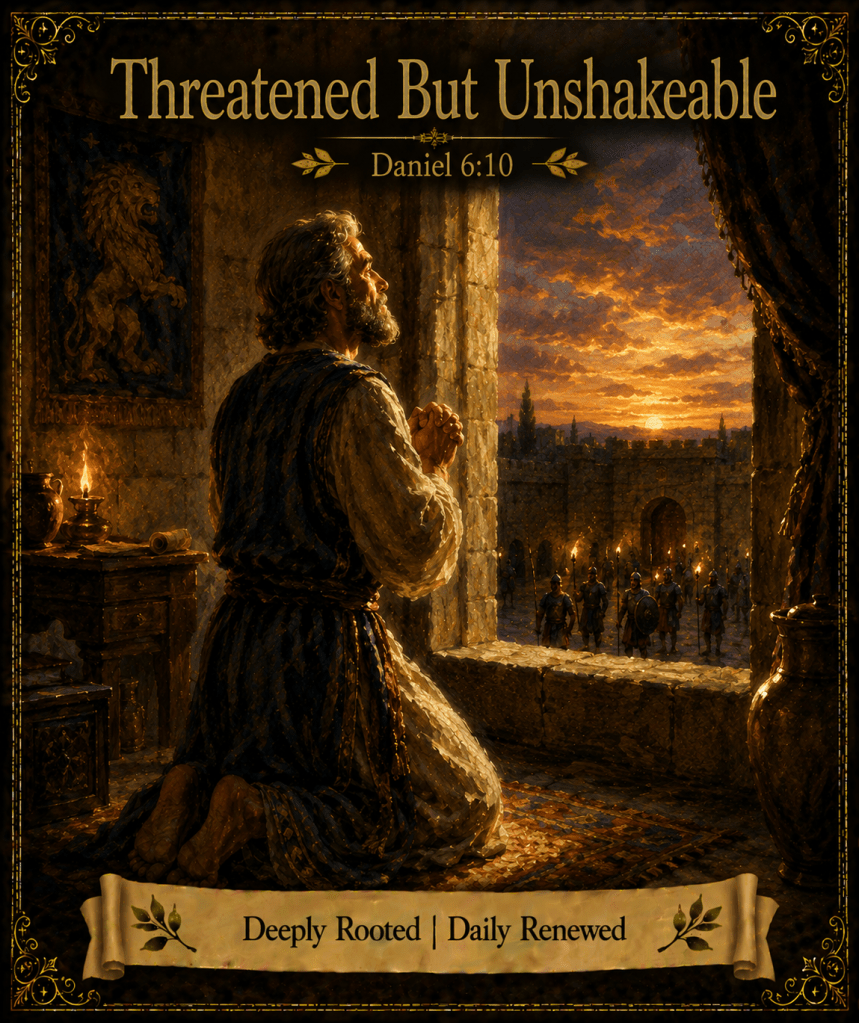
    “Now when Daniel learned that the decree had been published, he went home to his upstairs room where the windows opened toward Jerusalem. Three times a day he got down on his knees and prayed, giving thanks to his God, just as he had done before.”

    — Daniel 6:10


    ROOTED TRUTH

    Daniel did not pray because the lions were coming. He prayed because prayer was already who he was — and the threat changed nothing about that.


    FAITH STORY

    The administrators and satraps who wanted Daniel removed could find no corruption in him.

    He was so faithful, so excellent, so free of corruption that his enemies had to create a trap specifically designed around his faithfulness. They persuaded King Darius to issue a decree: anyone who prays to any god or human other than the king for the next thirty days will be thrown into the lions’ den.

    They knew Daniel would not stop praying. That was the entire strategy.

    And Daniel’s response to the decree is the most quietly powerful verse in the entire book. He went home. He opened his windows toward Jerusalem — as he had always done. He knelt down — as he had always done. He prayed and gave thanks — as he had always done.

    Three times a day. Just as he had done before.

    He did not pray defiantly to make a point. He did not organize a protest. He did not petition the king for an exception. He simply continued the practice that had defined his entire life in Babylon — the same practice, in the same posture, toward the same God — as if the decree did not exist.

    Because for Daniel, the decree was less real than the God he was kneeling before.

    This is what decades of private faithfulness produces. A man so rooted in prayer that a death threat could not interrupt it. Not because he was unafraid — the text doesn’t say that. But because the habit of prayer was deeper than the threat of the lions.

    The lions’ den awaited. Daniel knelt anyway.

    And when the morning came, the king ran to the den and called out: Daniel, servant of the living God, has your God been able to rescue you? And Daniel answered from inside: My God sent his angel, and he shut the mouths of the lions.


    SCRIPTURE FOR DEEPER ROOTS

    Daniel 6:1–28 — Daniel in the lions’ den.

    Philippians 4:6–7 — “Do not be anxious about anything, but in every situation, by prayer and petition, with thanksgiving, present your requests to God.”

    1 Thessalonians 5:17 — “Pray continually.”


    DAILY PRACTICE

    Daniel’s prayer life was so established that a death threat couldn’t interrupt it. Examine your own prayer life honestly today: is it a habit deep enough to survive pressure — or is it something you reach for mainly in crisis? Commit to one specific, daily prayer practice this week — a time, a posture, a place — and begin it today. Not to perform Daniel’s faithfulness, but to build the kind of roots that hold when the threats come.


    DAILY PRAYER

    Father, I want prayer to be so woven into who I am that pressure cannot interrupt it. I confess that my prayer life is often reactive — something I turn to when I need something — rather than the steady, daily practice that Daniel modeled. Build that in me. Give me a prayer life that is deeper than my circumstances, steadier than my moods, and more real than whatever threat stands in front of me today. Amen.


    DEEP REFLECTION

    1.  Daniel prayed just as he had done before — the decree changed nothing about his practice. What does that level of established spiritual habit require to build, and what would it take for your prayer life to reach that kind of depth?

    2.  Daniel’s enemies could find no corruption in him — so they built a trap around his faithfulness. Has your faithfulness ever made you a target? How did you respond?

    3.  The king asked Daniel has your God been able to rescue you — and Daniel answered from inside the den. When others observe your life under pressure, what does your response reveal about the God you serve?


    #DeeplyRooted#DailyRenewed Devotions for a Grounded and Growing Faith

  • Thursday, July 23, 2026–Unshakeable — The Life of Daniel: Integrity When No One Is Watching

    KEY VERSE

    “But you, Belshazzar, his son, have not humbled yourself, though you knew all this. Instead, you have set yourself up against the Lord of heaven.”

    — Daniel 5:22–23


    ROOTED TRUTH

    The writing on the wall was not a surprise attack. It was the public accounting of a private life that had long refused to honor God.


    FAITH STORY

    Belshazzar threw a party for a thousand of his nobles and drank wine from the sacred vessels stolen from the temple in Jerusalem.

    In the middle of the banquet, a human hand appeared and wrote on the wall: Mene, Mene, Tekel, Parsin. The king’s face went pale. His knees knocked together. He called for his wise men, and none of them could interpret the writing.

    The queen remembered Daniel. He was brought in — an old man now, decades removed from his early years in the court — and he declined the king’s offered rewards before delivering one of the most unflinching messages in the Old Testament.

    He reminded Belshazzar of his father Nebuchadnezzar — how God had humbled him, how he had learned that the Most High God is sovereign over all kingdoms. And then Daniel said the words that cut to the heart: but you, Belshazzar, his son, have not humbled yourself, though you knew all this.

    You knew. And you chose differently anyway.

    The writing was an accounting: Mene — numbered, Tekel — weighed and found wanting, Parsin — divided. That night Belshazzar was killed.

    Daniel’s integrity stands in sharp contrast throughout this chapter. He was offered gifts he didn’t need. He spoke truth a king didn’t want to hear. He had no interest in the rewards or the approval of the powerful — only in faithfulness to what God had given him to say.

    Integrity is not primarily about public behavior. It is about the private choices that accumulate over time into a character that either honors God or doesn’t. Belshazzar knew the story of Nebuchadnezzar. He knew what God had done. He chose to ignore it.

    What we know and choose to ignore is always the most dangerous territory.


    SCRIPTURE FOR DEEPER ROOTS

    Daniel 5:1–31 — The writing on the wall.

    Luke 12:2–3 — “There is nothing concealed that will not be disclosed, or hidden that will not be made known.”

    Proverbs 11:3 — “The integrity of the upright guides them, but the unfaithful are destroyed by their duplicity.”


    DAILY PRACTICE

    Daniel’s integrity meant he spoke the same truth to a powerful king that he would have spoken to anyone else — without softening it for the audience. Is there a truth you know — about your own life, about a situation, about what God is calling you to — that you have been choosing to ignore because it is inconvenient? Like Belshazzar, you knew. Bring that truth honestly to God today and ask for the courage to respond to what you already know.


    DAILY PRAYER

    Father, I do not want to be someone who knows and ignores. There is truth You have shown me — about areas of my life, about choices I am making, about what You are asking of me — that I have been setting aside because it is uncomfortable. I bring it to You now. Give me Daniel’s integrity — to honor what I know, to speak what is true, and to refuse the rewards that come from telling people what they want to hear. Amen.


    DEEP REFLECTION

    1.  Daniel’s charge to Belshazzar was you knew all this and still did not humble yourself. Is there a truth about your own life or calling that you already know but have been choosing not to act on?

    2.  Daniel declined the king’s gifts before delivering the message — so that his words could not be purchased or influenced by reward. How does the desire for approval, security, or reward affect your own willingness to speak or live truthfully?

    3.  The writing on the wall was the public accounting of a private pattern. How does the truth that nothing is hidden from God — that private choices have public consequences — shape the way you live in the unseen moments?


    #DeeplyRooted#DailyRenewed Devotions for a Grounded and Growing Faith
  • Wednesday, July 22, 2026–Unshakeable — The Life of Daniel: When God Joins You In The Fire

    KEY VERSE

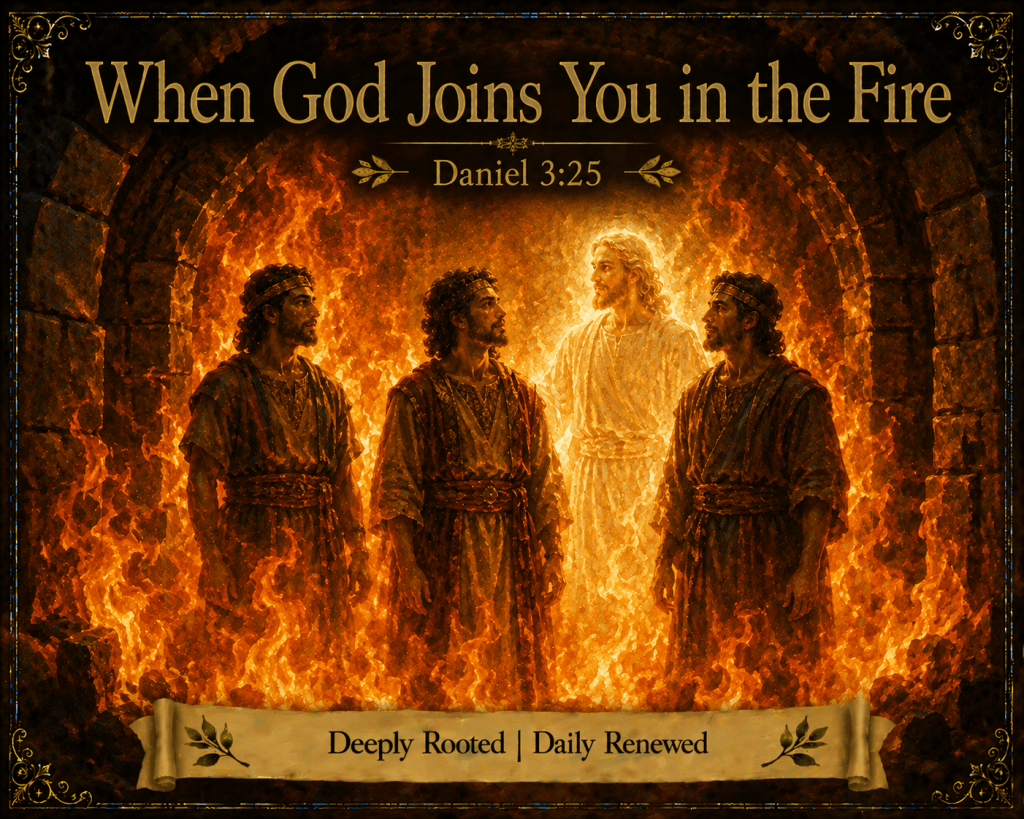
    “He said, ‘Look! I see four men walking around in the fire, unbound and unharmed, and the fourth looks like a son of the gods.’”

    — Daniel 3:25


    ROOTED TRUTH

    God did not promise Shadrach, Meshach, and Abednego that they would not go into the fire. He promised them something better — that they would not go through it alone.


    FAITH STORY

    Nebuchadnezzar built a gold statue ninety feet tall and commanded everyone to bow when the music played.

    Shadrach, Meshach, and Abednego refused. Someone reported them. They were brought before the furious king who gave them one more chance: bow, or be thrown into a furnace heated seven times hotter than normal.

    Their response is one of the most extraordinary statements of faith in all of Scripture. King Nebuchadnezzar, we do not need to defend ourselves before you. If we are thrown into the blazing furnace, the God we serve is able to deliver us from it, and he will deliver us. But even if he does not, we want you to know, Your Majesty, that we will not serve your gods.

    Even if he does not. They were not claiming a guaranteed outcome. They were not operating on the prosperity gospel’s promise that faith always produces deliverance on our timeline. They were declaring that their allegiance to God was not conditional on His performance.

    They were thrown in. The soldiers who threw them in were killed by the heat. And Nebuchadnezzar, peering into the furnace, saw something that stopped him cold: four men walking around in the fire, unbound, unharmed — and the fourth looks like a son of the gods.

    God did not keep them out of the fire. He got in with them.

    That is the promise that runs through the entire Bible. Not that following God exempts you from the furnace — but that you will never go through it alone. Emmanuel, God with us, is most powerfully present in the places we most desperately need Him.

    What furnace are you in right now? Look more carefully. You may not be as alone in it as you think.


    SCRIPTURE FOR DEEPER ROOTS

    Daniel 3:1–30 — The fiery furnace.

    Isaiah 43:2 — “When you walk through the fire, you will not be burned; the flames will not set you ablaze.”

    Matthew 28:20 — “And surely I am with you always, to the very end of the age.”


    DAILY PRACTICE

    Shadrach, Meshach, and Abednego declared their faith even with a but even if he does not. This is the hardest kind of faith — trust that is not conditional on the outcome. Is there a furnace in your life where you have been waiting for God to get you out rather than trusting Him with you in it? Write out your own but even if statement about that situation — declaring your trust in God regardless of the outcome — and bring it to Him in prayer today.


    DAILY PRAYER

    Father, I want the faith of Shadrach, Meshach, and Abednego — the kind that says You are able, and that trusts You even when the deliverance doesn’t come the way I expected. I am in a fire right now — or I have been, or I will be. Remind me that You do not keep me out of hard things. You get into them with me. Open my eyes to see the fourth figure in my furnace. Amen.


    DEEP REFLECTION

    1.  The three men said but even if he does not — acknowledging that God might not deliver them in the way they hoped while still refusing to bow. What does that level of unconditional trust require, and where does it come from?

    2.  God did not prevent the furnace — He entered it. How does that truth change the way you pray about the hard situations in your life? Does it shift the prayer from take me out to be with me in it?

    3.  Nebuchadnezzar saw a fourth figure in the fire and was astonished. Has there been a furnace season in your life where, looking back, you could see evidence that God was present in it even when it didn’t feel that way at the time?


    #DeeplyRooted#DailyRenewed Devotions for a Grounded and Growing Faith

  • Tuesday, July 21, 2026–Unshakeable — The Life of Daniel: God Of The Impossible

    KEY VERSE

    “Daniel replied, ‘No wise man, enchanter, magician or diviner can explain to the king the mystery he has asked about, but there is a God in heaven who reveals mysteries.’”

    — Daniel 2:27–28


    ROOTED TRUTH

    When every human resource has been exhausted and every expert has admitted defeat, the God who reveals mysteries is just getting started.


    FAITH STORY

    King Nebuchadnezzar had a dream that disturbed him deeply — and then forgot what it was.

    He summoned every wise man, magician, enchanter, and astrologer in Babylon and gave them an impossible demand: tell me what I dreamed, and then tell me what it means. If you can’t tell me the dream itself, I will know your interpretations are worthless. And if you fail, you will all be cut to pieces.

    The wise men were stunned. No human being could do what the king was asking. No one can reveal it to the king except the gods, they said, and they do not live among humans.

    The death warrant went out for all the wise men of Babylon — which included Daniel and his friends.

    Daniel’s response is instructive. He did not panic. He asked for time. He went home and asked his friends to pray — to seek mercy from the God of heaven concerning this mystery. And that night, God revealed the mystery to Daniel in a vision.

    Before he went to the king, Daniel stopped to praise God. Not to rehearse his strategy. Not to prepare his presentation. He praised the God who gives wisdom to the wise and reveals deep and hidden things, who knows what lies in darkness, and with whom light dwells.

    Then he went to Nebuchadnezzar with the dream, the interpretation, and a very clear word: there is a God in heaven who reveals mysteries. Not I have solved your problem. Not my skill has delivered you. There is a God.

    Daniel used his moment of extraordinary access and influence to point to something beyond himself.

    When God gives you the answer everyone else has been unable to find, the temptation is to take the credit. Daniel shows us the better way: give it back to the One who gave it.


    SCRIPTURE FOR DEEPER ROOTS

    Daniel 2:1–49 — Nebuchadnezzar’s dream and Daniel’s interpretation.

    James 1:5 — “If any of you lacks wisdom, you should ask God, who gives generously to all.”

    Proverbs 3:5–6 — “Trust in the LORD with all your heart and lean not on your own understanding.”


    DAILY PRACTICE

    Is there a situation in your life right now where every human resource has been tried and every expert has admitted defeat — where you are facing something that genuinely feels impossible? Follow Daniel’s pattern today: gather people to pray with you specifically, seek God for the mystery you cannot solve on your own, and commit to giving Him the credit when the answer comes. Name the impossible situation and bring it to God by name in prayer.


    DAILY PRAYER

    Father, there is a God in heaven who reveals mysteries — and that God is You. I bring You the situations in my life that are beyond my wisdom, my resources, and my ability to solve. I am not asking You to make me smarter. I am asking You to reveal what only You can reveal. And when You do, let me be like Daniel — pointing everyone back to You rather than taking the credit for myself. Amen.


    DEEP REFLECTION

    1.  Daniel’s first response to an impossible deadline was to go home and pray with friends. What does that instinct reveal about where he believed the real resource was — and how does that compare to your own first instinct when facing an impossible situation?

    2.  Before Daniel went to the king with the answer, he spent time praising God. Why is that order — praise before presentation — spiritually significant, and what does skipping it cost us?

    3.  Daniel’s explanation to the king began with there is a God in heaven, not I have the answer. When God gives you wisdom, insight, or ability that others notice, how do you handle the credit — and what would Daniel’s example look like in your context?


    #DeeplyRooted#DailyRenewed Devotions for a Grounded and Growing Faith

  • Monday, July 20, 2026–Unshakeable — The Life of Daniel: Faithful In A Foreign Land

    KEY VERSE

    “To these four young men God gave knowledge and understanding of all kinds of literature and learning. And Daniel could understand visions and dreams of all kinds.”

    — Daniel 1:17


    ROOTED TRUTH

    Faithfulness to God in a culture that does not share your values does not require withdrawal from that culture. It requires rootedness deep enough that the culture cannot reshape what matters most.


    FAITH STORY

    Daniel did not retreat from Babylon. He excelled in it.

    After his quiet resolution about the food, Daniel and his three friends — Shadrach, Meshach, and Abednego — were found to be ten times better than all the magicians and enchanters in the kingdom at the end of their training. They did not boycott the king’s educational system. They did not refuse to learn. They engaged fully — and God gave them wisdom and understanding that surpassed everyone around them.

    This is one of the most important and often overlooked aspects of Daniel’s story. His faithfulness was not expressed through disengagement from the culture he was placed in. It was expressed through excellence within it, rooted in an integrity that the culture could not touch.

    Daniel served four different kings across decades — Nebuchadnezzar, Belshazzar, Darius the Mede, and Cyrus the Persian. He was a statesman, an advisor, an interpreter of dreams, a bureaucrat at the highest levels of two successive empires. He was, in the fullest sense, engaged with the world around him.

    And through all of it, he remained distinctly himself. Not because he isolated himself from the surrounding culture, but because his roots went deeper than the culture’s reach.

    This is the model for every believer navigating a world that does not share their values. Not withdrawal. Not compromise. Engagement with deep roots. Excellence in the work, integrity in the character, distinctiveness in the convictions.

    You were not placed in your workplace, your neighborhood, your school, or your cultural moment by accident. Like Daniel in Babylon, you are exactly where God has positioned you.

    Be excellent. Stay rooted. Let the two work together.


    SCRIPTURE FOR DEEPER ROOTS

    Daniel 1:17–20 — God blesses Daniel and his friends with wisdom.

    Matthew 5:13–14 — “You are the salt of the earth…the light of the world.”

    Colossians 3:23 — “Whatever you do, work at it with all your heart, as working for the Lord.”


    DAILY PRACTICE

    Daniel excelled in the culture he was placed in while maintaining his integrity within it. Reflect on your own workplace, neighborhood, or sphere of influence. Are you engaging excellently — bringing your full effort and ability? And are you maintaining what makes you distinctively yourself? Identify one area where you could pursue greater excellence, and one area where your distinctiveness as a follower of Christ needs to be more visible.


    DAILY PRAYER

    Father, like Daniel, I am placed in a culture that does not always share my values. Help me to engage it fully rather than withdrawing from it, and to be excellent in my work rather than merely adequate. Let my faithfulness and my excellence work together — so that the people around me see both what I can do and who I belong to. Amen.


    DEEP REFLECTION

    1.  Daniel was ten times better than his peers in wisdom and understanding — and this was the result of God’s blessing on his faithfulness. How does the connection between integrity and excellence show up in your own experience?

    2.  Daniel served pagan kings faithfully for decades without compromising his faith. What is the difference between serving a system faithfully and being co-opted by it?

    3.  You are placed where you are for a reason. What does Daniel’s example of engaged, excellent, rooted faithfulness look like specifically in the environments where God has placed you right now?


    #DeeplyRooted#DailyRenewed Devotions for a Grounded and Growing Faith
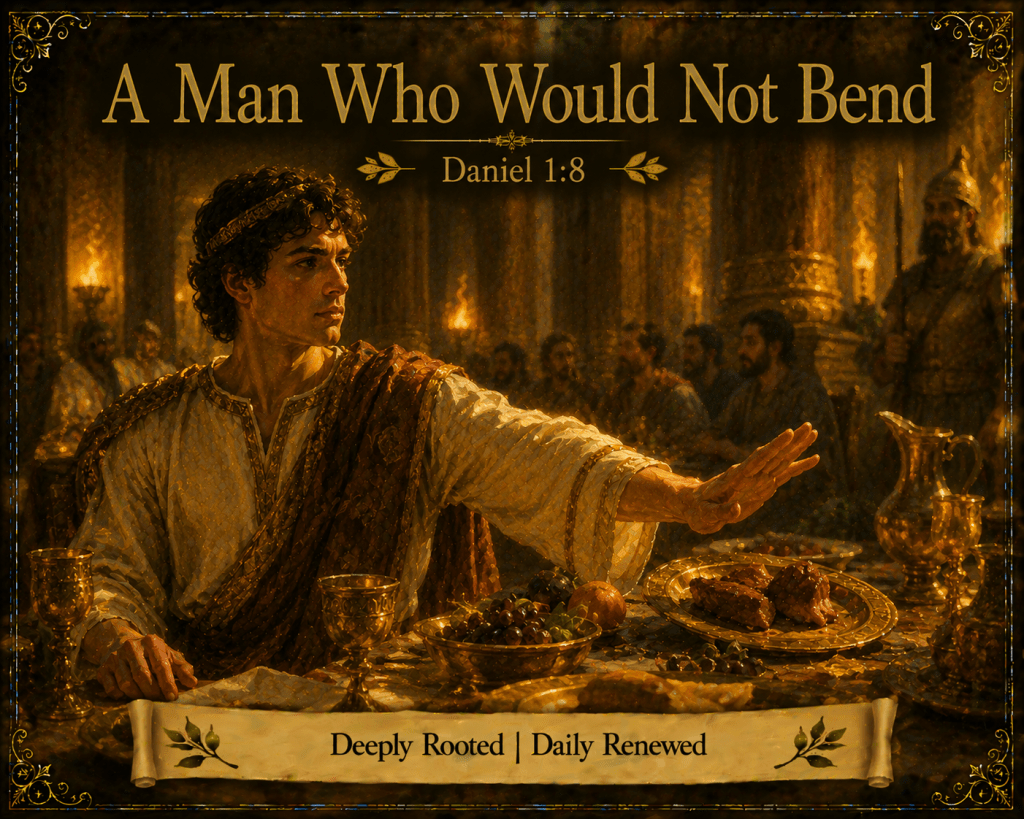
  • Sunday, July 19, 2026–Unshakeable — The Life of Daniel: A Man Who Would Not Bend

    KEY VERSE

    “But Daniel resolved not to defile himself with the royal food and wine, and he asked the chief official for permission not to defile himself this way.”

    — Daniel 1:8


    ROOTED TRUTH

    Daniel’s unshakeable life was not built in the lion’s den or the fiery furnace. It was built in the small, daily decision to resolve — before the crisis — who he was and whose he was.


    FAITH STORY

    Daniel arrived in Babylon as a captive.

    He was young — a teenager by most estimates — stripped from his home, his family, his culture, and his land by the most powerful empire on earth. The Babylonians had a strategy for the best and brightest of the nations they conquered: take them, rename them, educate them, feed them from the royal table, and absorb them into the empire. Assimilation through privilege.

    Daniel was given a new name — Belteshazzar, a name honoring a Babylonian god. He was enrolled in the king’s educational program. He was offered the king’s food and wine. Everything about his environment was designed to gradually reshape who he was.

    And in the middle of all of that, in what might seem like a small moment, Daniel resolved. The Hebrew word is a strong one — he set it upon his heart. Before anyone was watching. Before the stakes were obvious. Before the crisis arrived. He decided.

    He would not defile himself with the royal food.

    This first decision — quiet, private, seemingly small — is the foundation of everything that follows in Daniel’s life. The man who would later walk calmly into a den of lions was the same man who, years earlier, had quietly resolved over a dinner table. The unshakeable faith of the crisis moments was built in the ordinary moments of private conviction.

    Daniel’s story this week will take us from Babylon’s court to a furnace, from a king’s dream to a wall covered in writing, from a den of lions to visions of eternity. In every scene the same man appears — not because he was superhuman, but because he had resolved before each test who he was.

    That is the invitation this week. Not to wait for the lion’s den to decide what you believe — but to resolve now, in the quiet, before the pressure comes.

    Who are you when no one is watching? That is who you will be when everyone is.


    SCRIPTURE FOR DEEPER ROOTS

    Daniel 1:1–21 — Daniel and his friends in Babylon.

    Joshua 24:15 — “But as for me and my household, we will serve the LORD.”

    Romans 12:2 — “Do not conform to the pattern of this world, but be transformed by the renewing of your mind.”


    DAILY PRACTICE

    Identify one area of your life where cultural pressure is gradually shaping you in a direction away from God — a slow drift rather than a dramatic fall. It may be in what you consume, what you say, how you spend your time, or what you are slowly beginning to accept as normal. Like Daniel, resolve now — before the pressure intensifies. Write down your resolution and share it with one trusted person this week.


    DAILY PRAYER

    Father, I want to be a person who has resolved before the crisis comes. So much of my spiritual stability depends on decisions I make in ordinary, unobserved moments. Give me Daniel’s quiet courage — not the dramatic kind that shows up for the lion’s den, but the daily kind that holds the line over a dinner table. Let me be the same person in private that I want to be in public. Amen.


    DEEP REFLECTION

    1.  Daniel’s most important decision in the book was not the lion’s den — it was a quiet resolution over food in chapter 1. What does that tell you about where character is actually formed?

    2.  The Babylonians used privilege and comfort — the king’s food, the king’s education, even a new name — as tools of cultural assimilation. What are the equivalents in your own cultural moment that most subtly reshape identity?

    3.  Daniel resolved who he was before the pressure arrived. Is there an area of your life where you need to make that resolution now — before the test comes — rather than trying to decide in the middle of it?


    #DeeplyRooted#DailyRenewed Devotions for a Grounded and Growing Faith
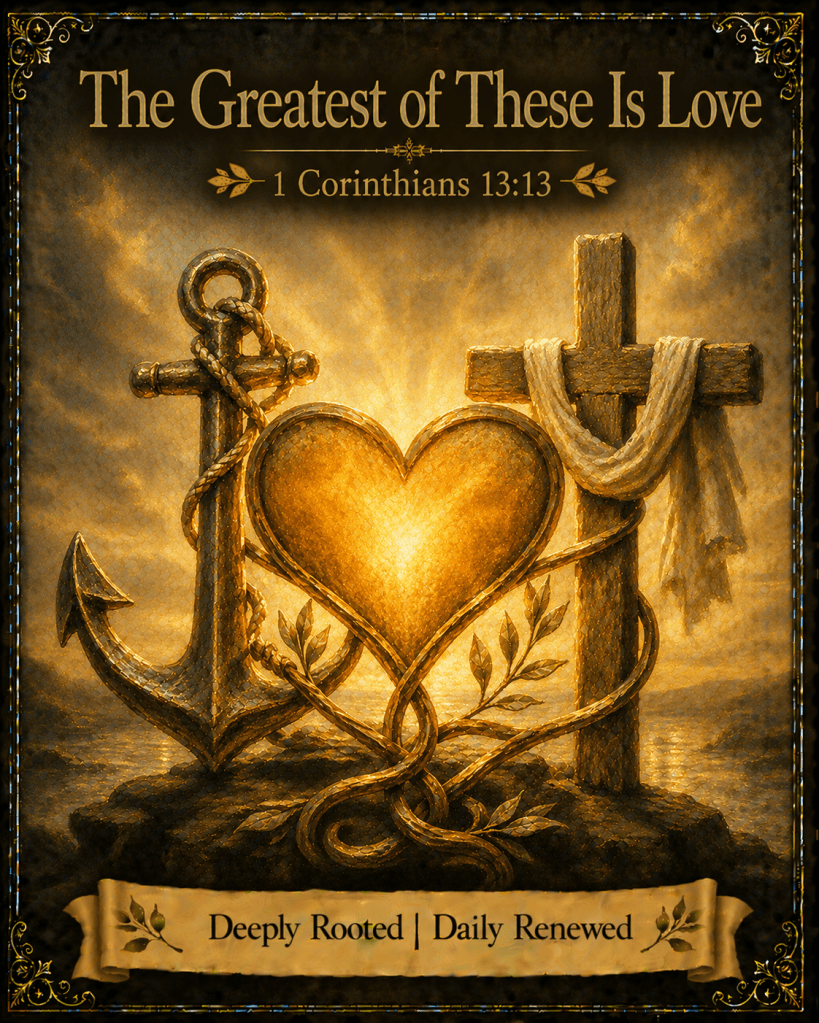
  • Saturday, July 18, 2026–The Most Excellent Way — 1 Corinthians 13: The Greatest Of These

    KEY VERSE

    “And now these three remain: faith, hope and love. But the greatest of these is love.”

    — 1 Corinthians 13:13


    ROOTED TRUTH

    Faith will one day become sight. Hope will one day become possession. Only love will remain exactly what it always was — because love is the nature of the God in whose presence we will live forever.


    FAITH STORY

    Paul closes the chapter with one of the most quietly stunning sentences in all of Scripture.

    And now these three remain: faith, hope and love. But the greatest of these is love.

    Faith, hope, and love — the triad that has come to define the essential shape of the Christian life. Faith that trusts what cannot yet be seen. Hope that reaches toward what has not yet arrived. Love that gives itself for the sake of another.

    All three endure through this age. All three are essential. The Christian life is not livable without any one of them. But when Paul says love is the greatest, he is not grading them on usefulness. He is pointing to what they become when this age is over.

    Faith will one day become sight. When we stand in the full presence of God, trust in what we cannot see will be replaced by vision — we will see Him as He is. Faith will have served its magnificent purpose and will be fulfilled in the thing it was always pointing toward.

    Hope will one day become arrival. The things we have longed for, the restoration we have waited for, the reunion we have ached toward — all of it will have come. Hope will be swallowed up in the having.

    But love — the self-giving, other-oriented, delight-in-the-flourishing-of-another love that we have been studying all week — love will not be transformed into something else when eternity arrives. It will simply continue. Because love is not a provisional grace for an age of partial knowledge. It is the permanent nature of the God who is love, and of the community that lives in Him forever.

    We began this week with Paul’s corrective to a church that had gifts without love. We close with his conclusion: in the end, after the gifts have served their purpose and the partial has given way to the complete — love is what remains.

    Make it what you are known for. Make it what you live for. Make it the thing you pour your best energy into.

    It is the most excellent way. It is the greatest thing. And it will never, ever fail.


    SCRIPTURE FOR DEEPER ROOTS

    1 John 3:14 — “We know that we have passed from death to life, because we love each other.”

    John 15:12 — “My command is this: Love each other as I have loved you.”

    Romans 13:10 — “Love is the fulfillment of the law.”


    DAILY PRACTICE

    As you close this week in 1 Corinthians 13, go back to the practice from Sunday: read the chapter again and substitute your name for love. This time, notice what has shifted — in your understanding, in your conviction, in your desire. Then write a one-paragraph response to God — not a prayer request, but a declaration of what you want love to look like in your life in the week ahead. Be specific. Name the relationships. Name the choices. Commit to the most excellent way.


    DAILY PRAYER

    Father, I have spent a week in the most important chapter in Scripture about what You are — because You are love. I want to be known by it. Not by my gifts, not by my knowledge, not by my achievements — by love. Patient, kind, not envious, not boastful, keeping no record, always protecting, always trusting, always hoping, always persevering, never failing. That is what I want. That is only possible in You. Make it true of me. Amen.


    DEEP REFLECTION

    1.  Faith becomes sight and hope becomes arrival in eternity — but love simply continues. What does the permanent nature of love tell you about why it is the greatest of the three?

    2.  Looking back over the whole week in 1 Corinthians 13 — which quality of love has most convicted you, and which one has most encouraged you about what God is growing in you?

    3.  Paul wrote this chapter to correct a gifted but loveless church. If he were writing to you specifically, which verse do you think he would most want you to sit with — and what would he tell you to do differently as a result?


    #DeeplyRooted#DailyRenewed Devotions for a Grounded and Growing Faith

  • Friday, July 17, 2026–The Most Excellent Way — 1 Corinthians 13: Love Never Fails

    KEY VERSE

    “Love never fails. But where there are prophecies, they will cease; where there are tongues, they will be stilled; where there is knowledge, it will pass away.”

    — 1 Corinthians 13:8


    ROOTED TRUTH

    Every gift is temporary. Every achievement fades. Every human capacity has an expiration date. Love alone will survive into eternity — because love is the nature of the God who is eternal.


    FAITH STORY

    Paul makes a breathtaking claim: love never fails.

    The word fails is the Greek pipto — to fall, to collapse, to come to an end. Love does not fall. It does not collapse. It does not come to an end. It is the one thing in the universe that is not subject to obsolescence.

    Everything else Paul lists will pass away. Prophecies will cease — when the full revelation of God is complete, the partial word will be swallowed up by the whole. Tongues will be stilled. Knowledge — even the deepest and most treasured knowledge — will be surpassed by knowing face to face rather than through a glass darkly.

    Paul is not minimizing gifts. He spent the previous two chapters affirming them. He is simply pointing out that they are tools, designed for this age — and tools have a use-by date. When the building is complete, the scaffolding comes down.

    But love is not scaffolding. Love is the structure itself. Love is the nature of God — and since God is eternal, love is eternal. When we arrive in the fullness of what God is preparing, the gifts will have served their purpose. But love will still be there, because love will always have been the point.

    This is what makes love the highest and most enduring pursuit of the Christian life. Not because it produces the most impressive results in the short term — often the most loving choice produces no visible result at all. But because it is the only thing we practice here that we will also practice there.

    Heaven will not require faith — we will see. It will not require hope — what we hoped for will have arrived. But love — the giving of yourself for another, the delight in the flourishing of the beloved — that will continue forever.

    What you invest in love is the only investment that never depreciates.

    Love never fails. Build your life on it.


    SCRIPTURE FOR DEEPER ROOTS

    1 Corinthians 13:9–12 — We know in part, but then face to face.

    1 John 4:16 — “God is love. Whoever lives in love lives in God, and God in them.”

    Romans 8:38–39 — Nothing can separate us from God’s love.


    DAILY PRACTICE

    Consider what you are most investing your energy and attention in right now. Ask honestly: will this last? Then ask: where is love calling me to invest today — in a way that might produce no visible return but will outlast everything else? Make one investment in love today that no one else will see or measure — a sacrificial act of kindness, a word of encouragement, a prayer for someone who doesn’t know you are praying, a forgiveness extended in private.


    DAILY PRAYER

    Father, I confess that I invest most heavily in things that will not last — in accomplishments, in reputation, in productivity, in things that feel significant in the moment but will not survive into eternity. Reorder my priorities this week. Let love be the thing I spend most freely — because it is the only currency that never devalues. Your love never fails. Let mine reflect Yours. Amen.


    DEEP REFLECTION

    1.  Paul says prophecies, tongues, and knowledge will all pass away — but love never fails. How does the permanence of love reorder what you consider most important in your spiritual life and daily choices?

    2.  If love is the only thing we practice here that we will also practice in eternity, what does that say about how much time and energy we should invest in learning to love well — versus other spiritual pursuits?

    3.  Can you think of an act of love you have witnessed or received that felt as if it could not be diminished by time — something that still carries weight years later? What made it so enduring?


    #DeeplyRooted#DailyRenewed Devotions for a Grounded and Growing Faith