KEY VERSE
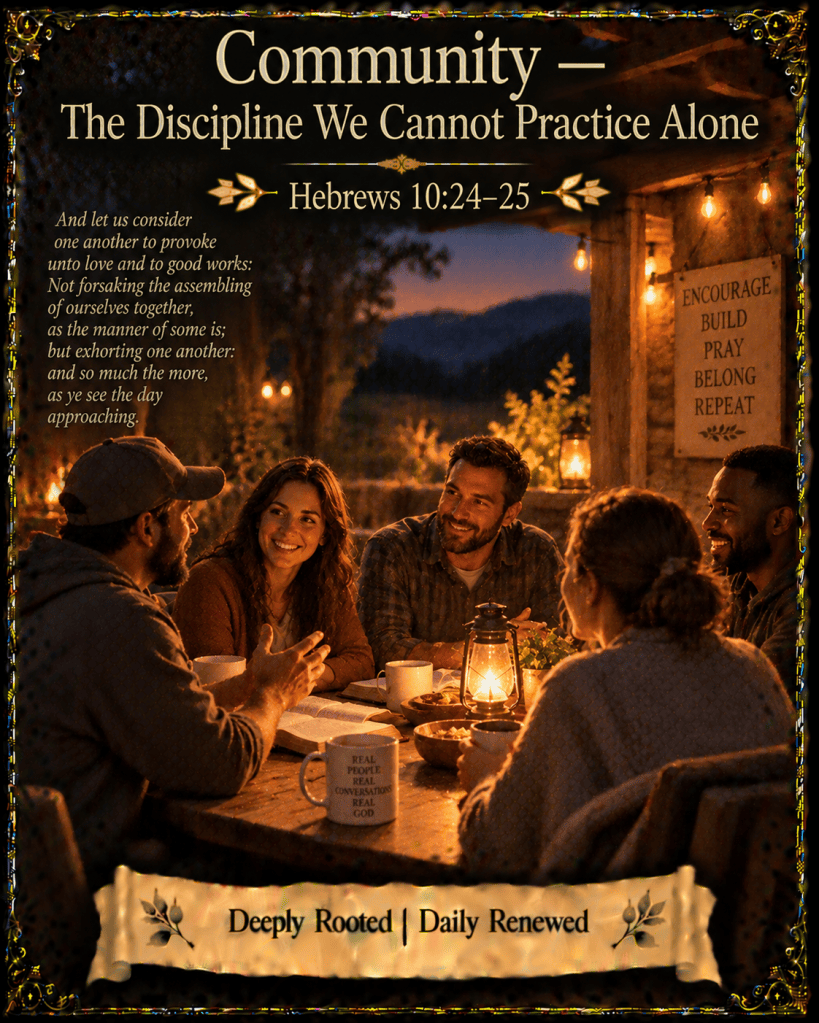
“And let us consider how we may spur one another on toward love and good deeds, not giving up meeting together, as some are in the habit of doing, but encouraging one another — and all the more as you see the Day approaching.”
— Hebrews 10:24–25
ROOTED TRUTH
Community is not an optional addition to the spiritual life. It is the environment in which many of the most essential disciplines of the Christian life can only be practiced — because they require another person to work on.
FAITH STORY
Every discipline we have studied this week can be practiced alone.
Scripture reading: alone. Fasting: alone. Sabbath: alone, or at least in private. Solitude: by definition alone. Generosity: largely private. But the final discipline — community — cannot be practiced alone. It requires others. It is, by nature, a corporate practice.
And this is not accidental. The Christian life is not designed to be a solo project. The New Testament knows nothing of the isolated believer growing in godliness through purely private disciplines. From the earliest pages of Acts, the followers of Jesus were together — devoted to one another, sharing meals, praying together, bearing each other’s burdens, confessing sins to one another, spurring one another toward love and good deeds.
The author of Hebrews writes to a community that was beginning to drift from gathering — and his concern is not institutional or organizational. It is pastoral and urgent. Don’t give up meeting together. You need each other. The approaching Day makes the togetherness more important, not less.
Community does things for us that no private discipline can. It confronts our blind spots — the ones we cannot see about ourselves because we have too much invested in not seeing them. It provides the accountability that makes long-term change more possible. It gives us people to practice love and patience on — the hardest and most important practice of all. And it provides the witness that Jesus said would make the watching world believe.
This is also a discipline because it requires effort against the drift. Community does not maintain itself. Relationships require showing up even when you don’t feel like it, investing even when there is no immediate return, staying even when it would be easier to withdraw.
Which community are you committed to? And what is your commitment actually costing you?
As we close this week of disciplines, the last one is perhaps the most revealing: the willingness to be known, to stay, to spur and be spurred. That is where many of the other disciplines come together and become visible.
SCRIPTURE FOR DEEPER ROOTS
Acts 2:42–47 — The early church devoted to community.
Galatians 6:2 — “Carry each other’s burdens, and in this way you will fulfill the law of Christ.”
James 5:16 — “Confess your sins to each other and pray for each other so that you may be healed.”
DAILY PRACTICE
As you close this week, identify the specific community you are committed to — or need to commit to. Then identify one person in that community to invest in this week with specific intentionality: a conversation, a meal, a word of encouragement, an act of service. And identify one person in that community from whom you could receive something — accountability, prayer, honest feedback. Make one concrete move toward each of those two things before the week is out.
DAILY PRAYER
Father, I need people — even when my introvert tendencies or my past hurts tell me otherwise. You designed the Christian life to be lived in community, and I cannot grow into everything You intend for me in isolation. Give me the courage to stay, the grace to be known, the humility to receive what others offer, and the love to invest in what community requires. Knit me into the body of Christ — deeply, not superficially. Amen.
DEEP REFLECTION
1. The author of Hebrews connects the urgency of community to the approaching Day — as if the stakes of togetherness increase over time. Why might Christian community become more important, not less, as the world becomes more fragmented?
2. Community confronts our blind spots and provides the people we practice love on. Which of those functions do you most need from community right now — and which are you most resistant to?
3. Looking back over this entire week — Scripture, fasting, sabbath, solitude, generosity, and community — which discipline has most deeply challenged you, and which one do you sense God specifically inviting you to take more seriously in this season? What will you actually do differently next week?
#DeeplyRooted#DailyRenewed Devotions for a Grounded and Growing Faith
 Deeply Rooted Daily Renewed
Leave a comment