KEY VERSE
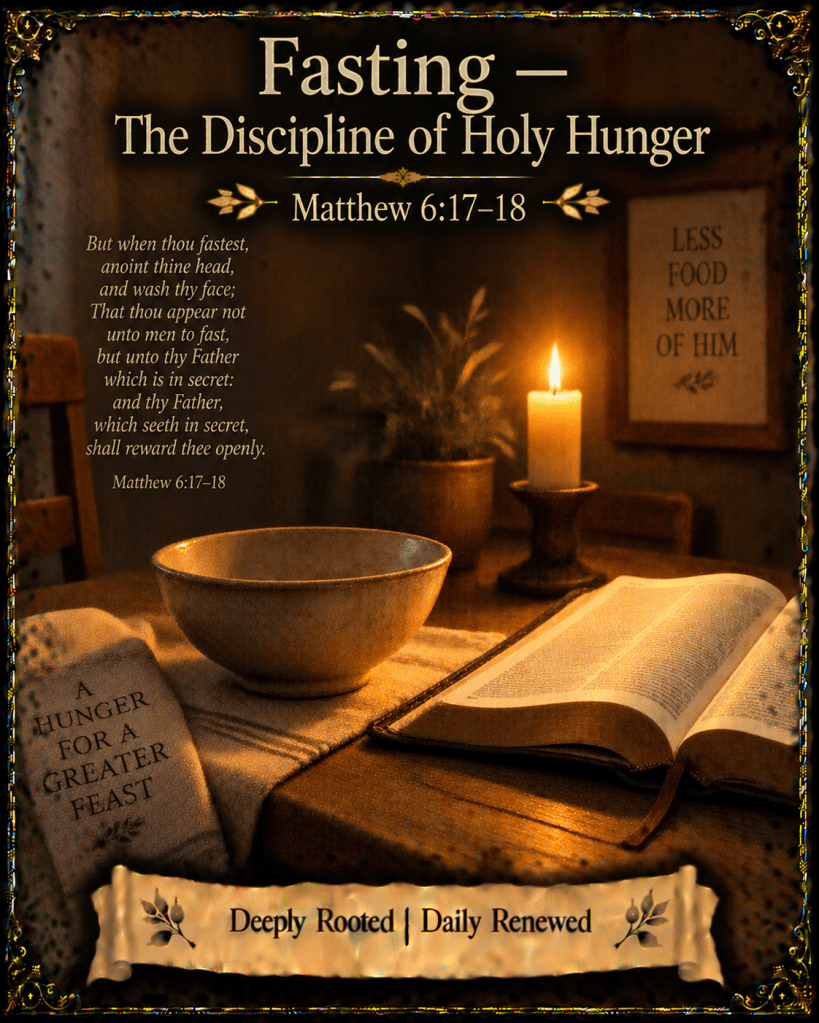
“But when you fast, put oil on your head and wash your face, so that it will not be obvious to others that you are fasting, but only to your Father, who is unseen; and your Father, who sees what is done in secret, will reward you.”
— Matthew 6:17–18
ROOTED TRUTH
Fasting does not change God’s willingness to act. It changes our capacity to receive — quieting the noise of appetite so we can hear more clearly, and reminding our bodies that we were made for something more than physical satisfaction.
FAITH STORY
Of all the spiritual disciplines, fasting is probably the most avoided in contemporary Western Christianity.
We are comfortable with Bible reading, with prayer, with giving, even with occasional solitude. But fasting — the voluntary abstention from food, or sometimes from other things, for a spiritual purpose — feels extreme to many believers. Something for monasteries, not modern life. Something for the very devout, not the ordinary follower of Jesus.
But Jesus assumed His disciples would fast. In Matthew 6 He said when you fast — not if. He placed it alongside prayer and giving as one of the basic practices of the religious life. And He gave a very specific instruction about how to do it: quietly, privately, without performance or public display.
What does fasting actually do? It does not change God — He is not more inclined to hear us because our stomach is empty. What it changes is us. Fasting exposes our dependencies. It reveals, very quickly, what we reach for when we are uncomfortable — and for most people in the modern world, food (or its digital equivalent: entertainment, distraction, comfort) is the first thing reached for.
When we fast, we create a hunger. And then — this is the discipline — we redirect that hunger toward God. Instead of filling the space with food, we fill it with prayer. Instead of reaching for comfort, we reach for the Comforter. The physical hunger becomes a training device for spiritual hunger.
Jesus fasted forty days before His ministry began. Moses fasted on the mountain. Esther fasted before approaching the king. The early church fasted before sending out missionaries. Fasting has always been the companion of significant spiritual moments — not because it earns anything, but because it tunes the soul.
You do not have to fast for forty days. Start with one meal. See what surfaces in the hunger. Let it become a prayer.
SCRIPTURE FOR DEEPER ROOTS
Matthew 6:16–18 — Jesus on fasting.
Isaiah 58:6–7 — The fast God chooses.
Acts 13:2–3 — The early church fasting before sending Paul and Barnabas.
DAILY PRACTICE
Practice a simple fast today — skip one meal and use the time you would have spent eating in prayer instead. When hunger surfaces, let it be a prompt rather than a problem: instead of thinking about food, redirect the awareness to God. Bring to that prayer time one specific request or area of spiritual need that you want to bring before God with heightened intentionality. Notice what the hunger reveals about your dependencies — and let it deepen your hunger for God.
DAILY PRAYER
Father, I confess that I reach for food, for entertainment, for comfort far more readily than I reach for You. Fasting reveals that dependency — and I receive the revelation. Today I create a hunger and redirect it toward You. Let this physical emptiness become spiritual attentiveness. Speak into the quiet that appetite usually fills. And grow in me a hunger for You that is deeper and more persistent than any physical craving. Amen.
DEEP REFLECTION
1. Jesus said when you fast — assuming it as a regular practice. Why do you think fasting has largely disappeared from contemporary Christian practice, and what might be lost as a result?
2. Fasting exposes dependency — it reveals what you reach for first when uncomfortable. What does your response to hunger, boredom, or discomfort reveal about your deepest dependencies? What would fasting from that specific thing teach you?
3. Isaiah 58 describes the fast God chooses as one that leads to justice and generosity — fasting from injustice, loosening the chains of the oppressed. How does that broaden your understanding of fasting beyond skipping meals?
#DeeplyRooted#DailyRenewed Devotions for a Grounded and Growing Faith
 Deeply Rooted Daily Renewed
Leave a comment