KEY VERSE
“Mordecai recorded these events, and he sent letters to all the Jews…to have them celebrate annually the fourteenth and fifteenth days of the month of Adar as the time when the Jews got relief from their enemies, and as the month when their sorrow was turned into joy and their mourning into a day of celebration.”
— Esther 9:20–22
ROOTED TRUTH
The story of Esther ends not with a private victory but with a public celebration that has been observed for over two thousand years — because when God works through a surrendered life, the impact outlasts the moment and reaches generations.
FAITH STORY
The reversal was complete.
Haman, who had built a gallows to hang Mordecai, was hanged on it himself. The edict for the destruction of the Jewish people was countered — because Persian law could not be revoked, a new edict was issued giving the Jewish people the right to defend themselves. They did. Their enemies were defeated. Mordecai was elevated to Haman’s position. Esther’s people were saved.
And Mordecai wrote it all down. He sent letters throughout the empire establishing the festival of Purim — named after the pur, the lot that Haman had cast to determine the date of destruction. The very instrument of evil’s planning became the name of the celebration of evil’s defeat.
This is the final and most sweeping statement of God’s sovereignty in the book of Esther: not only does He work through the positioning and the courage and the timing — He works through the enemy’s own schemes, turning them inside out. The lot that was cast for destruction became the lot that marks a festival of deliverance. The gallows built for Mordecai became the gallows that carried Haman.
And a young orphan woman who did not choose her position, who was afraid to act, who waited when the pressure was to speak, who said if I perish, I perish — became the name remembered two and a half millennia later as the woman who saved her people.
She did not know any of that when she put on her royal robes and walked toward the king’s inner court.
She only knew that she was here, that her people needed her, and that God might have placed her in this position for exactly this moment.
That was enough.
You are here. Your people need you. And God may have placed you in your position for exactly this moment.
That is still enough.
SCRIPTURE FOR DEEPER ROOTS
Esther 9:1–32 — The victory and the establishment of Purim.
Isaiah 61:3 — “A crown of beauty instead of ashes, the oil of joy instead of mourning.”
Romans 8:28 — “In all things God works for the good of those who love him.”
DAILY PRACTICE
As you close this week with Esther, write your own such a time as this statement. Complete this sentence as honestly and specifically as you can: I believe God has placed me in [specific position or role] at this moment in history because [specific need or purpose]. It does not have to be certain — Mordecai only asked who knows but that. Write it as a possibility that compels action rather than a certainty that excuses passivity. Then carry it forward as the defining question of your next season.
DAILY PRAYER
Father, I have spent this week with a woman who did not choose her position, who was afraid, who waited, who counted the cost and said if I perish, I perish — and through whose obedience You saved a people and established a celebration that has lasted more than two thousand years. I don’t know what You will do through my obedience. But I know what You did through hers. Use me for such a time as this. I am available. I am willing. I am here. Amen.
DEEP REFLECTION
1. The festival of Purim turns the enemy’s own instrument — the pur, the lot — into the name of the celebration of his defeat. How does that final reversal capture the ultimate trajectory of God’s sovereignty over evil?
2. Esther did not know she would be remembered for two and a half thousand years when she walked through that door. She only knew the need in front of her and the position she occupied. How does that perspective challenge any tendency to calculate whether your obedience will produce significant enough results to justify the cost?
3. Looking back over the whole week with Esther — God’s fingerprints, the involuntary positioning, Haman’s plot, Mordecai’s challenge, if I perish I perish, the banquet’s wisdom, and the final reversal — what is the single most significant thing this story has said to you about your own life and calling right now?
🖼️ IMAGE PROMPT
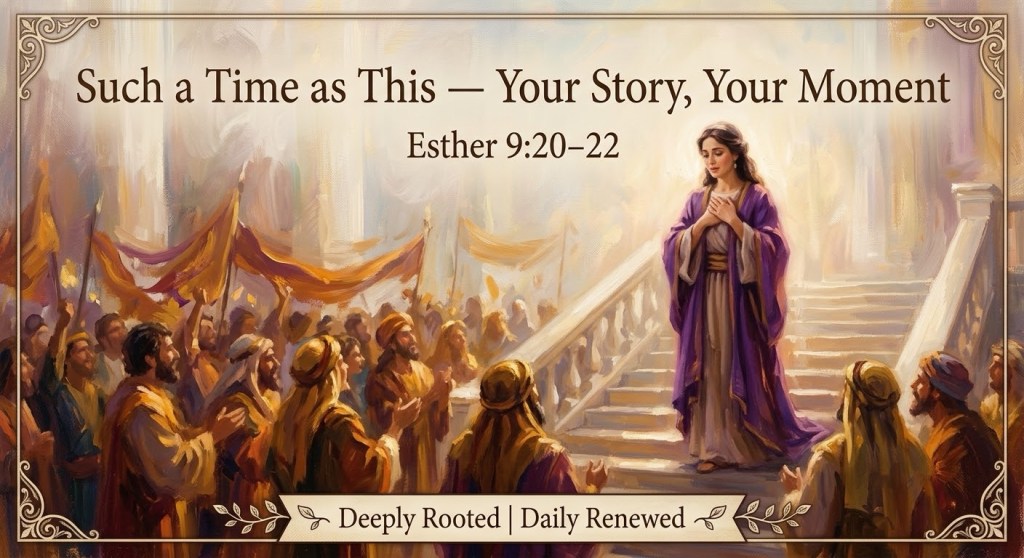
Saturday — Such a Time as This — Your Story, Your Moment
A woman standing at the top of a grand staircase overlooking a celebrating crowd below — not in triumph or pride, but in quiet wonder and gratitude, fully aware that what happened was beyond her own capacity. Her posture is one of humble astonishment at what God has accomplished through her willingness. Painterly, impressionistic style. Rich amber and gold celebration below, warm royal purple robes, and soft humble light on the figure above. Humble, grateful, and quietly historic mood. Include the title “Such a Time as This — Your Story, Your Moment” at the top in elegant serif font, “Esther 9:20–22” beneath it, and a banner at the bottom reading “Deeply Rooted | Daily Renewed” with small leaf decorations. Decorative corner borders framing the image.
#DeeplyRooted#DailyRenewed Devotions for a Grounded and Growing Faith


Leave a comment