
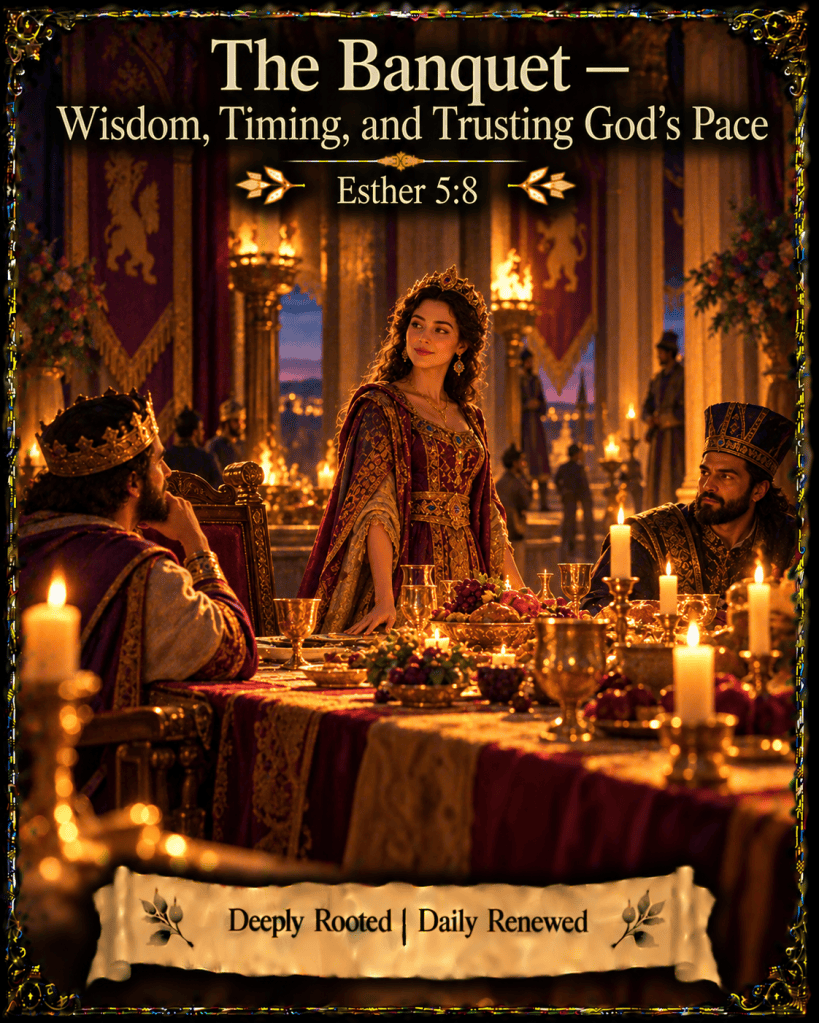
KEY VERSE
“‘My petition and my request is this: if the king regards me with favor and if it pleases the king to grant my petition and fulfill my request, let the king and Haman come tomorrow to the banquet I will prepare for them.’”
— Esther 5:7–8
ROOTED TRUTH
Esther had the king’s ear, the golden scepter extended, and the moment to speak. And she waited. Wisdom is not only knowing what to do — it is knowing when.
FAITH STORY
Esther approached the king. Three days of fasting had come to an end, and she put on her royal robes and stood in the inner court.
The king saw her and extended his golden scepter. She was not struck down. She was welcomed. And he asked: what is it, Queen Esther? What is your request? Even up to half the kingdom, it will be given you.
She had what she came for. The access. The favor. The invitation to ask. And what she asked for — was a banquet. She invited the king and Haman to a banquet she would prepare.
At the banquet, the king asked again: what is your petition? And again — even up to half the kingdom. And again, Esther did not make her request. She invited them to a second banquet.
Why? Why did Esther wait when she had everything she needed to speak?
The text doesn’t fully explain her reasoning. But what follows in chapter 6 is stunning: on the night between the first and second banquets, the king could not sleep. He had the royal records read to him. He discovered that Mordecai had once uncovered a plot against his life and had never been honored for it. The next morning, Haman arrived at the palace — intending to ask permission to hang Mordecai — and instead was commanded to honor him publicly.
If Esther had made her request at the first banquet, this would not have happened. The turning of the king’s heart toward Mordecai — the reversal of fortune that set the stage for everything that followed — occurred in the space that Esther’s waiting created.
She did not know that when she waited. But God did.
Timing is not hesitation. It is sometimes the most active form of trust — creating space for God to do what only He can do in the gaps between our actions.
SCRIPTURE FOR DEEPER ROOTS
Esther 5:1–8 — The first banquet.
Esther 6:1–14 — The night the king could not sleep.
Ecclesiastes 3:1 — “There is a time for everything, and a season for every activity under the heavens.”
DAILY PRACTICE
Is there a situation in your life right now where you feel the pressure to act immediately — to make the request, have the conversation, force the resolution — but something is telling you to wait? Today, practice Esther’s discipline of discerning timing. Bring the situation to God in prayer and ask specifically: is now the moment, or is there something You want to do in the waiting that I cannot see yet? Commit to being attentive to timing rather than simply driven by urgency.
DAILY PRAYER
Father, I am not naturally a patient person. When I have access and the moment seems right, my instinct is to speak and act. But Esther teaches me that wisdom includes knowing when — that the waiting is sometimes the most active thing I can do. Give me discernment about timing today. Show me what You want to accomplish in the gaps between my actions. And help me trust that when You are at work in the waiting, the delay is not failure — it is faithfulness. Amen.
DEEP REFLECTION
1. Esther waited at the moment of greatest access — when the king had already extended favor and invited her request. What do you think she was sensing that caused her to wait? And how do you develop that kind of sensitivity to timing?
2. The night the king could not sleep — the coincidence that changed everything — occurred in the space Esther’s waiting created. Can you think of a time when something you did not plan happened in the gap between your actions that turned out to be crucial? What did you learn from it?
3. How do you distinguish between waiting on God’s timing and simply avoiding a difficult action out of fear? What markers help you tell the difference?
#DeeplyRooted#DailyRenewed Devotions for a Grounded and Growing Faith


Leave a comment