KEY VERSE
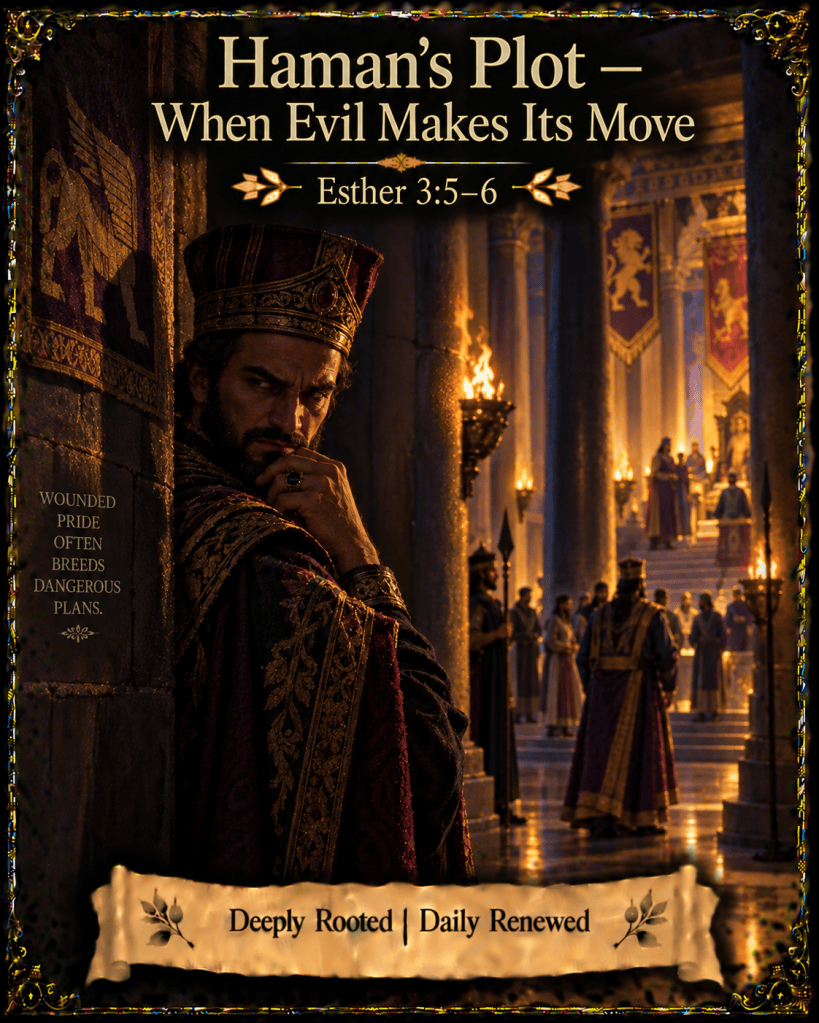
“When Haman saw that Mordecai would not kneel down or pay him honor, he was enraged. Yet having learned who Mordecai’s people were, he scorned the idea of killing only Mordecai. Instead Haman looked for a way to destroy all Mordecai’s people.”
— Esther 3:5–6
ROOTED TRUTH
Evil rarely reveals itself as evil at first. It begins with wounded pride, moves to resentment, and grows — if unchecked — into something that threatens far more than the original offense ever justified.
FAITH STORY
Haman had been elevated above all the other nobles in the king’s court.
Everyone bowed to him. Everyone, that is, except Mordecai. Day after day, the royal officials would bow, and day after day, Mordecai would not. The text does not give us a full explanation of why — only that Mordecai identified himself as a Jew and that this was the reason he would not kneel.
Haman noticed. And what started as a notice became an offense, and what became an offense became a rage, and what became a rage became something far larger than any single man’s refusal to bow. Haman decided that killing Mordecai alone was insufficient — he would destroy the entire Jewish people throughout the empire.
He cast lots — the pur, from which the festival of Purim takes its name — to determine the most auspicious date for the slaughter. He went to the king with a carefully framed argument: there is a certain people scattered throughout the provinces who do not obey the king’s laws. It is not in the king’s interest to tolerate them. Let an order be written for their destruction.
And the king, with barely a second thought, handed Haman his signet ring and said do with the people as you please.
The edict went out. An entire people sentenced to death because one man refused to bow to another man’s pride.
Haman’s arc is a warning that runs through all of human history: unchecked pride produces resentment, resentment produces hatred, and hatred, given power and opportunity, produces atrocity. It never stays the size it started.
But Esther’s story also says this: when evil makes its most devastating move, it does not catch God off guard. The positioning has already happened. The rescue is already in motion. The pur was cast — but the LORD determines the outcome of the lot (Proverbs 16:33).
Evil moves. But it does not move last.
SCRIPTURE FOR DEEPER ROOTS
Esther 3:1–15 — Haman’s plot.
Proverbs 16:18 — “Pride goes before destruction, a haughty spirit before a fall.”
Genesis 50:20 — “You intended to harm me, but God intended it for good.”
DAILY PRACTICE
Haman’s destruction began with wounded pride that he chose to nurse rather than release. Spend time today doing an honest inventory of any pride, resentment, or bitterness you are currently carrying — particularly toward someone who has slighted or disrespected you. Name it honestly. Then trace where that resentment is leading if left unchecked — what does it produce over time? Bring it to God and ask for the grace to release it before it grows into something larger than the original offense.
DAILY PRAYER
Father, Haman’s story is a warning about what wounded pride becomes when it is fed instead of released. I confess the resentments I carry — the slights, the disrespects, the moments when I was not honored the way I felt I deserved. I do not want to become what Haman became. Take the pride. Take the bitterness. I release the offense before it grows. And remind me that evil’s most decisive move is never its last one — because You are still the One determining the outcome. Amen.
DEEP REFLECTION
1. Haman’s hatred began with wounded pride over one man’s refusal to bow. How does the progression from pride to resentment to murderous rage illuminate the danger of unchecked offenses — and where do you see that progression most clearly in your own heart?
2. The king signed Haman’s edict without hesitation — power wielded carelessly on behalf of someone else’s wounded ego. What does that dynamic say about the responsibility that comes with authority and influence?
3. Haman cast lots to determine the timing — but Proverbs 16:33 says the LORD determines the outcome of the lot. How does the truth of God’s sovereignty over even the enemy’s planning change the way you respond to situations where evil seems to be gaining the upper hand?
#DeeplyRooted#DailyRenewed Devotions for a Grounded and Growing Faith
 Deeply Rooted Daily Renewed
Leave a comment