Author: gdousay

  • Thursday, January 22, 2026–Restoring Joy

    Key Verse:

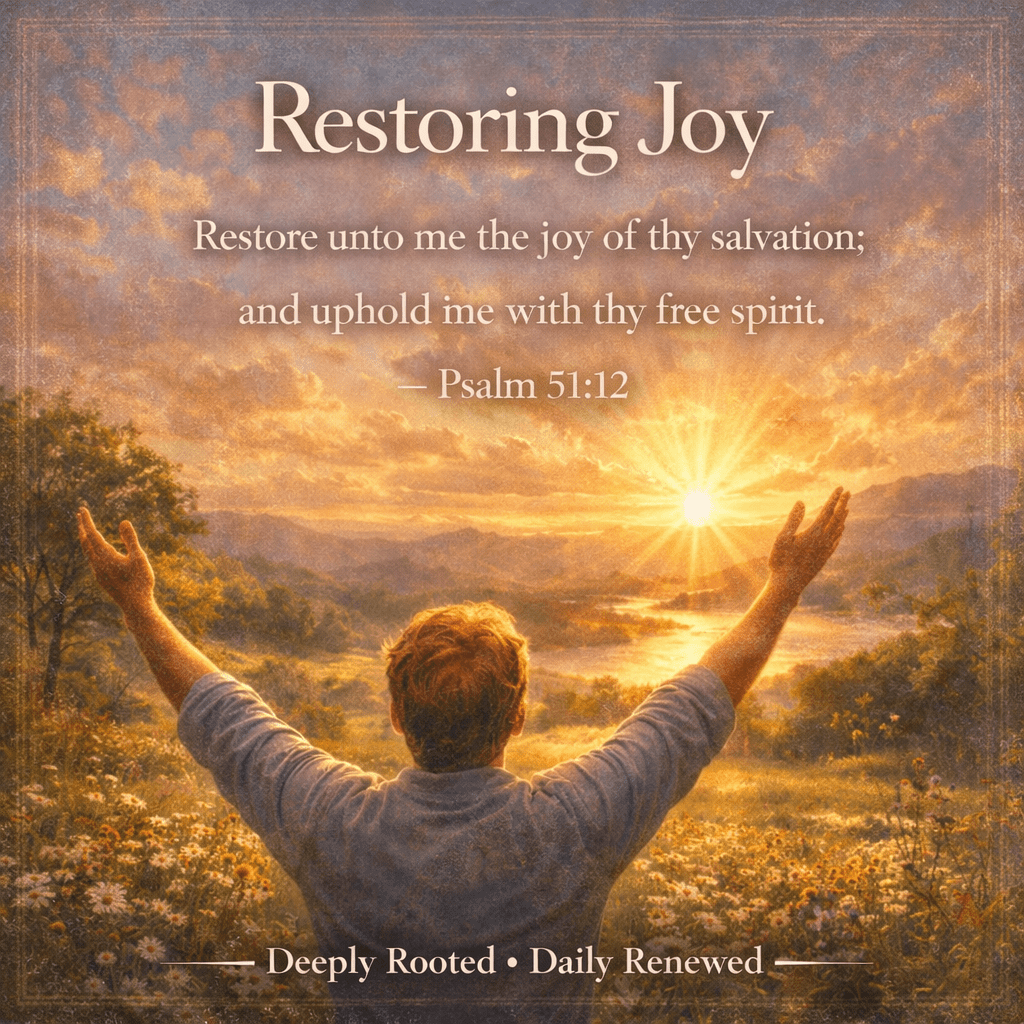
    “Restore unto me the joy of thy salvation; and uphold me with thy free spirit.”

    — Psalm 51:12

    Rooted Truth:

    Joy is not something we manufacture—it is something God restores when we return to Him.

    Faith Story:

    Joy can quietly slip away.

    Not always through dramatic rebellion, but through fatigue, distraction, prolonged stress, or seasons of spiritual heaviness. David knew this well. After his sin, his greatest loss was not position or reputation—it was joy.

    “Restore unto me the joy of thy salvation.”

    David did not ask for comfort or relief first. He asked for restored joy—the deep, steady gladness that comes from walking closely with God.

    Biblical joy is not shallow happiness or constant enthusiasm. It is a settled delight rooted in salvation—knowing we belong to God, are forgiven by grace, and are upheld by His Spirit.

    When joy fades, God does not scold us. He invites us back.

    Restored joy flows from repentance, humility, and renewed fellowship. It comes when burdens are confessed, grace is received, and the soul is reminded of what God has already done.

    Joy is often restored quietly. It returns as peace in prayer, gratitude in worship, and confidence in God’s mercy. It does not erase hardship—but it reframes it with hope.

    God desires His people to walk with joy, not as a reward for perfect faithfulness, but as a gift of His sustaining grace.

    Scripture for Deeper Roots:

    Nehemiah 8:10 – “The joy of the LORD is your strength.”

    John 15:11 – “…that my joy might remain in you…”

    Isaiah 61:3 – “The oil of joy for mourning…”

    Daily Practice:

    Ask God to restore joy in one area where heaviness has lingered.

    Spend a few moments thanking Him specifically for your salvation.

    Daily Prayer:

    Gracious God, restore to me the joy that comes from walking with You. Lift the heaviness that weighs on my heart and renew my delight in Your salvation. Uphold me by Your Spirit and help me walk forward with gladness again.

    Amen.

    Deep Reflection:

    • Where has joy quietly diminished in your life?

    • How does remembering your salvation renew joy?

    • What would restored joy look like in your current season?

    #DeeplyRooted #DailyRenewed

    Devotions for a Grounded and Growing Faith

  • Wednesday, January 21, 2026–A Renewed Mind

    Key Verse:

    “And be not conformed to this world: but be ye transformed by the renewing of your mind, that ye may prove what is that good, and acceptable, and perfect, will of God.”

    — Romans 12:2

    Rooted Truth:

    Lasting renewal begins not with changed circumstances, but with a transformed mind.

    Faith Story:

    Hope begins to take root when the way we think is reshaped by truth. Paul reminds us that renewal is not merely emotional—it is transformational. God does not simply adjust our behavior; He renews the very patterns of our thinking.

    The world constantly presses us to conform—to measure success by outcomes, to define worth by productivity, to interpret hardship as failure. Left unchecked, these messages quietly shape our perspective and drain our hope.

    But God offers another way.

    The renewal of the mind happens as truth replaces distortion, as Scripture reorients our thoughts, and as the Spirit teaches us to see life through God’s promises rather than our fears.

    This transformation is ongoing. It does not happen all at once, nor does it require perfection. Each time we choose truth over lies, faith over fear, and obedience over impulse, our minds are renewed.

    A renewed mind allows us to discern God’s will—not as a burden, but as something good, acceptable, and perfect. Hope grows when we begin to trust that God’s ways are for our good, even when they challenge our comfort.

    As the mind is renewed, the heart follows—and life begins to reflect the quiet confidence of one anchored in God’s truth.

    Scripture for Deeper Roots:

    Philippians 4:8 – “Whatsoever things are true… think on these things.”

    Colossians 3:2 – “Set your affection on things above…”

    Psalm 119:105 – “Thy word is a lamp unto my feet…”

    Daily Practice:

    Identify one thought pattern that needs renewal today.

    Replace it intentionally with a specific truth from Scripture.

    Daily Prayer:

    God of truth, renew my mind by Your Word and Your Spirit. Help me resist the patterns of this world and align my thoughts with Your will. Transform the way I think so that my life reflects hope and obedience.

    Amen.

    Deep Reflection:

    • What thoughts have most shaped your outlook recently?

    • How does renewing your mind strengthen hope?

    • What truth from God’s Word do you need to dwell on today?

    #DeeplyRooted #DailyRenewed

    Devotions for a Grounded and Growing Faith

  • Tuesday, January 20, 2026–Strength For The Weary

    Key Verse:

    “But they that wait upon the LORD shall renew their strength; they shall mount up with wings as eagles; they shall run, and not be weary; and they shall walk, and not faint.”

    — Isaiah 40:31

    Rooted Truth:

    God does not merely restore our energy—He renews our strength as we learn to wait on Him.

    Faith Story:

    Weariness is a familiar companion in the life of faith. It settles in quietly—after long seasons of responsibility, sorrow, perseverance, or unanswered prayer. Often, it is not dramatic failure that exhausts us, but faithful endurance over time.

    Isaiah speaks directly to this reality.

    Strength is not renewed through striving harder or pushing longer. Scripture tells us it is renewed through waiting on the Lord.

    Waiting is not passive. It is an active posture of trust—choosing to rest in God’s sufficiency rather than our own effort. It is laying down the burden of self-reliance and allowing God to sustain us.

    The promise of Isaiah 40:31 unfolds in stages:

    • Some days, God lifts us to soar above the weight.

    • Some days, He gives strength to run without collapsing.

    • And some days, He simply enables us to walk without fainting.

    All three are evidence of renewal.

    God meets us where we are. He does not shame our weakness. He supplies strength appropriate for the moment.

    Renewal does not always look like sudden energy. Sometimes it looks like quiet perseverance—the grace to keep going one step at a time.

    If you feel weary today, remember this: waiting on God is not wasted time. It is the very place where strength is renewed.

    Scripture for Deeper Roots:

    Psalm 73:26 – “My flesh and my heart faileth: but God is the strength of my heart…”

    2 Corinthians 12:9 – “My grace is sufficient for thee…”

    Matthew 11:28–30 – “Come unto me, all ye that labour and are heavy laden…”

    Daily Practice:

    When weariness surfaces today, pause and pray:

    “Lord, I wait on You. Renew my strength.”

    Release the pressure to push beyond what God is providing.

    Daily Prayer:

    Faithful God, You see my weariness and You know my limits. Teach me to wait on You rather than rely on my own strength. Renew my heart, steady my steps, and carry me through this day.

    Amen.

    Deep Reflection:

    • Where has weariness settled into your life recently?

    • How does waiting on God differ from striving in your own strength?

    • What does renewed strength look like for you today?

    #DeeplyRooted #DailyRenewed

    Devotions for a Grounded and Growing Faith

  • Monday, January 19, 2026–Renewed By God’s Mercy

    Key Verse:

    “It is of the LORD’S mercies that we are not consumed, because his compassions fail not. They are new every morning: great is thy faithfulness.”

    — Lamentations 3:22–23

    Rooted Truth:

    God’s mercy is not a one-time gift—it is renewed daily, sustaining us moment by moment.

    Faith Story:

    Renewal does not begin with us doing more—it begins with God showing mercy again.

    Jeremiah wrote these words in the midst of devastation. Jerusalem lay in ruins. Loss and grief surrounded him. Yet in the ashes, he made a deliberate choice to remember something unchanging:

    God’s mercy.

    God’s compassions had not failed—even when circumstances were bleak. Each morning carried fresh evidence of God’s faithfulness.

    This truth reshapes how we view renewal. Renewal is not pretending yesterday didn’t happen. It is trusting that God’s mercy meets us today.

    Some mornings we wake up energized and hopeful. Others we rise with heaviness still lingering. But Scripture assures us that God’s mercy is not dependent on our emotional state. It arrives faithfully, without hesitation.

    God does not ration mercy. He does not grow tired of giving it. He does not withdraw it when we struggle.

    Renewal flows from remembering that we are sustained not by our strength, but by God’s compassion.

    Each new day becomes an invitation to receive mercy again—and to live from gratitude rather than guilt.

    Scripture for Deeper Roots:

    Psalm 103:8–12 – “The LORD is merciful and gracious…”

    Micah 7:18–19 – “He delighteth in mercy.”

    Hebrews 4:16 – “Let us therefore come boldly unto the throne of grace…”

    Daily Practice:

    Begin today by thanking God specifically for His mercy.

    Name one area where you need to receive it again.

    Daily Prayer:

    Merciful God, thank You for compassion that never fails. Help me receive Your mercy without fear or hesitation. Renew my heart today and teach me to walk in gratitude for Your faithfulness.

    Amen.

    Deep Reflection:

    • Where do you most need God’s mercy today?

    • How does remembering God’s faithfulness renew hope?

    • What would change if you truly lived from God’s mercy each day?

    #DeeplyRooted #DailyRenewed

    Devotions for a Grounded and Growing Faith

  • Sunday, January 18, 2026–Hope That Does Not Disappoint

    Key Verse:

    “And hope maketh not ashamed; because the love of God is shed abroad in our hearts by the Holy Ghost which is given unto us.”

    — Romans 5:5

    Rooted Truth:

    Biblical hope is not wishful thinking—it is confident expectation rooted in God’s faithful love.

    Faith Story:

    After seasons of sorrow, disappointment, or deep searching, hope can feel fragile. We may want to hope—but fear being disappointed again.

    Scripture speaks directly into that fear.

    “Hope maketh not ashamed.”

    Paul is not describing optimism based on circumstances. He is describing hope grounded in something unchanging: the love of God poured into our hearts by the Holy Spirit.

    Christian hope does not deny pain. It grows through it.

    Earlier in Romans 5, Paul explains that suffering produces endurance, endurance produces character, and character produces hope. This hope is not shallow—it has been tested by hardship and refined through trust.

    Godly hope does not promise ease. It promises presence. It does not guarantee outcomes. It guarantees love.

    When hope is rooted in God’s love rather than our expectations, it becomes steady. It does not collapse when circumstances shift. It does not wither when answers delay.

    Renewal begins when we allow hope to rise again—not because everything is fixed, but because God is faithful.

    And this hope, Scripture says, will not disappoint.

    Scripture for Deeper Roots:

    Psalm 42:11 – “Hope thou in God…”

    Hebrews 6:19 – “Which hope we have as an anchor of the soul…”

    1 Peter 1:3 – “Begotten us again unto a lively hope…”

    Daily Practice:

    Ask God to restore hope in one area where discouragement has lingered.

    Pray honestly:

    “Lord, help me hope again—anchored in Your love.”

    Daily Prayer:

    Faithful God, thank You that hope in You does not disappoint. Renew my confidence in Your love and Your promises. Where my heart has grown weary, breathe fresh hope again. Teach me to trust You as I walk forward.

    Amen.

    Deep Reflection:

    • Where has hope felt fragile in your life recently?

    • How does God’s love strengthen hope beyond circumstances?

    • What would it look like to anchor your hope fully in Him again?

    #DeeplyRooted #DailyRenewed

    Devotions for a Grounded and Growing Faith

  • Saturday, January 17, 2026–Holy Anguish: From Anguish To Trust

    Key Verse:

    “But I have trusted in thy mercy; my heart shall rejoice in thy salvation. I will sing unto the LORD, because he hath dealt bountifully with me.”

    — Psalm 13:5–6

    Rooted Truth:

    Holy anguish does not end in despair—it leads the faithful heart into renewed trust in God.

    Faith Story:

    Psalm 13 begins in anguish.

    “How long, O LORD? wilt thou forget me for ever?”

    “How long shall I take counsel in my soul, having sorrow in my heart daily?”

    David does not rush past his pain. He names it. He feels it. He prays through it. But the psalm does not end where it begins.

    Something shifts.

    David moves from questioning God to trusting Him—not because circumstances suddenly changed, but because his heart was reoriented in prayer.

    “But I have trusted in thy mercy…”

    This is the pattern of holy anguish. It does not demand immediate answers. It clings to God’s character when clarity is absent. It chooses trust even while tears remain.

    Trust does not erase anguish—it transforms it.

    By the end of the psalm, David is not celebrating deliverance yet; he is celebrating God’s faithfulness. He remembers mercy. He recalls salvation. He looks back at how God has dealt bountifully with him before—and lets that history shape his hope.

    Holy anguish teaches us that faith does not mean the pain disappears. It means the pain no longer defines us.

    When anguish has done its work—convicting, humbling, interceding, and drawing us near—it gives way to quiet confidence. A confidence rooted not in outcomes, but in the unchanging goodness of God.

    And so the week closes not with answers, but with trust.

    Trust that God hears.

    Trust that God sees.

    Trust that God remains faithful—even when the heart has been heavy.

    Scripture for Deeper Roots:

    Psalm 62:8 – “Trust in him at all times; ye people, pour out your heart before him…”

    Lamentations 3:31–32 – “For the Lord will not cast off for ever…”

    Isaiah 26:3 – “Thou wilt keep him in perfect peace, whose mind is stayed on thee…”

    Daily Practice:

    Look back over this week and identify one place where anguish has softened into trust.

    Thank God for meeting you there—even if the situation has not fully resolved.

    Daily Prayer:

    Faithful God, thank You for meeting me in my anguish and leading me toward trust. Help me rest in Your mercy when answers are still forming. I choose to trust You—not because everything is clear, but because You are good.

    Amen.

    Deep Reflection:

    • How has God used anguish to draw you closer this week?

    • What does trusting God look like when circumstances remain difficult?

    • Where is God inviting you to rest in His mercy right now?

    #DeeplyRooted #DailyRenewed

    Devotions for a Grounded and Growing Faith
  • Friday, January 16, 2026–Holy Anguish: Jesus, The Man Of Sorrows

    Key Verse:

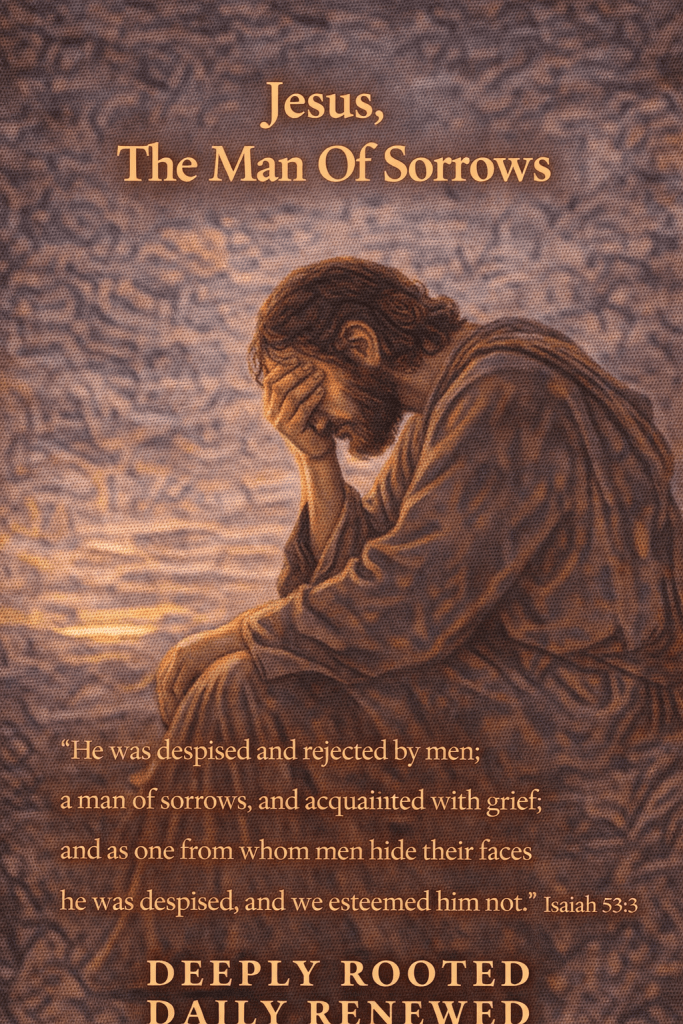
    “He is despised and rejected of men; a man of sorrows, and acquainted with grief…”

    — Isaiah 53:3

    Rooted Truth:

    Jesus understands our anguish because He willingly entered into it for our redemption.

    Faith Story:

    Holy anguish is not foreign to the heart of God.

    It is not something Christ observes from a distance—it is something He personally bore.

    Isaiah describes the Messiah not as triumphant in appearance, but as “a man of sorrows, and acquainted with grief.” Jesus stepped fully into the brokenness of a fallen world. He felt rejection, betrayal, misunderstanding, physical suffering, and spiritual agony.

    He wept at the tomb of Lazarus.

    He groaned over Jerusalem’s hardness of heart.

    He sweat drops of blood in Gethsemane.

    He cried out from the cross in anguish and abandonment.

    Jesus did not bypass sorrow to bring salvation—He went through it.

    This matters deeply for us.

    When we experience anguish, we do not approach a distant or indifferent Savior. We come to One who understands suffering from the inside out. Christ does not minimize our pain. He meets us in it with compassion and authority.

    Holy anguish finds its deepest meaning at the cross. There, Jesus carried not only our sins, but our sorrows. He bore grief so that our suffering would never be meaningless or alone.

    Because Jesus entered anguish willingly, our anguish can now become a place of communion rather than isolation.

    We suffer with Christ—and because of Christ, we suffer with hope.

    Scripture for Deeper Roots:

    Hebrews 4:15 – “We have not an high priest which cannot be touched with the feeling of our infirmities…”

    Matthew 26:38 – “My soul is exceeding sorrowful, even unto death…”

    1 Peter 5:7 – “Casting all your care upon him; for he careth for you.”

    Daily Practice:

    Bring your anguish honestly to Jesus today.

    Name it aloud and entrust it to the One who understands sorrow fully.

    Daily Prayer:

    Suffering Savior, thank You for entering into our grief and bearing our sorrow. Help me trust You with my pain, knowing You understand it completely. Meet me in my anguish and remind me that I am never alone.

    Amen.

    Deep Reflection:

    • How does knowing Jesus is the Man of Sorrows change the way you view your pain?

    • Where do you need to bring your anguish directly to Christ today?

    • How does the cross reshape suffering with hope?

    #DeeplyRooted #DailyRenewed

    Devotions for a Grounded and Growing Faith
  • Thursday, January 15, 2026–Holy Anguish: Anguish Over Sin And Separation

    Key Verse:

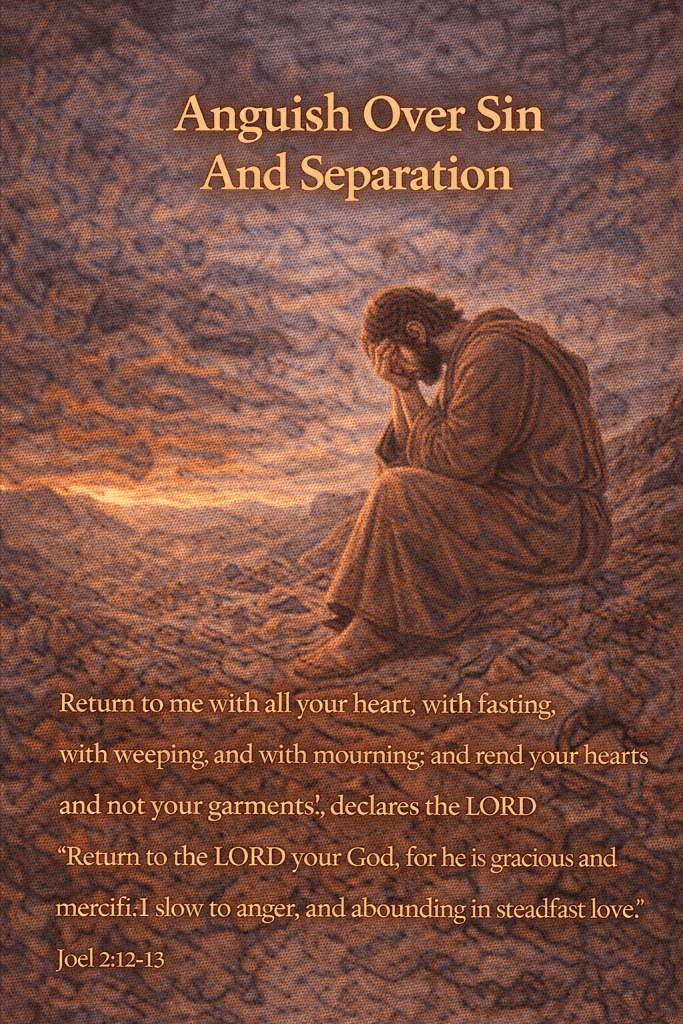
    “Now therefore saith the LORD, Turn ye even to me with all your heart, and with fasting, and with weeping, and with mourning: And rend your heart, and not your garments…”

    — Joel 2:12–13

    Rooted Truth:

    Holy anguish exposes the cost of sin—not to condemn us, but to draw us back into restored fellowship with God.

    Faith Story:

    There is a kind of sorrow that comes not from suffering, but from distance. Distance from God’s presence. Distance from His will. Distance created by sin—whether sudden or subtle, obvious or hidden.

    Joel speaks to a people who had grown spiritually dull. Their rituals remained, but their hearts had drifted. God did not call them to louder sacrifices or outward displays—He called them to something deeper:

    “Rend your heart, and not your garments.”

    Holy anguish over sin is not about embarrassment or fear of consequences. It is the grief that comes from realizing that sin disrupts communion with a holy and loving God.

    This kind of anguish does not harden the heart—it softens it. It awakens a longing to return. It produces repentance that is sincere, humble, and whole-hearted.

    God’s call through Joel is strikingly tender. He does not say, “Clean yourself up and then come back.” He says, “Turn to Me.”

    Repentance is not driven by terror—it is drawn by mercy.

    Holy anguish reminds us that sin is serious, but grace is greater. It reveals the cost of separation so that we might cherish restoration.

    When the heart is broken over sin, God does not turn away. He draws near.

    Scripture for Deeper Roots:

    Psalm 51:10–12 – “Create in me a clean heart, O God…”

    Isaiah 57:15 – “I dwell… with him also that is of a contrite and humble spirit…”

    James 4:8–10 – “Draw nigh to God, and he will draw nigh to you.”

    Daily Practice:

    Ask God to search your heart honestly today.

    Confess anything that has dulled your fellowship with Him.

    Receive His mercy with humility and gratitude.

    Daily Prayer:

    Merciful Father, search my heart and reveal what separates me from You. Give me a tender conscience and a willing spirit to repent. Thank You for Your patience and Your restoring grace. Draw me close again, O Lord.

    Amen.

    Deep Reflection:

    • Where might sin have quietly created distance in your walk with God?

    • How does holy anguish differ from shame or fear?

    • What does returning to God with your whole heart look like today?

    #DeeplyRooted #DailyRenewed

    Devotions for a Grounded and Growing Faith
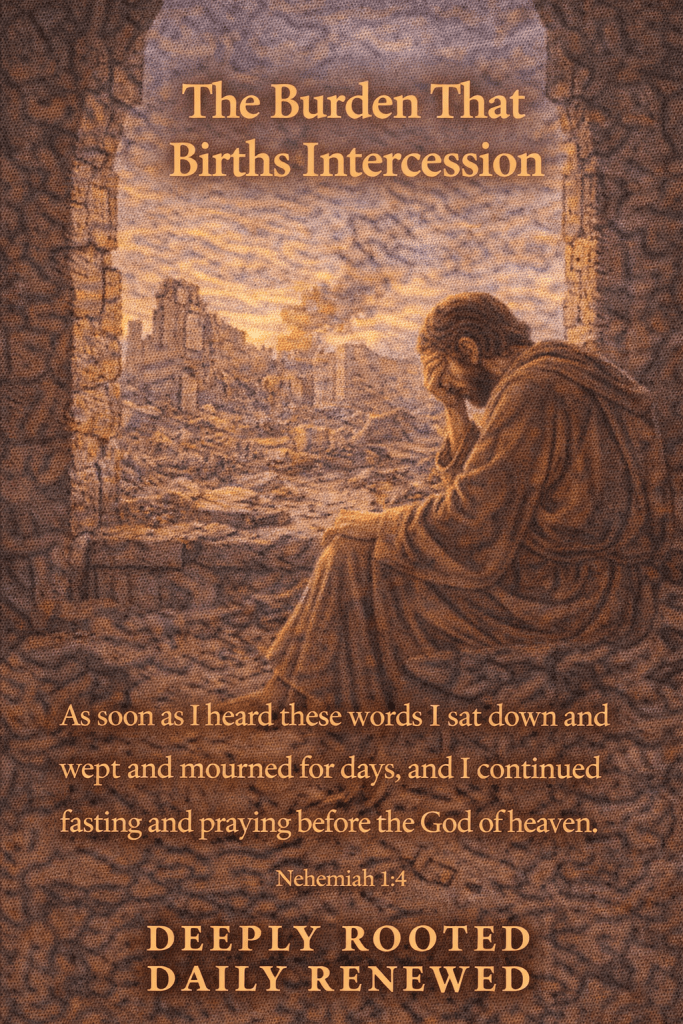
  • Wednesday, January 14, 2025–Holy Anguish: The Burden That Births Intercession

    Key Verse:

    “And it came to pass, when I heard these words, that I sat down and wept, and mourned certain days, and fasted, and prayed before the God of heaven.”

    — Nehemiah 1:4

    Rooted Truth:

    Holy anguish is often God’s invitation to move from personal pain into intercessory prayer.

    Faith Story:

    When Nehemiah heard of Jerusalem’s broken walls and burned gates, he did not rush to fix the problem. He did not begin with strategy or solutions. He began with anguish.

    Scripture says he sat down and wept.

    He mourned.

    He fasted.

    He prayed.

    This is holy anguish at work.

    Nehemiah’s burden was not merely emotional—it was spiritual. The brokenness of God’s people pierced his heart because it reflected dishonor to God’s name. His sorrow did not turn inward; it turned upward.

    Holy anguish has a way of enlarging our prayers. It shifts our focus from my pain to God’s purposes. It teaches us to carry the needs of others before the throne of grace.

    Intercession is often born where comfort ends.—

    God allows certain burdens to rest on our hearts because He intends to involve us in His redemptive work. The anguish we feel may be the very signal that God is calling us to stand in the gap.

    Nehemiah prayed before he acted. And when he finally moved, he moved with clarity, courage, and God-given authority—because the work was first shaped in prayer.

    If you feel a deep burden today—over sin, injustice, brokenness, or the suffering of others—do not dismiss it. That burden may be God drawing you into intercession.

    What begins as anguish can become a powerful ministry of prayer.

    Scripture for Deeper Roots:

    Ezekiel 22:30 – “I sought for a man among them, that should make up the hedge…”

    Romans 9:2–3 – “I have great heaviness and continual sorrow in my heart…”

    1 Timothy 2:1 – “I exhort therefore, that… intercessions be made for all men.”

    Daily Practice:

    Identify one burden God has placed on your heart—for a person, a family, a church, or a situation.

    Bring it intentionally before God in intercessory prayer today.

    Daily Prayer:

    God of heaven, You see the broken places that weigh on my heart. Teach me to carry these burdens to You in prayer. Use my anguish to deepen my love and expand my intercession. Make me faithful to stand in the gap where You call me.

    Amen.

    Deep Reflection:

    • What burden has God placed on your heart recently?

    • How does Nehemiah’s response challenge the way you handle anguish?

    • Where might God be inviting you to move from sorrow into intercession?

    #DeeplyRooted #DailyRenewed

    Devotions for a Grounded and Growing Faith
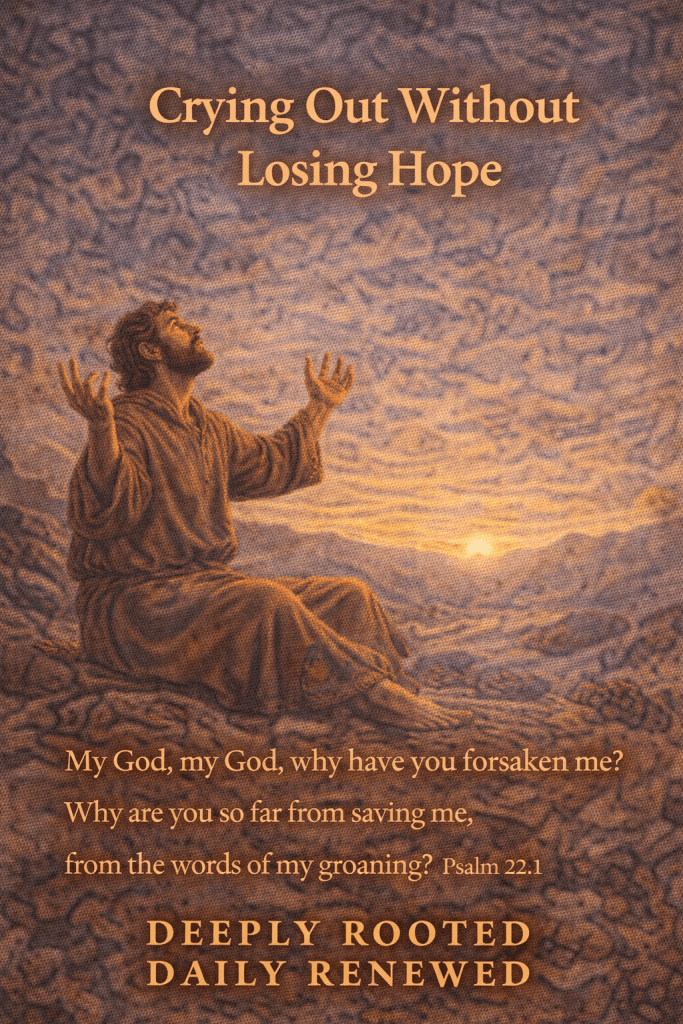
  • Tuesday, January 13, 2025–Holy Anguish: Crying Out Without Losing Hope

    Key Verse:

    “My God, my God, why hast thou forsaken me? why art thou so far from helping me, and from the words of my roaring?”

    — Psalm 22:1

    Rooted Truth:

    Holy anguish gives voice to pain without surrendering hope in God.

    Faith Story:

    Psalm 22 opens with words that feel raw, unsettling, and painfully honest. The psalmist does not soften the cry or hide the anguish. He asks the question that rises from the depths of suffering: “Why?”

    Yet this cry is not unbelief. It is faith speaking honestly.

    Notice where the psalmist directs his anguish—not inward, not toward despair, not away from God—but to God. He does not walk away in silence; he cries out in prayer.

    Holy anguish does not pretend everything is fine. It refuses shallow answers and easy platitudes. It brings the full weight of pain into the presence of God.

    What makes this psalm remarkable is that anguish does not have the final word. Even in the opening verses, the psalmist anchors himself in memory:

    “Our fathers trusted in thee: they trusted, and thou didst deliver them.”

    This is the tension of holy anguish—honest pain held together with remembered faithfulness.

    Jesus Himself would later quote this psalm from the cross. In the darkest moment of suffering, He cried out to the Father, fulfilling Scripture and revealing that even anguish can be an act of trust.

    Crying out does not mean you have lost hope. Sometimes it is the clearest evidence that hope is still alive.

    God does not rebuke cries born from faith. He receives them. He listens. And He meets us in the place where pain and trust intersect.

    Scripture for Deeper Roots:

    Psalm 13:1–2 – “How long wilt thou forget me, O LORD?”

    Lamentations 3:55–57 – “I called upon thy name, O LORD, out of the low dungeon…”

    Hebrews 5:7 – “Who in the days of his flesh… offered up prayers and supplications with strong crying and tears…”

    Daily Practice:

    Bring your honest questions before God today—without censoring them.

    Pray simply:

    “Lord, I trust You enough to tell You how much this hurts.”

    Daily Prayer:

    Faithful God, You see my pain and You hear my cries. Help me bring my anguish to You instead of carrying it alone. When my heart is overwhelmed, remind me of Your faithfulness. Hold my hope steady, even when the answers feel far away.

    Amen.

    Deep Reflection:

    • What questions or cries have you been holding back from God?

    • How does Psalm 22 show the difference between despair and honest faith?

    • What does it look like to trust God while still hurting?

    #DeeplyRooted #DailyRenewed

    Devotions for a Grounded and Growing Faith