
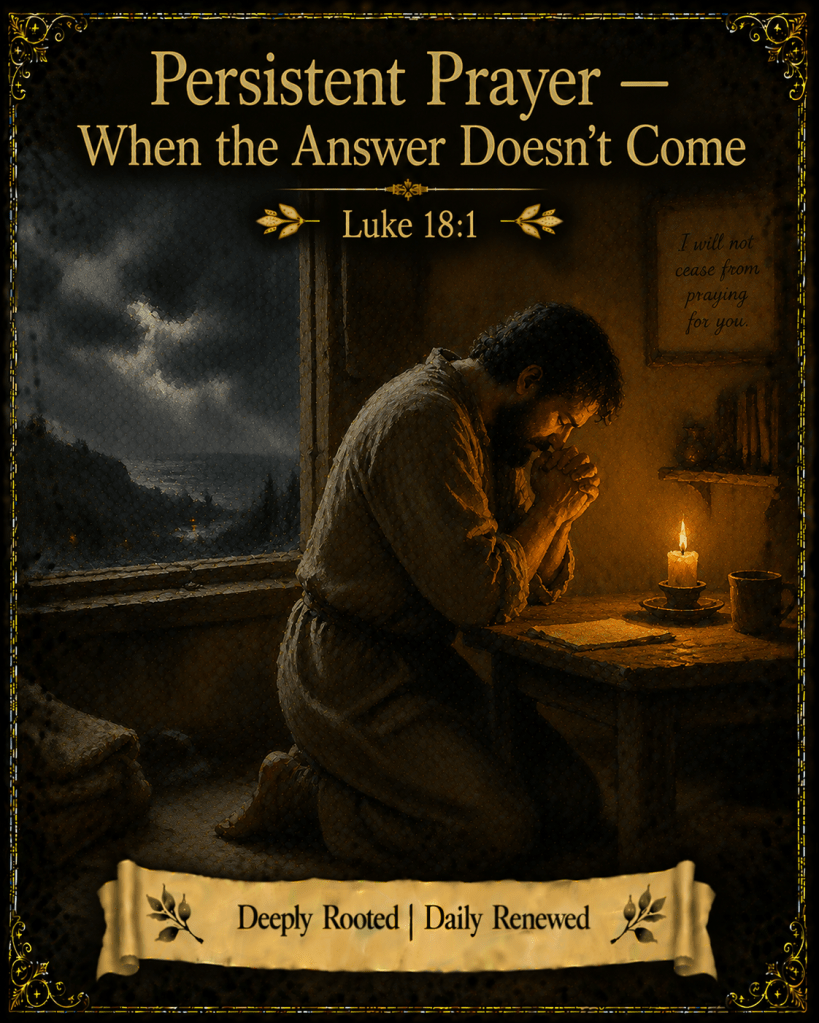
KEY VERSE
“Then Jesus told his disciples a parable to show them that they should always pray and not give up.”
— Luke 18:1
ROOTED TRUTH
The invitation to persistent prayer is not about changing God’s mind. It is about keeping our hearts oriented toward the One who holds the answer — and remaining in the posture of trust while we wait.
FAITH STORY
Jesus told the parable of the persistent widow with a stated purpose — Luke records it explicitly: He told this parable to show them that they should always pray and not give up.
A widow kept coming before an unjust judge who neither feared God nor cared about people. He ignored her. She kept coming. He ignored her again. She kept coming. Finally, he granted her request — not out of justice or compassion, but simply because she kept showing up.
The argument Jesus draws is from the lesser to the greater. If even an unjust judge eventually responds to persistence, how much more will a just and loving Father respond to the persistent prayers of His children? Will not God bring about justice for his chosen ones, who cry out to him day and night? I tell you, he will see that they get justice, and quickly.
Persistent prayer is one of the most misunderstood practices in the Christian life. It is not nagging God until He changes His mind. It is not a formula that unlocks divine reluctance. God is not a vending machine that requires enough prayer-coins before dispensing what we need.
Persistence in prayer is an act of faith. Every time you return to God with the same request, you are declaring: I still believe You are there. I still believe You hear. I still believe You are working even when I cannot see it. The persistence itself is the posture of trust — the refusal to conclude that the silence means absence.
Some prayers take years. Some take decades. Some the answer arrives in forms we didn’t expect. And some — in this life — are not resolved in the way we hoped. But the practice of returning, day after day, to bring the same need before the same God, shapes us in ways that the quick answer never could.
Keep praying. Don’t give up. The fact that you are still praying means you still believe — and that faith is never wasted.
SCRIPTURE FOR DEEPER ROOTS
Luke 18:1–8 — The parable of the persistent widow.
Matthew 7:7–8 — “Ask and it will be given to you; seek and you will find; knock and the door will be opened.”
Romans 12:12 — “Be joyful in hope, patient in affliction, faithful in prayer.”
DAILY PRACTICE
Write down the prayer you have been praying the longest — the request you have brought to God more times than you can count without a clear answer yet. Write it out fully. Then write the date beside it today as an act of recommitment: I am still praying. I have not given up. I still believe. Bring that prayer to God today with the same persistence the widow brought to the judge — and carry with you the assurance that the God you are bringing it to is nothing like that judge.
DAILY PRAYER
Father, I bring You again the prayer I have prayed so many times. I confess that I have been tempted to stop — to conclude that the silence means no or that the wait means You have forgotten. I choose today to keep praying. Not because I am wearing You down but because I still believe You hear, You care, and You are working. I will not give up. Amen.
DEEP REFLECTION
1. Jesus said the purpose of the parable was to show that we should always pray and not give up. What makes giving up on a long-unanswered prayer feel spiritually reasonable — and what does persistent prayer declare about what you believe in spite of that feeling?
2. The persistent widow’s persistence was not about changing the judge’s character — it was about her own need and her refusal to be silenced. How does that reframe the purpose of persistent prayer — is it more about the one praying or the one being prayed to?
3. Is there a prayer you have given up on that God may be asking you to pick back up? What would it take to return to it with renewed persistence and trust?
#DeeplyRooted#DailyRenewed Devotions for a Grounded and Growing Faith


Leave a comment