KEY VERSE
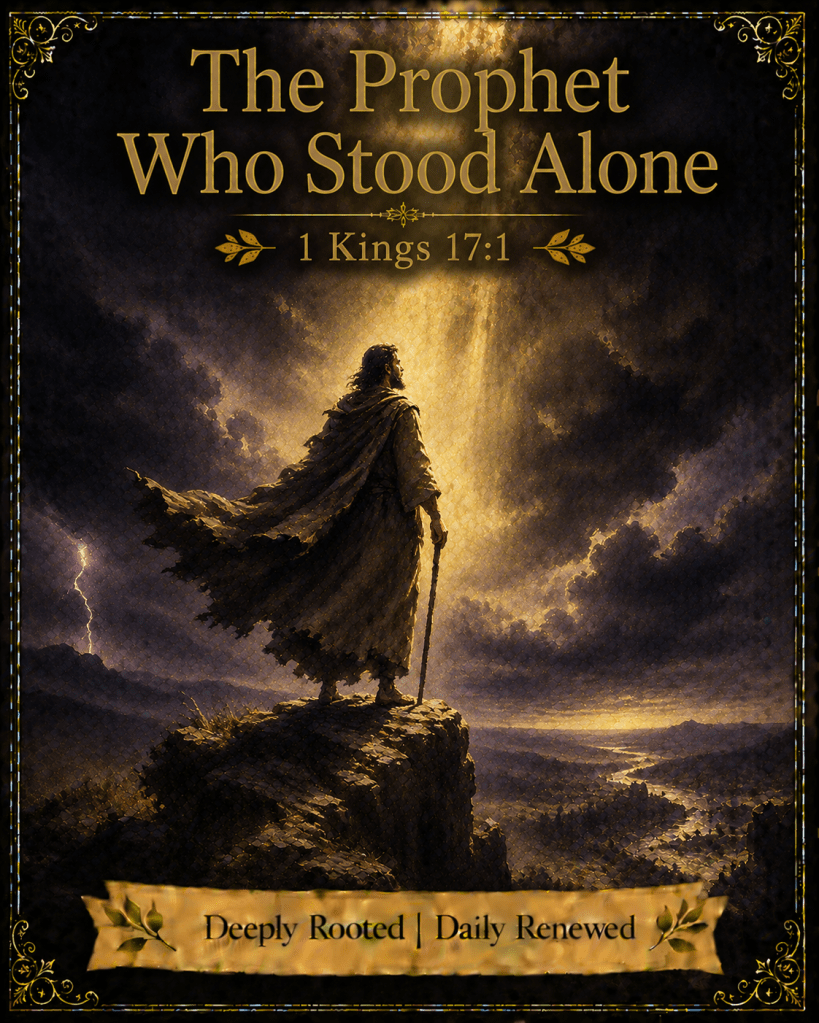
“As the LORD, the God of Israel, lives, whom I serve, there will be neither dew nor rain in the next few years except at my word.”
— 1 Kings 17:1
ROOTED TRUTH
Elijah’s boldness before kings and crowds was not the product of self-confidence. It was the overflow of a man who had first stood in the presence of God.
FAITH STORY
Elijah appears in Scripture without introduction.
There is no birth narrative, no backstory, no account of his calling or his early years. He simply steps onto the stage of history in 1 Kings 17:1, addresses the most powerful and wicked king in Israel’s recent memory, delivers a word that would reshape the nation, and disappears — into hiding, into the wilderness, into the care of God.
King Ahab and his wife Jezebel had led Israel into profound spiritual corruption. The worship of Baal — the Canaanite storm god believed to control rain and fertility — had become the official religion of the northern kingdom. Hundreds of the LORD’s prophets had been killed. The altars of God had been torn down. And the people had largely gone along with it.
Into that darkness, God sent one man. Not an army. Not a political movement. One prophet, with one word: there will be no rain except at my word.
Elijah’s story this week is one of the most dramatic in all of the Old Testament. It moves from hiding beside a brook to confronting four hundred and fifty prophets on a mountaintop, from calling down fire from heaven to collapsing in exhaustion under a tree, from wind and earthquake and fire to a still small voice in a cave.
In other words, Elijah’s story is profoundly human. He was capable of extraordinary courage and profound despair — sometimes within the same week. James tells us he was a human being just like us (James 5:17) — and that is exactly what makes his story so powerful.
God used an ordinary man with an extraordinary willingness to stand. This week, let Elijah’s life ask you the same question it asked Israel: who are you standing for — and will you stand when it costs you something?
SCRIPTURE FOR DEEPER ROOTS
1 Kings 17:1 — Elijah’s first appearance.
James 5:17 — “Elijah was a human being, even as we are.”
Romans 11:3–4 — Paul references Elijah’s loneliness and God’s faithful remnant.
DAILY PRACTICE
Read 1 Kings 16:29–17:1 today — the context of Ahab’s wickedness and Elijah’s sudden appearance. As you read, ask: what does it take for one person to stand for God in a culture moving in the opposite direction? Identify one area of your own life where the culture is pulling one way and God is calling you to stand another. Pray specifically for the courage Elijah carried.
DAILY PRAYER
Father, Elijah stood alone in a generation that had largely turned away from You. I don’t always find it easy to stand — the pressure to conform, to stay quiet, to go along is real. Give me Elijah’s boldness — not the boldness of self-confidence, but the boldness of someone who has stood in Your presence and carries that reality into every other room. Let me stand for You this week. Amen.
DEEP REFLECTION
1. Elijah appears without introduction — no credentials, no committee, just a word from God delivered with total confidence. What does his sudden, unannounced boldness tell you about where true spiritual authority comes from?
2. James says Elijah was just like us — a human being, not a superhero. How does that humanity make his story more accessible and his example more applicable to your own life?
3. Elijah stood virtually alone against the spiritual corruption of his entire nation. Can you think of a moment in your own life when you had to stand for something true in a context where almost no one else was standing with you? What did that cost — and what did it produce?
#DeeplyRooted#DailyRenewed Devotions for a Grounded and Growing Faith


Leave a Reply