
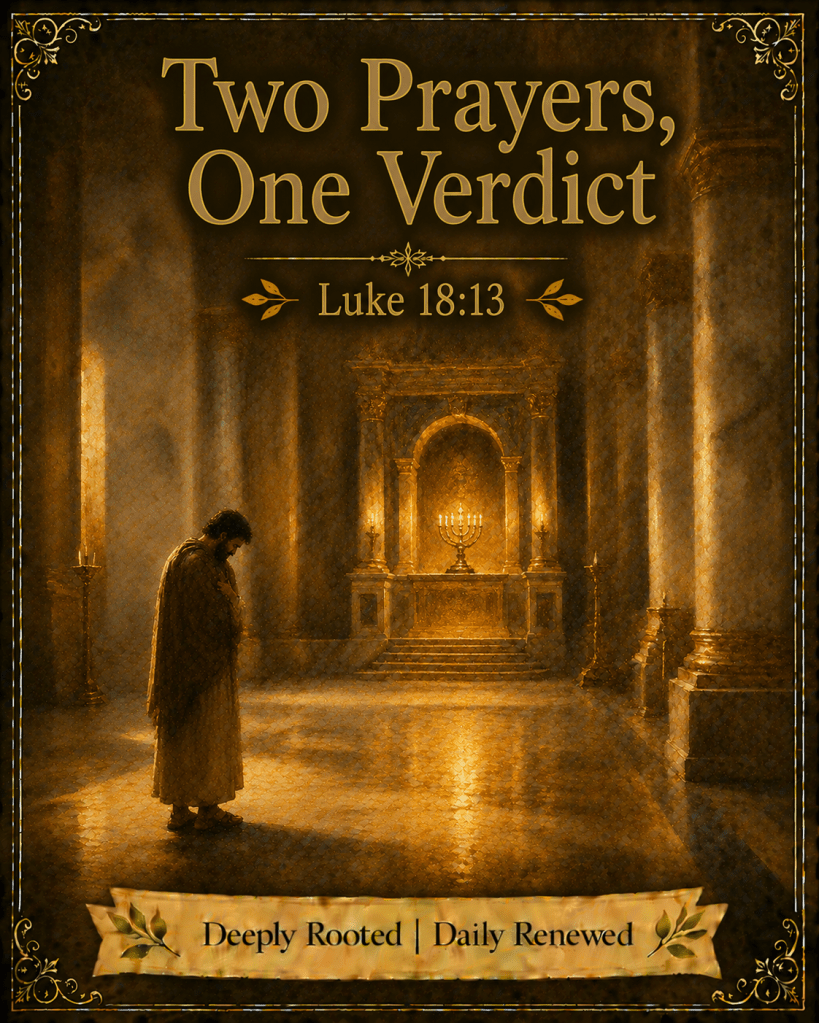
KEY VERSE
“But the tax collector stood at a distance. He would not even look up to heaven, but beat his breast and said, ‘God, have mercy on me, a sinner.’”
— Luke 18:13
ROOTED TRUTH
God is not impressed by the prayer that sounds best. He is moved by the prayer that is most honest.
FAITH STORY
Two men went to the temple to pray. Jesus could not have chosen more different characters.
The Pharisee was the religious elite — educated, disciplined, publicly respected. He fasted twice a week. He tithed everything. By every external measure, his spiritual life was exemplary. And his prayer reflected that: God, I thank you that I am not like other people — robbers, evildoers, adulterers — or even like this tax collector.
The tax collector was a traitor by his own people’s standards — a Jew who had collaborated with Rome to collect taxes, often skimming more than was owed. He was despised, excluded, considered beyond the reach of God’s favor.
His prayer was five words: God, have mercy on me, a sinner.
Jesus delivered the verdict plainly: it was the tax collector, not the Pharisee, who went home justified before God.
The Pharisee’s prayer was not really a prayer — it was a performance review, delivered upward. He was not speaking to God so much as informing God of his own righteousness. He came to the temple full of himself and left the same way.
The tax collector came with nothing. No achievements to present, no credentials to offer, no record to defend. Just an honest accounting of what he was and a desperate appeal to who God is: merciful.
And that — that posture of emptied, honest need — is exactly what God receives.
The parable closes this week the same way it opened the Beatitudes: blessed are the poor in spirit. The kingdom belongs to those who come empty. God is not looking for the most impressive prayer in the room. He is looking for the most honest one.
Come as you are. He hears that prayer every time.
SCRIPTURE FOR DEEPER ROOTS
Luke 18:9–14 — The parable of the Pharisee and the tax collector in full.
Isaiah 66:2 — “These are the ones I look on with favor: those who are humble and contrite in spirit.”
Matthew 5:3 — “Blessed are the poor in spirit, for theirs is the kingdom of heaven.”
DAILY PRACTICE
As you close this week of parables, examine your own prayer life honestly. Do your prayers more often resemble the Pharisee’s — full of your own goodness, your own efforts, your own spiritual achievements — or the tax collector’s — honest, empty-handed, dependent? Spend time today praying only the tax collector’s prayer, in your own words: God, have mercy on me. Sit in that posture for at least five minutes before asking for anything else.
DAILY PRAYER
God, have mercy on me, a sinner. I come to You today not with my record, not with my accomplishments, not with a list of reasons You should hear me. I come the way the tax collector came — honest about what I am and desperate for who You are. You are merciful. That is enough. That is everything. Amen.
DEEP REFLECTION
1. The Pharisee’s prayer was technically accurate — he really did fast and tithe. What made it unacceptable? What does that tell you about the difference between religious performance and genuine prayer?
2. The tax collector’s prayer contained no requests — only acknowledgment and appeal. What would it do to your prayer life if you spent more time in that posture before moving to your list of needs?
3. Looking back over this entire week of parables — the running father, the Good Samaritan, the four soils, the lost sheep, the talents, and the two prayers — which story has found you most personally? What is Jesus saying to you through it, and what will you carry forward?
#DeeplyRooted#DailyRenewed Devotions for a Grounded and Growing Faith


Leave a Reply